

HC 6: synucleopathies & prion and prion-like disease 04/11/20
Synucleopathies
-Learning objectives:
• Can describe and understands aspects of the pathology, clinic and genetics.
• Can describe and understands pathomechanistic aspects (neurotransmission, ubiquitin
proteasome, mitochondria, inflammation).
• Can describe and understands different treatments for PD.
• Understands the distinction between Parkinsonism, PD, PDD and LBD.
-Most known synucleopathy -> Parkinson’s disease
• Characteristics:
o Bradykinesia -> Slowness of movement
o Rigidity (stijf)
o Resting tremor
o Postural instability
• Movement disorder -> also affects your face muscles! -> hypomimia
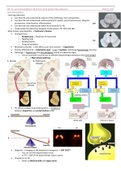
• Primary affected area -> Substantia nigra -> Loss of melanin containing dopaminergic neurons.
• Pathology -> Neuron loss and loss and gliosis mainly in substantia nigra.
o Loss of movement control due to affected dopaminergic pathway to the basal ganglia.
▪ -> Nigrostriatal pathway
• PD affects multiple transmittersystems -> Disbalance
between dopamine and acetyl/choline (Ach)!
• Diagnosis -> Imaging on the dopamine transporter -> DAT SPECT
o You can see the dopaminergic tracts.
o In PD -> Half of the dopaminergic tracts is gone.
• Progression in PD:
o Starts in olfactory bulb and vagus nerve
, ▪ Therefore, people often have a reduction of smell in early stages and can have obstipation.
o Then: more motor disturbances.
o Later: more brain areas get effected.
o When you start to notice anything, a lot of the pathology has already been developed and not much can
be done.
• Pathology:
o Extensive pathology already going on before diagnosis.
o Aggregates causes the degeneration!
o Aggregates of α-synuclein -> is a lewy body -> Results in neuronal
inclusions.
▪ Small synaptic protein
▪ Role -> Involved in synaptic vesical fusion (release)
▪ Aggregates? -> loss of function (maybe) and gain of
toxicity!
▪ The smaller ones are really toxic.
• Genetics:
o There are sporadic causes and genetic causes.
o Earlier the onset the higher the change that it is a monogenic cause!
, o Mutations in aggregating protein:
▪ Point mutations
▪ multiplications
o Genes that are involved:
▪ SNCA -> involved in aggregation
• NAC -> hydrophobic aggregation core.
o α-synuclein aggregations are involved in many toxic happenings, like:
▪ Altered α-synuclein function.
▪ Accumulation of α-synuclein → Toxic α-synuclein oligomers → Lewy body formation.
o Lewy bodies are ubiquitin positive in PD! -> ubiquituin proteosystem (UPS) have a very upstream role in
the disease process.
▪ Mutations affecting the UPS:
• UCHL1 mutation
• PARK2 mutation (E3 ligase)
• Dj1 mutation
Synucleopathies
-Learning objectives:
• Can describe and understands aspects of the pathology, clinic and genetics.
• Can describe and understands pathomechanistic aspects (neurotransmission, ubiquitin
proteasome, mitochondria, inflammation).
• Can describe and understands different treatments for PD.
• Understands the distinction between Parkinsonism, PD, PDD and LBD.
-Most known synucleopathy -> Parkinson’s disease
• Characteristics:
o Bradykinesia -> Slowness of movement
o Rigidity (stijf)
o Resting tremor
o Postural instability
• Movement disorder -> also affects your face muscles! -> hypomimia
• Primary affected area -> Substantia nigra -> Loss of melanin containing dopaminergic neurons.
• Pathology -> Neuron loss and loss and gliosis mainly in substantia nigra.
o Loss of movement control due to affected dopaminergic pathway to the basal ganglia.
▪ -> Nigrostriatal pathway
• PD affects multiple transmittersystems -> Disbalance
between dopamine and acetyl/choline (Ach)!
• Diagnosis -> Imaging on the dopamine transporter -> DAT SPECT
o You can see the dopaminergic tracts.
o In PD -> Half of the dopaminergic tracts is gone.
• Progression in PD:
o Starts in olfactory bulb and vagus nerve
, ▪ Therefore, people often have a reduction of smell in early stages and can have obstipation.
o Then: more motor disturbances.
o Later: more brain areas get effected.
o When you start to notice anything, a lot of the pathology has already been developed and not much can
be done.
• Pathology:
o Extensive pathology already going on before diagnosis.
o Aggregates causes the degeneration!
o Aggregates of α-synuclein -> is a lewy body -> Results in neuronal
inclusions.
▪ Small synaptic protein
▪ Role -> Involved in synaptic vesical fusion (release)
▪ Aggregates? -> loss of function (maybe) and gain of
toxicity!
▪ The smaller ones are really toxic.
• Genetics:
o There are sporadic causes and genetic causes.
o Earlier the onset the higher the change that it is a monogenic cause!
, o Mutations in aggregating protein:
▪ Point mutations
▪ multiplications
o Genes that are involved:
▪ SNCA -> involved in aggregation
• NAC -> hydrophobic aggregation core.
o α-synuclein aggregations are involved in many toxic happenings, like:
▪ Altered α-synuclein function.
▪ Accumulation of α-synuclein → Toxic α-synuclein oligomers → Lewy body formation.
o Lewy bodies are ubiquitin positive in PD! -> ubiquituin proteosystem (UPS) have a very upstream role in
the disease process.
▪ Mutations affecting the UPS:
• UCHL1 mutation
• PARK2 mutation (E3 ligase)
• Dj1 mutation



