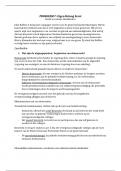
Economic Methodology
Summary of all Lectures & Tutorials
Radboud University Nijmegen
Yoël Guijt
, Lecture 1
Introduction
* Economic methodology = Set of methods in economics
* Focus is on the framework of their application, not on the methods themselves
* Critical re ection is important for example
* Method = how economists do things
* About the philosophy of social sciences applied to economics
* Should see the economy as a whole
Positive economics:
* What do economists really do?
* How is it really organized, what criteria are really applied, etc.
Normative economics:
* What should economists really do?
* Criteria of good science; what is good, what should we do, etc.
* We need economic methodology to understand what happens economic and how in real world
Lecture 2
Some Case Studies
* How to do research in economic methodology?
* Start complaining (surely, economics is no science? — people aren’t rational? etc.)
* Through Case Studies (From easy de nitions to how crisis changed economics, etc.)
De nition of economics
* Viners: Economics is what economists do!
* Smith: Science of wealth…
* Marshall: Economics is a study of mankind in the ordinary business of life… Wealth + behavior
* Robbins: Science which studies human behavior as relation between ends and scarce means
* De nition de nes the boundaries of the science!
Crisis 2008, for example:
* Economists didn’t see it coming, couldn’t be predicted by the economic science!
* Too simplistic equilibrium models, lack of knowledge on institutions, asymmetric info, etc.
Nobel Prize:
* Most important price for contribution of the science
* Lately, mostly climate and innovation etc. Economics is changing all the time!
* Formalizing is important ==> restating in term of maximization and equilibrium
* Is needed for better grasp of ideas; easier to understand
fi fl fi fi
, Lecture 3
Theories — Deduction and Induction
Logical Positivism
* Logic = Formal framework in which scienti c terms are best to be put (stating in logic form)
* Positivism/Empiricism = All evidence is directly or indirectly derived form ‘sensual
data’ (observe reality)
* Science is characterized by the ability to formulate theories
* Context of discovery = process that leads to the theories (thinking process)
* Context of justi cation = process of veri cation, given a theory and hypothesis
Logical positivist philosophy of science:
* Demarcation problem: To separate science from non-science (metaphysics)
* Which propositions are scienti c?
* Analytic = Truth is already in the premises (1+1=2; according to this model, this is bene cial)
* Synthetic = If they are con rmed by empirical research (as the empirical demonstrates …)
* All OTHER propositions are metaphysical, no meaning to science
* Synthetic proposition is only meaningful if it empirically veri able (or we can’t observe…)
Theories should be formulated in a way that it is possible to observe
* Best in sentences and described in formal language and rely on axioms (assumption)
* Then you could operationalize to make things observable !
Induction: From concrete to abstract = from observation to theory
* = easiest way to draw on observations (white, white, white … so every swan is white)
* Problem of induction: not all swans are observable
* AND future events are not easily formulated (Will it rain? Via induction, you cannot know)
John Stuart Mill:
* Compare two situation; in one, there is the phenomenon, in the other not… Is it di erent? The
phenomenon is the cause
How do theories generally explain? Logical positivism = deductive-nomological model
* Deductive = process of deriving (deducing) the thing to explain (explanandum) from the
statements (explanans)
* Nomological = these statements should include a law
* Deduction = from the abstract to the concrete; from general to speci c; from theory to observe
* BUT… Only use causally relevant factors for this model (about pregnancy, don’t use men…)
* Symmetry thesis ===> Explanation and prediction
Problem: How do we know that the statements in explanans are laws???
* They should be universally, but… there might not be according to empirical data… and then?
* Instrumentalism = Laws are just useful generalizations for predictions
* Con rmationism = Laws express most probable outcomes
John Stuart Mill: Economics…
* Borrow proven laws >> Derive predictions from these laws >> Test the predictions >> Correct?
Then the explanation is useful. Incorrect? Mistakes in deduction//interference//laws central?
Logical Positivists:
* Scienti c theories should be based on Empirical Data + Analytical or Synthetic + Operationalize
fi fi fi fi fi fi fi fi fi ff fi
Summary of all Lectures & Tutorials
Radboud University Nijmegen
Yoël Guijt
, Lecture 1
Introduction
* Economic methodology = Set of methods in economics
* Focus is on the framework of their application, not on the methods themselves
* Critical re ection is important for example
* Method = how economists do things
* About the philosophy of social sciences applied to economics
* Should see the economy as a whole
Positive economics:
* What do economists really do?
* How is it really organized, what criteria are really applied, etc.
Normative economics:
* What should economists really do?
* Criteria of good science; what is good, what should we do, etc.
* We need economic methodology to understand what happens economic and how in real world
Lecture 2
Some Case Studies
* How to do research in economic methodology?
* Start complaining (surely, economics is no science? — people aren’t rational? etc.)
* Through Case Studies (From easy de nitions to how crisis changed economics, etc.)
De nition of economics
* Viners: Economics is what economists do!
* Smith: Science of wealth…
* Marshall: Economics is a study of mankind in the ordinary business of life… Wealth + behavior
* Robbins: Science which studies human behavior as relation between ends and scarce means
* De nition de nes the boundaries of the science!
Crisis 2008, for example:
* Economists didn’t see it coming, couldn’t be predicted by the economic science!
* Too simplistic equilibrium models, lack of knowledge on institutions, asymmetric info, etc.
Nobel Prize:
* Most important price for contribution of the science
* Lately, mostly climate and innovation etc. Economics is changing all the time!
* Formalizing is important ==> restating in term of maximization and equilibrium
* Is needed for better grasp of ideas; easier to understand
fi fl fi fi
, Lecture 3
Theories — Deduction and Induction
Logical Positivism
* Logic = Formal framework in which scienti c terms are best to be put (stating in logic form)
* Positivism/Empiricism = All evidence is directly or indirectly derived form ‘sensual
data’ (observe reality)
* Science is characterized by the ability to formulate theories
* Context of discovery = process that leads to the theories (thinking process)
* Context of justi cation = process of veri cation, given a theory and hypothesis
Logical positivist philosophy of science:
* Demarcation problem: To separate science from non-science (metaphysics)
* Which propositions are scienti c?
* Analytic = Truth is already in the premises (1+1=2; according to this model, this is bene cial)
* Synthetic = If they are con rmed by empirical research (as the empirical demonstrates …)
* All OTHER propositions are metaphysical, no meaning to science
* Synthetic proposition is only meaningful if it empirically veri able (or we can’t observe…)
Theories should be formulated in a way that it is possible to observe
* Best in sentences and described in formal language and rely on axioms (assumption)
* Then you could operationalize to make things observable !
Induction: From concrete to abstract = from observation to theory
* = easiest way to draw on observations (white, white, white … so every swan is white)
* Problem of induction: not all swans are observable
* AND future events are not easily formulated (Will it rain? Via induction, you cannot know)
John Stuart Mill:
* Compare two situation; in one, there is the phenomenon, in the other not… Is it di erent? The
phenomenon is the cause
How do theories generally explain? Logical positivism = deductive-nomological model
* Deductive = process of deriving (deducing) the thing to explain (explanandum) from the
statements (explanans)
* Nomological = these statements should include a law
* Deduction = from the abstract to the concrete; from general to speci c; from theory to observe
* BUT… Only use causally relevant factors for this model (about pregnancy, don’t use men…)
* Symmetry thesis ===> Explanation and prediction
Problem: How do we know that the statements in explanans are laws???
* They should be universally, but… there might not be according to empirical data… and then?
* Instrumentalism = Laws are just useful generalizations for predictions
* Con rmationism = Laws express most probable outcomes
John Stuart Mill: Economics…
* Borrow proven laws >> Derive predictions from these laws >> Test the predictions >> Correct?
Then the explanation is useful. Incorrect? Mistakes in deduction//interference//laws central?
Logical Positivists:
* Scienti c theories should be based on Empirical Data + Analytical or Synthetic + Operationalize
fi fi fi fi fi fi fi fi fi ff fi