SILVERTHORN
CHAPTER 22 – METABOLISM & ENERGY BALANCE
APPETITE AND SATIETY
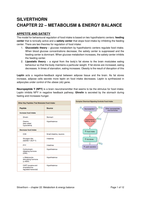
The model for behavioural regulation of food intake is based on two hypothalamic centers: feeding
center that is tonically active and a satiety center that stops food intake by inhibiting the feeding
center. There are two theories for regulation of food intake:
1. Glucostatic theory – glucose metabolism by hypothalamic centers regulate food intake.
When blood glucose concentrations decrease, the satiety center is suppressed and the
feeding center is dominant. When glucose metabolism increases, the satiety center inhibits
the feeding center.
2. Lipostatic theory – a signal from the body’s fat stores to the brain modulates eating
behaviour so that the body maintains a particular weight. If fat stores are increased, eating
decreases. In times of starvation, eating increases. Obesity is the result of disruption of this
Leptin acts a negative-feedback signal between adipose tissue and the brain. As fat stores
increase, adipose cells secrete more leptin en food intake decreases. Leptin is synthesized in
adipocytes under control of the obese (ob) gene.
Neuropeptide Y (NPY) is a brain neurotransmitter that seems to be the stimulus for food intake.
Leptin inhibits NPY in negative feedback pathway. Ghrelin is secreted by the stomach during
fasting and increases hunger.
Silverthorn – chapter 22: Metabolism & energy balance Page 1 of 12
CHAPTER 22 – METABOLISM & ENERGY BALANCE
APPETITE AND SATIETY
The model for behavioural regulation of food intake is based on two hypothalamic centers: feeding
center that is tonically active and a satiety center that stops food intake by inhibiting the feeding
center. There are two theories for regulation of food intake:
1. Glucostatic theory – glucose metabolism by hypothalamic centers regulate food intake.
When blood glucose concentrations decrease, the satiety center is suppressed and the
feeding center is dominant. When glucose metabolism increases, the satiety center inhibits
the feeding center.
2. Lipostatic theory – a signal from the body’s fat stores to the brain modulates eating
behaviour so that the body maintains a particular weight. If fat stores are increased, eating
decreases. In times of starvation, eating increases. Obesity is the result of disruption of this
Leptin acts a negative-feedback signal between adipose tissue and the brain. As fat stores
increase, adipose cells secrete more leptin en food intake decreases. Leptin is synthesized in
adipocytes under control of the obese (ob) gene.
Neuropeptide Y (NPY) is a brain neurotransmitter that seems to be the stimulus for food intake.
Leptin inhibits NPY in negative feedback pathway. Ghrelin is secreted by the stomach during
fasting and increases hunger.
Silverthorn – chapter 22: Metabolism & energy balance Page 1 of 12