3.3.1 Revenue
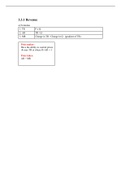
a) Formulae
1. TR PxQ
2. AR TR / Q
3. MR Change in TR / Change in Q (gradient of TR)
Price maker:
Have the ability to control prices
max TR at where D=AR =-1
Price taker:
AR = MR
, 3.3.2 Costs
a) Formulae
1. TC TVC + TFC
2. TFC Costs that do not vary directly with output
3. TVC Costs that varies directly with output
4. AC / ATC TC / Q (U shaped becoz when MC below, dragging average down)
5. AFC TFC / Q
6. AVC TVC / Q
7. MC Change in TC / change in Q (gradient of TC)
Law of diminishing marginal return (only SR, coz LR is called EOS)
Def: When a variable factor is added to a fixed amount of fixed factors, eventually
MC and AC rises // MP & AP falls
b) Derivation of short-run cost curves from the assumption of diminishing
marginal productivity
1st: a variable unit is added to a fixed input, output increases
2nd: after adding certain no. of variable input, output becomes constant (cannot further
increase) maybe becoz workers become less productive
3rd: Then, when variable input further increase, the marginal increase in output starts
to fall, MP and AP falls //where MC and AC start to rise
Why MC is U shaped?
The marginal cost curve is U-shaped. Initially, as output increases,
the marginal cost falls. But diminishing returns start to take place
at a certain level, and so marginal cost will start to rise.
a) Relationship between short-run and long-run average cost curves
SRAC minimum = capacity VS LRAC minimum = MES (lowest AC pt)
SRAC = at least one fixed factor
LRAC = all factors are variable
*************EOS only in LR*************
a) Formulae
1. TR PxQ
2. AR TR / Q
3. MR Change in TR / Change in Q (gradient of TR)
Price maker:
Have the ability to control prices
max TR at where D=AR =-1
Price taker:
AR = MR
, 3.3.2 Costs
a) Formulae
1. TC TVC + TFC
2. TFC Costs that do not vary directly with output
3. TVC Costs that varies directly with output
4. AC / ATC TC / Q (U shaped becoz when MC below, dragging average down)
5. AFC TFC / Q
6. AVC TVC / Q
7. MC Change in TC / change in Q (gradient of TC)
Law of diminishing marginal return (only SR, coz LR is called EOS)
Def: When a variable factor is added to a fixed amount of fixed factors, eventually
MC and AC rises // MP & AP falls
b) Derivation of short-run cost curves from the assumption of diminishing
marginal productivity
1st: a variable unit is added to a fixed input, output increases
2nd: after adding certain no. of variable input, output becomes constant (cannot further
increase) maybe becoz workers become less productive
3rd: Then, when variable input further increase, the marginal increase in output starts
to fall, MP and AP falls //where MC and AC start to rise
Why MC is U shaped?
The marginal cost curve is U-shaped. Initially, as output increases,
the marginal cost falls. But diminishing returns start to take place
at a certain level, and so marginal cost will start to rise.
a) Relationship between short-run and long-run average cost curves
SRAC minimum = capacity VS LRAC minimum = MES (lowest AC pt)
SRAC = at least one fixed factor
LRAC = all factors are variable
*************EOS only in LR*************