Frequency-dependent selection
Changes in genotype/phenotype leads to variation in fitness (so far, fitnesses are
treated as fixed, assigning selection coefficients to genotypes with performance
measured relative to the fittest morph)
Frequency-dependent selection takes place when fitness is a function of allele
frequencies or genotype frequencies
- Genotype has a different fitness when common than when rare
- No restriction on the type of frequency except that each Darwinian fitness
must be non-negative
- So when population undergoes frequency-dependent selection: positive and
negative forms
Positive frequency-dependent selection
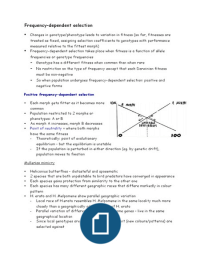
Each morph gets fitter as it becomes more
common
Population restricted to 2 morphs or
phenotypes: A or B
As morph A increases, morph B decreases
Point of neutrality = where both morphs
have the same fitness
- Theoretically: point of evolutionary
equilibrium – but the equilibrium is unstable
- If the population is perturbed in either direction (eg. by genetic drift),
population moves to fixation
Mullerian mimicry
Heliconius butterflies – distasteful and aposematic
2 species that are both unpalatable to bird predators have converged in appearance
Each species gains protection from similarity to the other one
Each species has many different geographic races that differe markedly in colour
pattern
H. erato and H. Melpomene show parallel geographic variation
- Local race of H.erato resembles H. Melpomene in the same locality much more
closely than a geographically adjacent race of H. erato
- Parallel variation of different species across same genes – live in the same
geographical location
- Since local genotypes are highly common, immigrant (new colours/patterns) are
selected against
, An example of predator learning – more common a phenotype is locally, the better
young predators learn to avoid it – fewer patterns to learn and plenty of encounters
with a common pattern
Gene flow between adjacent geographic races (ie. different patterns) countered by
positive frequency-dependent selection
- Immigrant butterflies that deviate from locally prevalent colour pattern are
selected against AS predators have not learned to avoid attacking individuals
with unusual colour patterns
Negative frequency-dependent selection
Each morph gets fitter as it
becomes less common
In a population restricted to 2
morphs
- Point of neutrality is stable
- If population moves away from
equilibrium point, fitness
differential will tend to push the population back to equilibrium point
- Shift to a higher frequency of A, then A has lower fitness and will drop in
frequency etc.
- Potential mechanism for maintenance of genetic polymorphism
Sex Ratio
Assuming that it is solely genetic
Define as proportion of males (or females) in a population of males and females
In species where sex is determined genetically – populations typically have equal
numbers of males and females – why 1:1 ratio?
- Heterogametic = 2 types of sex chromosome & 2 types of gamete; example is XY
male – producing X- and Y-bearing gametes.
- Homogametic = 1 type of sex chromosome & 1 type of gamete; example is XX
female – producing X-bearing gametes.
Sex ratio – assume SR of next generation is due to gene action in current
generation
- Sex-biased mortality? Genes in XY alter ratio of male- and female- determining
gametes
OR
- Sex ratio modifier? Genes in XX alter success of 2 types of gamete in
fertilisation
What if sex ratio changes from parity so that there are fewer males than females
(assume diploidy, random mating, males and females are equally costly to produce)
, - For next generation each zygote has 1 mother and 1 father – so average
contribution of each male greater than that of female
- Hence males are fitter than females and will be selected for – driving SR
towards parity
- The bigger the skew in the sex ratio, the larger the selective differential
between the sexes
- If SR isn’t 50:50 – individual of rarer sex can expect a greater share of
descendants
- Drives selection to rebalance SR – stable equilibrium value is therefore 1:1
What is a stable sex ratio?
- Resource allocation: selection will favour parents who devote more resources
proportionately of offspring of the minority sex until expenditure on sons and
daughters is balanced
- In most contexts: equivalent expenditure means equal numbers of songs and
daughters – except where offspring of one sex cost more to rear than other sex
- Genetic terms: alleles causing their bearers to invest equally in sons and
daughters will not be replaced by alleles that bias the sex ratio
- Example of Evolutionarily Stable Strategy (ESS)
Evolutionary Stable Strategy (ESS)
Strategy such that, if all the members of a
population adopt it, then no alternative mutant
strategy can invade under influence of natural
selection
ESSs have been used to model evolution of
frequency-dependent traits, using Game
Theory, - application pioneered by John
Maynard Smith and George Price, 1973
Evolutionary Game Theory – HAWK-DOVE game (simplest)
Stage 1: Define strategies
HAWK and DOVE strategies set for the game
Behavioural options available to individuals playing the game
Assumes that the resource is not readily divisible, it cannot be divided
An animal playing HAWK fights unconventionally, without restraint until it wins (its
opponent gives in or runs away) or until it is so seriously injured it cannot continue
An animal playing DOVE, merely threatens – runs away if an opponent shows any sign of
real aggression, so it never gets injured
Changes in genotype/phenotype leads to variation in fitness (so far, fitnesses are
treated as fixed, assigning selection coefficients to genotypes with performance
measured relative to the fittest morph)
Frequency-dependent selection takes place when fitness is a function of allele
frequencies or genotype frequencies
- Genotype has a different fitness when common than when rare
- No restriction on the type of frequency except that each Darwinian fitness
must be non-negative
- So when population undergoes frequency-dependent selection: positive and
negative forms
Positive frequency-dependent selection
Each morph gets fitter as it becomes more
common
Population restricted to 2 morphs or
phenotypes: A or B
As morph A increases, morph B decreases
Point of neutrality = where both morphs
have the same fitness
- Theoretically: point of evolutionary
equilibrium – but the equilibrium is unstable
- If the population is perturbed in either direction (eg. by genetic drift),
population moves to fixation
Mullerian mimicry
Heliconius butterflies – distasteful and aposematic
2 species that are both unpalatable to bird predators have converged in appearance
Each species gains protection from similarity to the other one
Each species has many different geographic races that differe markedly in colour
pattern
H. erato and H. Melpomene show parallel geographic variation
- Local race of H.erato resembles H. Melpomene in the same locality much more
closely than a geographically adjacent race of H. erato
- Parallel variation of different species across same genes – live in the same
geographical location
- Since local genotypes are highly common, immigrant (new colours/patterns) are
selected against
, An example of predator learning – more common a phenotype is locally, the better
young predators learn to avoid it – fewer patterns to learn and plenty of encounters
with a common pattern
Gene flow between adjacent geographic races (ie. different patterns) countered by
positive frequency-dependent selection
- Immigrant butterflies that deviate from locally prevalent colour pattern are
selected against AS predators have not learned to avoid attacking individuals
with unusual colour patterns
Negative frequency-dependent selection
Each morph gets fitter as it
becomes less common
In a population restricted to 2
morphs
- Point of neutrality is stable
- If population moves away from
equilibrium point, fitness
differential will tend to push the population back to equilibrium point
- Shift to a higher frequency of A, then A has lower fitness and will drop in
frequency etc.
- Potential mechanism for maintenance of genetic polymorphism
Sex Ratio
Assuming that it is solely genetic
Define as proportion of males (or females) in a population of males and females
In species where sex is determined genetically – populations typically have equal
numbers of males and females – why 1:1 ratio?
- Heterogametic = 2 types of sex chromosome & 2 types of gamete; example is XY
male – producing X- and Y-bearing gametes.
- Homogametic = 1 type of sex chromosome & 1 type of gamete; example is XX
female – producing X-bearing gametes.
Sex ratio – assume SR of next generation is due to gene action in current
generation
- Sex-biased mortality? Genes in XY alter ratio of male- and female- determining
gametes
OR
- Sex ratio modifier? Genes in XX alter success of 2 types of gamete in
fertilisation
What if sex ratio changes from parity so that there are fewer males than females
(assume diploidy, random mating, males and females are equally costly to produce)
, - For next generation each zygote has 1 mother and 1 father – so average
contribution of each male greater than that of female
- Hence males are fitter than females and will be selected for – driving SR
towards parity
- The bigger the skew in the sex ratio, the larger the selective differential
between the sexes
- If SR isn’t 50:50 – individual of rarer sex can expect a greater share of
descendants
- Drives selection to rebalance SR – stable equilibrium value is therefore 1:1
What is a stable sex ratio?
- Resource allocation: selection will favour parents who devote more resources
proportionately of offspring of the minority sex until expenditure on sons and
daughters is balanced
- In most contexts: equivalent expenditure means equal numbers of songs and
daughters – except where offspring of one sex cost more to rear than other sex
- Genetic terms: alleles causing their bearers to invest equally in sons and
daughters will not be replaced by alleles that bias the sex ratio
- Example of Evolutionarily Stable Strategy (ESS)
Evolutionary Stable Strategy (ESS)
Strategy such that, if all the members of a
population adopt it, then no alternative mutant
strategy can invade under influence of natural
selection
ESSs have been used to model evolution of
frequency-dependent traits, using Game
Theory, - application pioneered by John
Maynard Smith and George Price, 1973
Evolutionary Game Theory – HAWK-DOVE game (simplest)
Stage 1: Define strategies
HAWK and DOVE strategies set for the game
Behavioural options available to individuals playing the game
Assumes that the resource is not readily divisible, it cannot be divided
An animal playing HAWK fights unconventionally, without restraint until it wins (its
opponent gives in or runs away) or until it is so seriously injured it cannot continue
An animal playing DOVE, merely threatens – runs away if an opponent shows any sign of
real aggression, so it never gets injured