LECTURE 14
What is neoliberalism? What is the human nature of neoliberal subjects
(the symbol used: "Robinson Crusoe")?
Cooperations today are expected to take responsibility for communities and the
environment through caring: caring is everything we do to maintain/continue/repair
our world in order to maintain it.
Care is relational. Everyone cares and it cared for. Care involves emotion, as well as
reason, shows concern for others and entails a different ontology in which people
are understood relationally.
There are 3 forms of care:
1. spontaneous care: Samaritan kind of care, no ongoing relationship established, but
necessary care is provided to another, where no reciprocal relationship is expected
to develop.
1
LECTURE 14
, 2. Necessary care: providing care to someone else, that the recipient cannot provide
to oneself, reciprocity. Fe doctors
3. Personal service: Care provided to oneself, but someone else provides it instead.
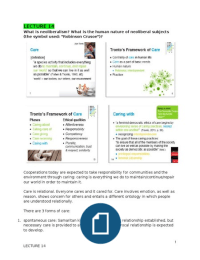
Caring is a complex process. There are 4 steps of care to be identified:
1. Caring about: identify needs: whose need is it: someone or some group notices
unmet caring needs.
Linked to attentiveness: someone or some group notices unmet caring needs. It
calls for the moral quality of a suspension of one’s self interest and a capacity to
genuinely look from the perspective of the one in need: attentiveness.
2. Taking care of: what strategies do corporations use to reach the needs: once needs
are identified, someone needs to take on the burden of meeting those needs. this is
responsibility.
3. me group has to take responsibility in order to make certain these needs are
met.Care giving: do the people who give care have the resources to give it: actual
care work needs to be done
Competence: this step requires people to be competent to give care
4. Care receiving: what is the response of those who are given care: good stories are
often shown, but what about the bad stories: audience reception: how do people
who get care respond?
Responsiveness: observing the response and making judgements about it.
Democratic caring:
5. Caring with: how caring are met, how those correspond to moral qualities:
communication, trust, respect, solidarity. Goal of caring practices: privileged
responsibility: practice of feminist citizenship. Make sure the required needs and the
ways in which these needs are met, need to be consistent with democratic
commitments to justice, equality, and freedom for all.
Democratic equality however requires the provision of equal human rights.
Democratic life rests upon the presumption that citizens are equal. What equality
means however, varies across theories. What is distinctive about democratic caring
is that is presumes quality rests upon a very different ground. It presumes that we
are equal as democratic citizens in being care receivers. All citizens’ needs for care
and their interdependent reliance on others to help them to meet their caring needs
become the basis for equality. Yet this is not the same as saying every human has
the same caring needs. Yet the quality of being needy is being shared by all
humans. If humans are needy, they are not needy in the same ways.
Added to this can be plurality, communication, trust and respect: solidarity:caring
with
Feminist democratic ethic of care begins by envisioning series of caring practices,
nested within one another. The broadest of these is to pertain society as a whole.
The goal here is to ensure that all members of the society can live as well as
possible by making the society as democratic as possible. This is the essence of
2
LECTURE 14
What is neoliberalism? What is the human nature of neoliberal subjects
(the symbol used: "Robinson Crusoe")?
Cooperations today are expected to take responsibility for communities and the
environment through caring: caring is everything we do to maintain/continue/repair
our world in order to maintain it.
Care is relational. Everyone cares and it cared for. Care involves emotion, as well as
reason, shows concern for others and entails a different ontology in which people
are understood relationally.
There are 3 forms of care:
1. spontaneous care: Samaritan kind of care, no ongoing relationship established, but
necessary care is provided to another, where no reciprocal relationship is expected
to develop.
1
LECTURE 14
, 2. Necessary care: providing care to someone else, that the recipient cannot provide
to oneself, reciprocity. Fe doctors
3. Personal service: Care provided to oneself, but someone else provides it instead.
Caring is a complex process. There are 4 steps of care to be identified:
1. Caring about: identify needs: whose need is it: someone or some group notices
unmet caring needs.
Linked to attentiveness: someone or some group notices unmet caring needs. It
calls for the moral quality of a suspension of one’s self interest and a capacity to
genuinely look from the perspective of the one in need: attentiveness.
2. Taking care of: what strategies do corporations use to reach the needs: once needs
are identified, someone needs to take on the burden of meeting those needs. this is
responsibility.
3. me group has to take responsibility in order to make certain these needs are
met.Care giving: do the people who give care have the resources to give it: actual
care work needs to be done
Competence: this step requires people to be competent to give care
4. Care receiving: what is the response of those who are given care: good stories are
often shown, but what about the bad stories: audience reception: how do people
who get care respond?
Responsiveness: observing the response and making judgements about it.
Democratic caring:
5. Caring with: how caring are met, how those correspond to moral qualities:
communication, trust, respect, solidarity. Goal of caring practices: privileged
responsibility: practice of feminist citizenship. Make sure the required needs and the
ways in which these needs are met, need to be consistent with democratic
commitments to justice, equality, and freedom for all.
Democratic equality however requires the provision of equal human rights.
Democratic life rests upon the presumption that citizens are equal. What equality
means however, varies across theories. What is distinctive about democratic caring
is that is presumes quality rests upon a very different ground. It presumes that we
are equal as democratic citizens in being care receivers. All citizens’ needs for care
and their interdependent reliance on others to help them to meet their caring needs
become the basis for equality. Yet this is not the same as saying every human has
the same caring needs. Yet the quality of being needy is being shared by all
humans. If humans are needy, they are not needy in the same ways.
Added to this can be plurality, communication, trust and respect: solidarity:caring
with
Feminist democratic ethic of care begins by envisioning series of caring practices,
nested within one another. The broadest of these is to pertain society as a whole.
The goal here is to ensure that all members of the society can live as well as
possible by making the society as democratic as possible. This is the essence of
2
LECTURE 14