Organizational behavior and management - Ivancevich, Konopaske
& Matteson (2018)
Chapter 16: Organizational Structure and Design
Organisation = people working collectively for a common purpose → properties: (a) self-evident,
and (b) hidden behind golden bricks (people don’t think about how an organisation operates and
take organisations for granted) → organisational failure often caused by organisational structure.
Organisational structure = the anatomy/foundation of an organization within which it functions
→ a framework that focuses on (a) the differentiation of positions, (b) formulation of rules and
procedures, and (c) prescriptions of authority.
Models of organisational design:
1. Mechanistic model: (machine-like functioning) formal, centralized and complex
structures, task-oriented → principles: (a) high specialisation, (b) functional
departmentalisation = jobs are grouped according to specialty, (c) centralised
authority, (d) scalar chain = vertical communications from lowest level must pass
through each superior in the chain of command, (e) bureaucracy (high degree of
calculability of results).
a. Bureaucracy = regulatory procedures, division of responsibility, hierarchy and
impersonal relationships → principles: rationalisation (procedures and rules) -
formality (standardisation of processes) - specialisation (one clear job to do) -
hierarchy (top-down management) - universal access, but no individual control.
i. advantages: high degree of calculability of results → organisations
become more productive → possibility to monitor activities.
ii. disadvantage: employees, customers and patients have no say in the
process (powerless and meaningless) - inflexible/rigid (due to many
departments and subtasks) - inefficient and viscous - differentiation and
disintegration - limited goal rationality and value morality.
→ traditionally, health professionals had much autonomy → inefficient and no standards or
procedures → called for: more transparency and governance, voice and choice (of patients),
demand-driven healthcare → solution: new public management = professionals are embedded in
an organisation → properties:
Strengthening position Making achievements tangible Accountability not solely Improvement of
of consumers. (instead of secret knowledge). horizontal (role of insurers). performance.
→ NPM creates a tension between the relation of professionalism (protected professionals treat
cases based on scientific knowledge and experience) and management (well-run organisations
deliver products to customers based on controlled access and autonomy) → FEX. Dutch
regulated market competition, involves a regulated healthcare market, transparency,
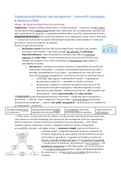
accountability, demand- and supply-driven → insurance triangle = (picture left) based on
consumer choice, competition between insurance companies for
enrollees, negotiation for good quality and price (between insurers
and healthcare providers) → regulation of healthcare market by
Ministry of Health, Welfare and Sport and Zorginstituut Nederland.
→ market failure in healthcare: (a) healthcare is not a business → (b)
insufficient competition to offer high quality care at the best price
→ (c) no direct interaction between supply and demand (mediated
by a third party) → (d) increased accountability (bureaucracy is
revisited).
, 2. Organic model: (a) tasks, authority and routines are constantly redefined, (b) flat
organisations, (c) informal, decentralised and simple, and (d) complex and dynamic
environments → few ranks and titles, wide spans of control (cross-functional teams).
a. individuals are free to: (a) pursue ideas on their own, (b) communicate with each
other and (c) collaborate out of self-motivation rather than a sense of duty.
b. mechanistic model; maximize efficiency and production, organic model; maximize
satisfaction, flexibility and development.
Design choices: managers decide… (a) how to divide the overall task into smaller jobs (division of
labour), (b) the bases by which to group individual jobs (authority), (c) the appropriate size of the
group reporting to each superior (departmentalisation), (d) the number of subordinates
reporting to a superior/manager (span of control).
→ division of labour: extent to which jobs are specialized based on personal specialties, natural
sequence of work (horizontal specialisation) and vertical plane (hierarchy of authority from the
lowest-level to the highest-level manager).
→ delegation of authority: how much authority (of making decisions) should be delegated to each
job and jobholder → centralise authority to; save training costs, gain control, no need for extra
monitoring institutions and prevent duplication of functions.
→ types of departmentalisation (organisational structures);
- functional: combine jobs according to the functions of the organization (FEX. production,
marketing, finance, accounting, and human resources) → often small organisations with a
narrow range of products → based on differentiation.
- advantage: specialisation and efficiency (employees can focus on their role), a
general manager (for integration and standardisation).
- disadvantage: inefficient use of managerial time, can create tunnel vision (focus
only on one role), fragmentation of services for customers.
- geographic: establish groups according to geographic area (most prevalent) → used when:
physical separation of activities makes centralized coordination difficult and when a
company has operations, units or subsidiaries in different countries.
- service-product: group jobs on the basis of products/services → authority, responsibility
and accountability in specific departments → based on integration.
- advantage: more autonomy promotes entrepreneurship (to offer unique product/
service), more integration of functions.
- disadvantage: duplication of activities, coordination across business units is
difficult (internal rivalry for customers and resources), inefficiency.
- customer: customers and clients as basis for grouping jobs → FEX. educational
institutions and loan offices.
3. Matrix model: compromise between functional and service-product organization →
product management departments along with using functional departments = dual
authority system (functional and product manager) → found in organisations that: (a)
require responses to rapid change, (b) face uncertainties that require high
info-processing, and (3) must deal with financial and human resources constraints.
a. advantages: efficient use of resources and skills, flexibility in conditions of change
and uncertainty (info is channeled vertically and horizontally), technical
excellence, freeing top management for long-range planning (they are less
involved with day-to-day operations), improved motivation and commitment,
opportunities for personal development, more aware of total organisation.
, b. disadvantages: some duplication of activities, coordination across business units
is difficult (internal rivalry for customers and resources), dual reporting
relationships (the workload is not centrally known).
c. evolution of matrix: task force (with individuals from each department, dissolves
when objective is achieved) -> teams (permanent teams of representatives of
each department that meet regularly to solve interdepartmental issues) ->
product manager (chairs a team permanently, no formal authority over the team
members, but relies on expertise and interpersonal skill to influence them) ->
product management departments (subproduct managers for each product line).
Issues to consider: design trade-offs: mechanic = left, organic = right.
centralisation: extent to which authority of decision making is decentralisation: more responsive to local
retained in top management → result of: high specialisation of circumstances and opportunities for staff
labour, low delegation of authority, use of functional departments development, BUT a sense of control is good
and wider span of control (specialized jobs need little authority). for the staff’s motivation.
control (top-down) → who decides how work is done? autonomy (bottom-up).
differentiation: highly specialised, patient=disease, healthcare integration: collaboration, holistic view of
silos (people don’t work together) → horizontal differentiation: care delivery → person-centered care.
number of different units at the same level → vertical
differentiation: number of levels in the organization.
formalisation: rules and procedures to guide actions → result of: low formalisation: few rules and procedures
high specialization of labor, high delegation of authority, use of to guide action.
functional departments and wide span of control.
complexity: number of different jobs/units within an organisation simple: low specialisation and low number of
→ result of: high specialisation of labour, high delegation of jobs/units within an organisation.
authority, use of geographic, customer and product bases and
narrow span of control (jobs are different from each other).
narrow span of control: tall organisations, small departments with large span of control: (1) much contact
highly specialised and similar jobs, managers do not have to between superior and subordinates, (2)
manage many people. highly specialized, similar jobs are combined
in large departments, and (3) superiors can
clearly communicate with subordinates and
are able to manage more people.
Virtual organization = geographically distributed and functionally and/or culturally diverse
aggregations of individuals linked by electronic communication → FEX. Barclays’ global bank.
- characteristics: personnel distributed geographically - electronically connected -
differences in expertise and function - culturally diverse - work schedule differences -
horizontally arranged with little emphasis on command and control authority.
- design implications: contractual relationships - constant change and reconfiguration - no
rigid boundaries - flexible - little or no personal/social contact.
- benefits: increase in communication - relationships are tenuous - continual surety of
roles, tasks and assignments - greater equity of participation.
& Matteson (2018)
Chapter 16: Organizational Structure and Design
Organisation = people working collectively for a common purpose → properties: (a) self-evident,
and (b) hidden behind golden bricks (people don’t think about how an organisation operates and
take organisations for granted) → organisational failure often caused by organisational structure.
Organisational structure = the anatomy/foundation of an organization within which it functions
→ a framework that focuses on (a) the differentiation of positions, (b) formulation of rules and
procedures, and (c) prescriptions of authority.
Models of organisational design:
1. Mechanistic model: (machine-like functioning) formal, centralized and complex
structures, task-oriented → principles: (a) high specialisation, (b) functional
departmentalisation = jobs are grouped according to specialty, (c) centralised
authority, (d) scalar chain = vertical communications from lowest level must pass
through each superior in the chain of command, (e) bureaucracy (high degree of
calculability of results).
a. Bureaucracy = regulatory procedures, division of responsibility, hierarchy and
impersonal relationships → principles: rationalisation (procedures and rules) -
formality (standardisation of processes) - specialisation (one clear job to do) -
hierarchy (top-down management) - universal access, but no individual control.
i. advantages: high degree of calculability of results → organisations
become more productive → possibility to monitor activities.
ii. disadvantage: employees, customers and patients have no say in the
process (powerless and meaningless) - inflexible/rigid (due to many
departments and subtasks) - inefficient and viscous - differentiation and
disintegration - limited goal rationality and value morality.
→ traditionally, health professionals had much autonomy → inefficient and no standards or
procedures → called for: more transparency and governance, voice and choice (of patients),
demand-driven healthcare → solution: new public management = professionals are embedded in
an organisation → properties:
Strengthening position Making achievements tangible Accountability not solely Improvement of
of consumers. (instead of secret knowledge). horizontal (role of insurers). performance.
→ NPM creates a tension between the relation of professionalism (protected professionals treat
cases based on scientific knowledge and experience) and management (well-run organisations
deliver products to customers based on controlled access and autonomy) → FEX. Dutch
regulated market competition, involves a regulated healthcare market, transparency,
accountability, demand- and supply-driven → insurance triangle = (picture left) based on
consumer choice, competition between insurance companies for
enrollees, negotiation for good quality and price (between insurers
and healthcare providers) → regulation of healthcare market by
Ministry of Health, Welfare and Sport and Zorginstituut Nederland.
→ market failure in healthcare: (a) healthcare is not a business → (b)
insufficient competition to offer high quality care at the best price
→ (c) no direct interaction between supply and demand (mediated
by a third party) → (d) increased accountability (bureaucracy is
revisited).
, 2. Organic model: (a) tasks, authority and routines are constantly redefined, (b) flat
organisations, (c) informal, decentralised and simple, and (d) complex and dynamic
environments → few ranks and titles, wide spans of control (cross-functional teams).
a. individuals are free to: (a) pursue ideas on their own, (b) communicate with each
other and (c) collaborate out of self-motivation rather than a sense of duty.
b. mechanistic model; maximize efficiency and production, organic model; maximize
satisfaction, flexibility and development.
Design choices: managers decide… (a) how to divide the overall task into smaller jobs (division of
labour), (b) the bases by which to group individual jobs (authority), (c) the appropriate size of the
group reporting to each superior (departmentalisation), (d) the number of subordinates
reporting to a superior/manager (span of control).
→ division of labour: extent to which jobs are specialized based on personal specialties, natural
sequence of work (horizontal specialisation) and vertical plane (hierarchy of authority from the
lowest-level to the highest-level manager).
→ delegation of authority: how much authority (of making decisions) should be delegated to each
job and jobholder → centralise authority to; save training costs, gain control, no need for extra
monitoring institutions and prevent duplication of functions.
→ types of departmentalisation (organisational structures);
- functional: combine jobs according to the functions of the organization (FEX. production,
marketing, finance, accounting, and human resources) → often small organisations with a
narrow range of products → based on differentiation.
- advantage: specialisation and efficiency (employees can focus on their role), a
general manager (for integration and standardisation).
- disadvantage: inefficient use of managerial time, can create tunnel vision (focus
only on one role), fragmentation of services for customers.
- geographic: establish groups according to geographic area (most prevalent) → used when:
physical separation of activities makes centralized coordination difficult and when a
company has operations, units or subsidiaries in different countries.
- service-product: group jobs on the basis of products/services → authority, responsibility
and accountability in specific departments → based on integration.
- advantage: more autonomy promotes entrepreneurship (to offer unique product/
service), more integration of functions.
- disadvantage: duplication of activities, coordination across business units is
difficult (internal rivalry for customers and resources), inefficiency.
- customer: customers and clients as basis for grouping jobs → FEX. educational
institutions and loan offices.
3. Matrix model: compromise between functional and service-product organization →
product management departments along with using functional departments = dual
authority system (functional and product manager) → found in organisations that: (a)
require responses to rapid change, (b) face uncertainties that require high
info-processing, and (3) must deal with financial and human resources constraints.
a. advantages: efficient use of resources and skills, flexibility in conditions of change
and uncertainty (info is channeled vertically and horizontally), technical
excellence, freeing top management for long-range planning (they are less
involved with day-to-day operations), improved motivation and commitment,
opportunities for personal development, more aware of total organisation.
, b. disadvantages: some duplication of activities, coordination across business units
is difficult (internal rivalry for customers and resources), dual reporting
relationships (the workload is not centrally known).
c. evolution of matrix: task force (with individuals from each department, dissolves
when objective is achieved) -> teams (permanent teams of representatives of
each department that meet regularly to solve interdepartmental issues) ->
product manager (chairs a team permanently, no formal authority over the team
members, but relies on expertise and interpersonal skill to influence them) ->
product management departments (subproduct managers for each product line).
Issues to consider: design trade-offs: mechanic = left, organic = right.
centralisation: extent to which authority of decision making is decentralisation: more responsive to local
retained in top management → result of: high specialisation of circumstances and opportunities for staff
labour, low delegation of authority, use of functional departments development, BUT a sense of control is good
and wider span of control (specialized jobs need little authority). for the staff’s motivation.
control (top-down) → who decides how work is done? autonomy (bottom-up).
differentiation: highly specialised, patient=disease, healthcare integration: collaboration, holistic view of
silos (people don’t work together) → horizontal differentiation: care delivery → person-centered care.
number of different units at the same level → vertical
differentiation: number of levels in the organization.
formalisation: rules and procedures to guide actions → result of: low formalisation: few rules and procedures
high specialization of labor, high delegation of authority, use of to guide action.
functional departments and wide span of control.
complexity: number of different jobs/units within an organisation simple: low specialisation and low number of
→ result of: high specialisation of labour, high delegation of jobs/units within an organisation.
authority, use of geographic, customer and product bases and
narrow span of control (jobs are different from each other).
narrow span of control: tall organisations, small departments with large span of control: (1) much contact
highly specialised and similar jobs, managers do not have to between superior and subordinates, (2)
manage many people. highly specialized, similar jobs are combined
in large departments, and (3) superiors can
clearly communicate with subordinates and
are able to manage more people.
Virtual organization = geographically distributed and functionally and/or culturally diverse
aggregations of individuals linked by electronic communication → FEX. Barclays’ global bank.
- characteristics: personnel distributed geographically - electronically connected -
differences in expertise and function - culturally diverse - work schedule differences -
horizontally arranged with little emphasis on command and control authority.
- design implications: contractual relationships - constant change and reconfiguration - no
rigid boundaries - flexible - little or no personal/social contact.
- benefits: increase in communication - relationships are tenuous - continual surety of
roles, tasks and assignments - greater equity of participation.