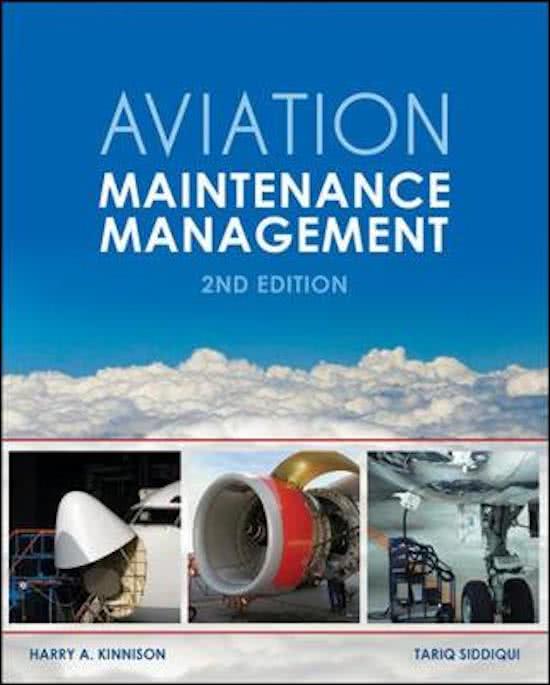
Aviation Maintenance
Management Summary
Summary of all reading material for the subject Aviation Maintenance
Management
Block 7
2nd Year
Aviation Engineering
Amsterdam University of Applied Sciences
,Index
Chapter 1 – Why We Have To Do Maintenance 3
Chapter 3 – Definitions, Goals and Objectives 4
Chapter 4 – Aviation Industry Certification Requirements 6
Chapter 6 – Requirements for a Maintenance Program 7
Chapter 7 – The Maintenance and Engineering Organization 8
Chapter 8 – Engineering 10
Chapter 9 – Production Planning and Control 11
Chapter 13 – Line Maintenance (on-Aircraft) 12
Chapter 14 – Hangar Maintenance (On-Aircraft) 13
Chapter 15 – Materiel Support 14
Chapter 16 – Quality Assurance 15
Chapter 17 – Quality Control 16
Chapter 18 – Reliability 17
Reader Engine Maintenance Concepts for Financiers 18
Reader Airframe 21
2
, Chapter 1 – Why We Have To Do Maintenance
Introduction:
o Maintenance of an aircraft provides assurance of flight safety,
reliability and airworthiness.
Thermodynamics Revisited:
o Entropy:
Energy that is unavailable for use.
The difference between designed and build system
(natural entropy of the system).
A Saw Blade Has Width:
o Theoretically you can divide a piece of wood indefinitely.
o In practice, the width of the saw blade is the limiting factor.
The Role of the Engineer:
o Other constrains: man made entropy.
The Role of the Mechanic:
o AMT: Aircraft Maintenance Technician
o FIM: Fault Isolation Manual
Two Types of Maintenance:
o Preventive (scheduled) maintenance.
o Unscheduled maintenance.
Reliability:
o Level of perfection of the system.
Redesign:
o Inherent reliability (starting reliability) higher.
o Detoriation however faster/as fast/slower.
o Increase in perfection is logarithmic.
o Increase in cost is exponential.
Failure Rate Paterns:
o Six basic failure patterns.
o Ideal component: no infant-mortality and no wear-out period,
just a steady failure rate throughout its life.
Other Maintenance Considerations:
o LRUs: Line Replaceable Units
o MEL: Minimum Equipment List (Airborne)
o MMEL: Master MEL (Manufacturer)
o PIC: Pilot-in-Command
o DDG: Dispatch Deviation Guide
o CDL: Configuration Deviation List
o NEF: Non-essential Equipment and Furnishing
Establishing a Maintenance Program:
o Parts showing life limits or measurable wear-out characteristics
van be part of a systematic, scheduled maintenance program.
3
Management Summary
Summary of all reading material for the subject Aviation Maintenance
Management
Block 7
2nd Year
Aviation Engineering
Amsterdam University of Applied Sciences
,Index
Chapter 1 – Why We Have To Do Maintenance 3
Chapter 3 – Definitions, Goals and Objectives 4
Chapter 4 – Aviation Industry Certification Requirements 6
Chapter 6 – Requirements for a Maintenance Program 7
Chapter 7 – The Maintenance and Engineering Organization 8
Chapter 8 – Engineering 10
Chapter 9 – Production Planning and Control 11
Chapter 13 – Line Maintenance (on-Aircraft) 12
Chapter 14 – Hangar Maintenance (On-Aircraft) 13
Chapter 15 – Materiel Support 14
Chapter 16 – Quality Assurance 15
Chapter 17 – Quality Control 16
Chapter 18 – Reliability 17
Reader Engine Maintenance Concepts for Financiers 18
Reader Airframe 21
2
, Chapter 1 – Why We Have To Do Maintenance
Introduction:
o Maintenance of an aircraft provides assurance of flight safety,
reliability and airworthiness.
Thermodynamics Revisited:
o Entropy:
Energy that is unavailable for use.
The difference between designed and build system
(natural entropy of the system).
A Saw Blade Has Width:
o Theoretically you can divide a piece of wood indefinitely.
o In practice, the width of the saw blade is the limiting factor.
The Role of the Engineer:
o Other constrains: man made entropy.
The Role of the Mechanic:
o AMT: Aircraft Maintenance Technician
o FIM: Fault Isolation Manual
Two Types of Maintenance:
o Preventive (scheduled) maintenance.
o Unscheduled maintenance.
Reliability:
o Level of perfection of the system.
Redesign:
o Inherent reliability (starting reliability) higher.
o Detoriation however faster/as fast/slower.
o Increase in perfection is logarithmic.
o Increase in cost is exponential.
Failure Rate Paterns:
o Six basic failure patterns.
o Ideal component: no infant-mortality and no wear-out period,
just a steady failure rate throughout its life.
Other Maintenance Considerations:
o LRUs: Line Replaceable Units
o MEL: Minimum Equipment List (Airborne)
o MMEL: Master MEL (Manufacturer)
o PIC: Pilot-in-Command
o DDG: Dispatch Deviation Guide
o CDL: Configuration Deviation List
o NEF: Non-essential Equipment and Furnishing
Establishing a Maintenance Program:
o Parts showing life limits or measurable wear-out characteristics
van be part of a systematic, scheduled maintenance program.
3