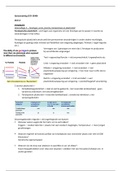
Hedonic vs utilitarian consumption
ELM High involvement: central route
Low involvement: peripheral route
Perception involves (1) external stimuli, (2) sensory
receptors, (3) mental processes, and (4) reactions to stimuli
o Inter-observer reliability: between people
o Intra-observer reliability: over time
Brunswik’s Lens Model
Ecological validity: ambiguity
o Distal variables <-> proximal cues
o Cue predictive validity
Cue utilisation: combination of cues
o Proximal cues <-> perceptual response
o Cue confidence value
Functional validity
o Distal variable <-> perceptual response
Value based quality consist of: (Steenkamp)
Evaluative judgement (1)
o Quality cues: intrinsic (colour, size) & extrinsic (price, brand, label)
o Quality attribute: intrinsic (organic production) & extrinsic (Fair Trade)
On subject – object interaction (2)
o Comparative: brand A vs B (if other products are very good, this one is worse)
o Personal: differs among subjects (involvement, prior knowledge, perceived risk)
o Situational: depends on context (usage goal, time pressure)
In a consumption context (3)
Formation of (quality) attributes can be based on:
Descriptive belief formation: based on what you see and feel
Informational belief formation: based on outside sources (friends, ads)
Inferential belief formation: based on previous experiences
Search attributes: can be determined before purchase (colour, weight, brand)
Experience attributes: can be discerned only after purchase (vacations, taste)
Credence attributes: hard to evaluate even after purchase (medical diagnosis, auto repair)
Deterministic choice rule: winner gets all
Max-utility (first-choice) rule AND High involvement, durables, expensive, one-time buy
Probabilistic choice rules: winner gets most, but not all:
BTL rule: Logit rule:
Criteria for selection of attributes:
Differentiate between products
Important to consumers (qualitative research)
Communicable the more vividly presented, the more important an attribute will seem to be
Objective
Actionable: relevant for company’s decision making
Criteria for selection of levels:
Mutually exclusive
Preferably an equal number of levels per attribute (the more levels the more important)
Range of levels somewhat outside existing range
, Issues with categorisation
Cross-categorisation: objects can belong to single taxonomic category only but can belong to
multiple goal derived categories.
Functional categorisation: limit your options, as you don’t look outside that category
Consideration set formation: situational goal triggers relevant functional category.
Unfamiliar goal triggers more cross-category.
Most abstract Values Personal goal derived
Abstract Situational context Consequences Situational goal derived
Concrete Situational characteristics Attributes Taxonomic feature based
PCA assumptions: independent observations, sufficient number of large correlations, KMO>.8,
Barlett’s test significant
How many factors? A priori, eigenvalue > 1, scree plot, cumulative VAF > 60%, <50% residual
correlations >.5, interpretability
Orthogonal (varimax): more stable estimates
Non-orthogonal (oblimin): loadings unclear otherwise
Homogeneous evaluations consumer & heterogeneous evaluations products
Heterogeneous evaluations consumer & homogeneous evaluations products
Heterogeneous evaluations across different subgroups of products
Correlation vs covariation matrix
Compositional vs Decompositional mapping
Object classification
o Concrete singular object: One object, commonly known (regular Coca Cola)
o Abstract collective object: Heterogeneous objects that form a category (Soft Drinks)
o Abstract formed object: Object that is composed of different, possibly unrelated,
components. People have different interpretations. (Marketing)
Attribute classification
o Concrete attribute: Simple measurement by a single item. Only needs 1 question.
(colour, price perception)
o Eliciting / reflective attribute: Set of items measuring a sample of concrete attributes.
1 dimensional scale (need for cognition, attitude)
o Formed attribute: The attribute is defined by the dimensions that you measure.
Multi-dimensional scale (IQ, Social Class, Income, Job, Education, Speed)
Rater or Respondent identification
o Individual rater: Self reports that are analysed for classification and for individual
differences (most common in surveys / experiments)
o Group raters: Representative sample for a population and analysed for population
scores (opinion-type research)
o Expert raters: Trained and used for classifying of objects (professional taste testers)
Service quality is: (ServQual) Responsiveness Assurance Tangibles Empathy Reliability
ELM High involvement: central route
Low involvement: peripheral route
Perception involves (1) external stimuli, (2) sensory
receptors, (3) mental processes, and (4) reactions to stimuli
o Inter-observer reliability: between people
o Intra-observer reliability: over time
Brunswik’s Lens Model
Ecological validity: ambiguity
o Distal variables <-> proximal cues
o Cue predictive validity
Cue utilisation: combination of cues
o Proximal cues <-> perceptual response
o Cue confidence value
Functional validity
o Distal variable <-> perceptual response
Value based quality consist of: (Steenkamp)
Evaluative judgement (1)
o Quality cues: intrinsic (colour, size) & extrinsic (price, brand, label)
o Quality attribute: intrinsic (organic production) & extrinsic (Fair Trade)
On subject – object interaction (2)
o Comparative: brand A vs B (if other products are very good, this one is worse)
o Personal: differs among subjects (involvement, prior knowledge, perceived risk)
o Situational: depends on context (usage goal, time pressure)
In a consumption context (3)
Formation of (quality) attributes can be based on:
Descriptive belief formation: based on what you see and feel
Informational belief formation: based on outside sources (friends, ads)
Inferential belief formation: based on previous experiences
Search attributes: can be determined before purchase (colour, weight, brand)
Experience attributes: can be discerned only after purchase (vacations, taste)
Credence attributes: hard to evaluate even after purchase (medical diagnosis, auto repair)
Deterministic choice rule: winner gets all
Max-utility (first-choice) rule AND High involvement, durables, expensive, one-time buy
Probabilistic choice rules: winner gets most, but not all:
BTL rule: Logit rule:
Criteria for selection of attributes:
Differentiate between products
Important to consumers (qualitative research)
Communicable the more vividly presented, the more important an attribute will seem to be
Objective
Actionable: relevant for company’s decision making
Criteria for selection of levels:
Mutually exclusive
Preferably an equal number of levels per attribute (the more levels the more important)
Range of levels somewhat outside existing range
, Issues with categorisation
Cross-categorisation: objects can belong to single taxonomic category only but can belong to
multiple goal derived categories.
Functional categorisation: limit your options, as you don’t look outside that category
Consideration set formation: situational goal triggers relevant functional category.
Unfamiliar goal triggers more cross-category.
Most abstract Values Personal goal derived
Abstract Situational context Consequences Situational goal derived
Concrete Situational characteristics Attributes Taxonomic feature based
PCA assumptions: independent observations, sufficient number of large correlations, KMO>.8,
Barlett’s test significant
How many factors? A priori, eigenvalue > 1, scree plot, cumulative VAF > 60%, <50% residual
correlations >.5, interpretability
Orthogonal (varimax): more stable estimates
Non-orthogonal (oblimin): loadings unclear otherwise
Homogeneous evaluations consumer & heterogeneous evaluations products
Heterogeneous evaluations consumer & homogeneous evaluations products
Heterogeneous evaluations across different subgroups of products
Correlation vs covariation matrix
Compositional vs Decompositional mapping
Object classification
o Concrete singular object: One object, commonly known (regular Coca Cola)
o Abstract collective object: Heterogeneous objects that form a category (Soft Drinks)
o Abstract formed object: Object that is composed of different, possibly unrelated,
components. People have different interpretations. (Marketing)
Attribute classification
o Concrete attribute: Simple measurement by a single item. Only needs 1 question.
(colour, price perception)
o Eliciting / reflective attribute: Set of items measuring a sample of concrete attributes.
1 dimensional scale (need for cognition, attitude)
o Formed attribute: The attribute is defined by the dimensions that you measure.
Multi-dimensional scale (IQ, Social Class, Income, Job, Education, Speed)
Rater or Respondent identification
o Individual rater: Self reports that are analysed for classification and for individual
differences (most common in surveys / experiments)
o Group raters: Representative sample for a population and analysed for population
scores (opinion-type research)
o Expert raters: Trained and used for classifying of objects (professional taste testers)
Service quality is: (ServQual) Responsiveness Assurance Tangibles Empathy Reliability