
Decision Science 1, Computer Practical,
Practical work, Week 5 P5 Pair number: 14
Name: Lars van der Horst Studentnumber: 1 0 4 9 5 2 8
Name: Dennis van den Berg Studentnumber: 1 0 4 8 1 6 8
Watch the Introduction clip to practical P5
Exercise 9
The next questions are all related to exercise 9 (farmers problem) of your syllabus.
Use file << DS1_09 Farmer extended.mos >>.
9-b1 Show that the objective value of the optimal basic solution X of the primal problem is equal to the
objective value of the optimal basic solution U'=(u',v') of the dual problem.
(Hint: Remember that c’x = b’u and locate c, x, b, u in the output of Xpress.)
C’x = b u
(5.00, 2.02 1,85) (4500 5000 6000) = (350 400 10) (37,97 20,65 2212,03)
43700 43669,8
Because of rounding off a small difference.
9-b2 Suppose the profit per hectare for potatoes might decrease. Until which level may the profit drop knowing for
sure that the current cultivation plan remains optimal?
>= 911.39 (lower bound cost coefficient)
9-c Give your answer on question c.
La_Ma the shadow price > 30 so use extra labour because the profit will rise
La_Oc the shadow price < 30 so don't use extra labour because the total profit will decrease
9-d1 Give your answer on question d1.
Hint: don’t try to calculate this by hand. Extend the model with additional variables and with a constraint
called “Subs” (mind the capital “S”!) that models the way in which you spend your subsidy budget.
Extra hectare: 0,934 hectare
Extra labour: 137,722
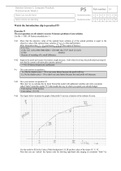
9-d2 The figure below sketches the graph of the profit (Y-axis) as a function of the subsidy (X-axis).
Use the model to fill in the Value of Subs breakpoints I, II, III and the values of the slopes IV, V, VI.
Note that you can ‘unlock’ the Xpress code for showing right-hand side ranging on constraint “Subs” by
Practical work, Week 5 P5 Pair number: 14
Name: Lars van der Horst Studentnumber: 1 0 4 9 5 2 8
Name: Dennis van den Berg Studentnumber: 1 0 4 8 1 6 8
Watch the Introduction clip to practical P5
Exercise 9
The next questions are all related to exercise 9 (farmers problem) of your syllabus.
Use file << DS1_09 Farmer extended.mos >>.
9-b1 Show that the objective value of the optimal basic solution X of the primal problem is equal to the
objective value of the optimal basic solution U'=(u',v') of the dual problem.
(Hint: Remember that c’x = b’u and locate c, x, b, u in the output of Xpress.)
C’x = b u
(5.00, 2.02 1,85) (4500 5000 6000) = (350 400 10) (37,97 20,65 2212,03)
43700 43669,8
Because of rounding off a small difference.
9-b2 Suppose the profit per hectare for potatoes might decrease. Until which level may the profit drop knowing for
sure that the current cultivation plan remains optimal?
>= 911.39 (lower bound cost coefficient)
9-c Give your answer on question c.
La_Ma the shadow price > 30 so use extra labour because the profit will rise
La_Oc the shadow price < 30 so don't use extra labour because the total profit will decrease
9-d1 Give your answer on question d1.
Hint: don’t try to calculate this by hand. Extend the model with additional variables and with a constraint
called “Subs” (mind the capital “S”!) that models the way in which you spend your subsidy budget.
Extra hectare: 0,934 hectare
Extra labour: 137,722
9-d2 The figure below sketches the graph of the profit (Y-axis) as a function of the subsidy (X-axis).
Use the model to fill in the Value of Subs breakpoints I, II, III and the values of the slopes IV, V, VI.
Note that you can ‘unlock’ the Xpress code for showing right-hand side ranging on constraint “Subs” by



