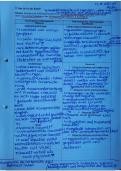
Solution concentration Factors affecting
units solubility
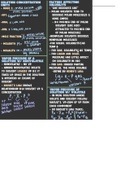
- mass % : mass solute +100 - “like dissolves like”
mass solution - polar solvents tend to
-ppt: above ✗ 1000 dissolve polar molecules &
Equation
ionic cmpds
-ppm: ✗ 1,000,000 - b/c pos/neg end of polar
solvent (like h2o)
-Ppb: ✗ 11000,000 ,
000
attracted to pos/neg end
of polar molecule
moles solute
-mole fraction: ✗ =
moles solution
-nonpolar solvents dissolve
nonpolar molecules
MO I solute
- Molarity: M = -for solids, solubility ↑ as
L solution
temp *
- molality: m= Moles solute - for gas, solubility as temp i •
solvent
kg - for liquid and solid:
Vapor pressure of a pressure has little affect
solution w/ nonvolatile on solubility in h2o
- nonvolatile = no vp - for gas: higher partial
- adding nonvolatile solute pressure, the more soluble
to solvent lowers vp b/c it -define by Henry’s law:
takes up space in the solution C. K P gas Partial
g.
= .
& interfers w/ escape of
solvent contentration P
constant
'
- raoult’s law shows
relationship b/w solvent vp & Vapor pressure of
concentration solution w/ volatile
- in ideal solution where
LP ✗ P
= °
•
, ,
solute and solvent follow
VP
pure mole VP Raoult’s, vp=sum of vp from
solvent fraction each component
over
solvent
solvent - do raoult’s law twice:
solution ✗A
{
PA = •
PAO P total =
PBO PA + PB
PB= ✗ B •
units solubility
- mass % : mass solute +100 - “like dissolves like”
mass solution - polar solvents tend to
-ppt: above ✗ 1000 dissolve polar molecules &
Equation
ionic cmpds
-ppm: ✗ 1,000,000 - b/c pos/neg end of polar
solvent (like h2o)
-Ppb: ✗ 11000,000 ,
000
attracted to pos/neg end
of polar molecule
moles solute
-mole fraction: ✗ =
moles solution
-nonpolar solvents dissolve
nonpolar molecules
MO I solute
- Molarity: M = -for solids, solubility ↑ as
L solution
temp *
- molality: m= Moles solute - for gas, solubility as temp i •
solvent
kg - for liquid and solid:
Vapor pressure of a pressure has little affect
solution w/ nonvolatile on solubility in h2o
- nonvolatile = no vp - for gas: higher partial
- adding nonvolatile solute pressure, the more soluble
to solvent lowers vp b/c it -define by Henry’s law:
takes up space in the solution C. K P gas Partial
g.
= .
& interfers w/ escape of
solvent contentration P
constant
'
- raoult’s law shows
relationship b/w solvent vp & Vapor pressure of
concentration solution w/ volatile
- in ideal solution where
LP ✗ P
= °
•
, ,
solute and solvent follow
VP
pure mole VP Raoult’s, vp=sum of vp from
solvent fraction each component
over
solvent
solvent - do raoult’s law twice:
solution ✗A
{
PA = •
PAO P total =
PBO PA + PB
PB= ✗ B •