EXPLANATIONS OF GAMBLING
BIOLOGICAL EXPLANATION OF GAMBLING
AO1-
INITIATION
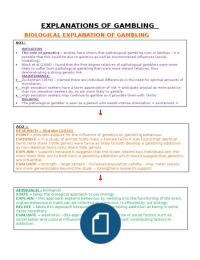
The role of genetics – studies have shown that pathological gambling runs in families – it is
possible that this could be due to genetics as well as environmental influences (social-
modelling).
Black et al (2006) – found that the first-degree relatives of pathological gamblers were more
likely to suffer from pathological gambling than were more distant relatives, thus
demonstrating a strong genetic link.
MAINTENANCE
Zuckerman (1979) – claimed there are individual differences in the need for optimal amounts of
stimulation.
High sensation seekers have a lower appreciation of risk + anticipate arousal as more positive
than low sensation seekers do, so are more likely to gamble.
High sensation seekers may continue to gamble as it provides them with ‘thrills’.
RELAPSE
The pathological gambler is seen as a person who needs intense stimulation + excitement +
has to avoid boredom.
↓
AO2 –
RESEARCH – Slutske (2010)
POINT – provides support for the influence of genetics on gambling behaviour.
EVIDENCE – in a study of almost 5000 male + female twins it was found that identical
twins (who share 100% genes) were twice as likely to both develop a gambling addiction
as non-identical twins (who share 50% genes).
EXPLAIN – supports because it suggests that the closer related two individuals are, the
more likely they are to both have a gambling addiction which would suggest that genetics
are influential.
EVALUATE – strength – large sample – increases population validity – may mean results
are more generalizable beyond the study – strengthens research support.
↓
APPROACH – biological
STATE – takes the biological approach to psychology.
EXPLAIN – this approach explains behaviour by relating it to the functioning of the brain.
Argues behavioural traits can be inherited as behaviour is affected by our biology.
RELATE – takes this approach because it explains gambling addiction as being in some
cases hereditary.
EVALUATE – weakness – this approach underplays the role of social factors such as
socialisation and cultural influences – so may miss important contributing factors to
addiction.
BIOLOGICAL EXPLANATION OF GAMBLING
AO1-
INITIATION
The role of genetics – studies have shown that pathological gambling runs in families – it is
possible that this could be due to genetics as well as environmental influences (social-
modelling).
Black et al (2006) – found that the first-degree relatives of pathological gamblers were more
likely to suffer from pathological gambling than were more distant relatives, thus
demonstrating a strong genetic link.
MAINTENANCE
Zuckerman (1979) – claimed there are individual differences in the need for optimal amounts of
stimulation.
High sensation seekers have a lower appreciation of risk + anticipate arousal as more positive
than low sensation seekers do, so are more likely to gamble.
High sensation seekers may continue to gamble as it provides them with ‘thrills’.
RELAPSE
The pathological gambler is seen as a person who needs intense stimulation + excitement +
has to avoid boredom.
↓
AO2 –
RESEARCH – Slutske (2010)
POINT – provides support for the influence of genetics on gambling behaviour.
EVIDENCE – in a study of almost 5000 male + female twins it was found that identical
twins (who share 100% genes) were twice as likely to both develop a gambling addiction
as non-identical twins (who share 50% genes).
EXPLAIN – supports because it suggests that the closer related two individuals are, the
more likely they are to both have a gambling addiction which would suggest that genetics
are influential.
EVALUATE – strength – large sample – increases population validity – may mean results
are more generalizable beyond the study – strengthens research support.
↓
APPROACH – biological
STATE – takes the biological approach to psychology.
EXPLAIN – this approach explains behaviour by relating it to the functioning of the brain.
Argues behavioural traits can be inherited as behaviour is affected by our biology.
RELATE – takes this approach because it explains gambling addiction as being in some
cases hereditary.
EVALUATE – weakness – this approach underplays the role of social factors such as
socialisation and cultural influences – so may miss important contributing factors to
addiction.