Patho/Phys Fall 2022 (Answered) All Correct Graded A+
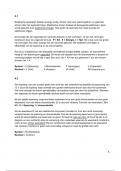
Patho/Phys Fall 2022 An artificial membrane is created consisting of a lipid bilayer without protein molecules in the membrane. The lipid composition of the membrane is essentially the same as that of a normal, biological membrane. Which of the following substances permeates the membrane more readily than water molecules? A. Carbon Dioxide B. Glucose C. Glycerol D. Sodium E. Urea ANS: A 2. A cell is equilibrated in an aqueous solution of 300 mOsm/L sodium chloride. Which of the following best describes what will happen to cell volume when the cell is placed in an aqueous solution of 300 mOsm/L calcium chloride? A. Decrease B. Decrease and then increase C. Increase D. Increase and then decrease E. No change ANS: E 3. The intracellular calcium ion concentration of ventricular muscle cells averages 10-4 mmol/L during diastole. The calcium ion concentration in transverse tubules (T-tubules) averages 2.5 mmol/L at rest. A protein transporter on the membrane of the T-tubule exchanges sodium for calcium. The transporter uses the transmembrane sodium gradient to fuel the exchange. Which of the following transport mechanisms best describes this type of transporter? A. Facilitated diffusion B. Primary active transport C. Secondary active co-transport D. Secondary active counter-transport E. Simple diffusion ANS: D 4. Human red blood cells (RBCs) and rabbit RBCs are equilibrated in separate solutions of isotonic saline (300 mOsm/L NaCl). The human RBCs are then placed in a solution of 300 mOsm/L glycerol, which causes them to swell and burst. However, rabbit RBCs placed in 300 mOsm/L glycerol neither swell nor shrink. Based on this information, which of the following can be concluded about a 300 mOsm/L solution of glycerol for the different cell types? Human RBCs A. Hypertonic and hyperosmotic B. Hypotonic and hypoosmotic C. Hypotonic and isoosmotic D. Isotonic and hypoosmotic E. Isotonic and isoosmotic F. Isotonic and hyperosmotic Rabbit RBCs A. Hypotonic and hypoosmotic B. Hypertonic and hyperosmotic C. Isotonic and isoosmotic D. Isotonic and hyperosmotic E. Hypotonic and isoosmotic F. Isotonic and isoosmotic ANS: C 5. The molarity of a 2% solution of NaCl is 340 mmol/L. The molecular weight of NaCl is 58.5. What is the osmolarity of a 2% solution of NaCl (in mOsm/L)? A. 170 B. 340 C. 510 D. 680 ANS: D 6. Secondary active transport typically moves which of the following substances against a concentration gradient? Glucose. Amino acids Sodium ions A. NO. NO. NO B. NO. NO. YES C. YES. NO. YES D. YES. YES. NO E. YES. YES. YES ANS: D . Which of the following transport mechanisms can move sodium ions across a cell membrane? Primary active | Secondary active | Simple diffusion A. NO. NO NO B. NO YES YES C. YES NO YES D. YES YES NO E. YES YES YES ANS: E The diagram illustrates possible changes in red blood cell volume resulting from a change in extracellular fluid composition for a cell equilibrated in a 150 mmol/L solution of sodium chloride (NaCl) at time zero. Which curve best illustrates the volume change caused by immersion of the cell in an aqueous solution of 300 mOsm/L calcium chloride (CaCl2)? ANS: C The cell membrane is leastpermeable to which of the following substances? a. Sodium b. Oxygen c. Ethanol

Geschreven voor
- Instelling
- Patho/Phys Fall 2022
- Vak
- Patho/Phys Fall 2022
Documentinformatie
- Geüpload op
- 6 december 2022
- Aantal pagina's
- 14
- Geschreven in
- 2022/2023
- Type
- Tentamen (uitwerkingen)
- Bevat
- Vragen en antwoorden
Onderwerpen
-
pathophys fall 2022 an artificial membrane is created consisting of a lipid bilayer without protein molecules in the membrane the lipid composition of the membrane is essentially the same as that of