Introduction to Microeconomics
(ECO1104)
,Chapter 1: Microeconomics and Life
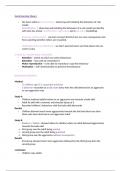
Economics: study of how individuals and firms manage resources (resources can be intangible)
Microeconomics: study of how individuals and firms manage resources
Macroeconomics: study of economics on a regional, national or international scale
Economists Classical theory
assume people - focused on a supply-demand equilibrium where if supply and
will behave in demand are not equal, the market will adjust in a way where
the best way to
equilibrium will prevail
achieve their
goals if they - pre-Great Depression; ironic given the Great Depression has a
have all surplus of goods and services and labour markets (quantity of
information assets exceeded quantity used)
needed Keynesian economics
(individuals - Explains why markets may not need to be in equilibrium to operate
have rational - Post-war 1940s and 1950s and after the 2008 financial crisis
behaviour)
Scarcity: condition of wanting more than we can get with available resources- constraint by
limited resources (i.e: money, time etc.)
- Scarcity on a collective level: society can produce limited things and must decide on
how to distribute available resources (i.e: number of workers, level of technology,
provincial budgets, etc.)
Performance and Decision Making
- Economic analysis requires theory to be combined with observations
- Measuring macroeconomy is done by focusing on performance indicators
- At an international level: using a ranking system
- At a regional and national level: comparison with past performance
Most Important Performance Measurements
- Policy-makers use these measurements to make policy decisions that result in faster
growth and reduce the severity of recession
- Gross Domestic Product
- Measurement of national income; accounts for the dollar value of goods and
services a country produces domestically for a specific period of time
- Income is also generated when goods and services are produced, which makes
GDP a measurement for output as well
- Unemployment Rates
- Labour is an input to an economy’s production capacity
- Decreased labour utilization (unemployment) equals a decrease in
economy output
- Consumer Price Index (CPI)
- CPI is the overall price level; inflation occurs when CPI rises
- Rapid inflation disrupts the saving-investment process which
correspondingly lowers economic output and growth
,Monetary policy: controls money supply by setting interest rates; controlled by Bank of Canada
- Low interest stimulates output and employment but may cause inflation
- High interest hinders output and employment but reduces inflation
Fiscal policy: Uses government spending and taxes to influence economy output; controlled by
the federal government
- Lower government spending and higher taxes keeps inflation and debt stable but may
cause lower output and unemployment
- Higher government spending and lower taxes boosts output but may cause increased
inflation and debt
All decisions involve weighing the trade-off between costs and benefits (making a choice
involves losing something else); rational behaviour dictates that when choosing, an individual will
choose the choice with the greatest benefit.
- Opportunity cost: the value you have to give up in order to get something else; the
value of the best alternative
- Marginal decision making: rational people compare additional benefits to additional
costs without related benefits and costs of past choices
- Net benefit=benefits−cost
- Consumers will only make decisions where marginal benefit > marginal cost
- Sunk costs: costs that have already been incurred and cannot be recovered
Incentive: something that causes people to behave in a certain way by changing the trade-offs
they face (changing the opportunity costs)
- Positive incentive: Makes people more likely to do something; lowers opportunity cost
- Negative incentive: Makes people less likely to do something; raises opportunity cost
Collateral: possession pledged by a borrower to a lender; if a loan is not repaid, the loander
keeps the collateral (generally a physical asset like a car)
Group responsibility: borrowers have a stronger incentive to repay loans because they don’t
want to risk relationships
Efficiency: Describes a situation in which resources are used in the most productive way
possible to produce goods and services that have the greatest total economic value to society.
- Abnormal circumstances prevent efficiency:
- Innovation: a new idea cannot be taken advantage of if it does not exist yet
- Market failure: people and firms take advantage of opportunities because
something prevents them from capturing benefits or imposes additional costs
- Intervention: A powerful force (often the government) interferes with the economy
- Goals other than profit: The idea won’t produce a profit
- Invisible Hand: Rational behaviour suggests that people pursuing self-interest leads to a
stable, predictable and optimal economy that is at an equilibrium.
Correlation: consistent relationship between two events or variables
- Positive correlation: both occur at the same time/move in the same direction
(↑↑)
- Negative correlation: one variable increases while the other decreases (↑↓)
Causation: one event brings another
Omitted variable: two correlated events occur because each has a relationship with a third
factor- the third factor is the omitted variable
, Models: simplified representations of complicated situations; used to analyze how people, firms
and governments make decisions about managing resources and how their decisions interact;
good models predict cause and effect, make clear assumptions and are real-world accurate.
- Circular flow model: Shows how transactions work together
- Circular flow diagram: Visualizes patterns of economic transactions
Goods and
Land, labour
services
and capital
Incom Households toSpen
be bought
e ding
Markets for Markets for
the factors goods
of production and services
Wages,
rent Reve
Firms nue
and profit
Purchased Goods and
land, labour and services
capital to be sold Flow of
goods
Flow of
Subsidies Households and
Public Sector money
Tax payments and Firms services
(flow of
inputs
Positive statement: factual declaration about how the world actually works and
outputs)
Normative statement: makes a claim about how the world should be (which is only correct for
those who share certain goals, understandings and beliefs)
(ECO1104)
,Chapter 1: Microeconomics and Life
Economics: study of how individuals and firms manage resources (resources can be intangible)
Microeconomics: study of how individuals and firms manage resources
Macroeconomics: study of economics on a regional, national or international scale
Economists Classical theory
assume people - focused on a supply-demand equilibrium where if supply and
will behave in demand are not equal, the market will adjust in a way where
the best way to
equilibrium will prevail
achieve their
goals if they - pre-Great Depression; ironic given the Great Depression has a
have all surplus of goods and services and labour markets (quantity of
information assets exceeded quantity used)
needed Keynesian economics
(individuals - Explains why markets may not need to be in equilibrium to operate
have rational - Post-war 1940s and 1950s and after the 2008 financial crisis
behaviour)
Scarcity: condition of wanting more than we can get with available resources- constraint by
limited resources (i.e: money, time etc.)
- Scarcity on a collective level: society can produce limited things and must decide on
how to distribute available resources (i.e: number of workers, level of technology,
provincial budgets, etc.)
Performance and Decision Making
- Economic analysis requires theory to be combined with observations
- Measuring macroeconomy is done by focusing on performance indicators
- At an international level: using a ranking system
- At a regional and national level: comparison with past performance
Most Important Performance Measurements
- Policy-makers use these measurements to make policy decisions that result in faster
growth and reduce the severity of recession
- Gross Domestic Product
- Measurement of national income; accounts for the dollar value of goods and
services a country produces domestically for a specific period of time
- Income is also generated when goods and services are produced, which makes
GDP a measurement for output as well
- Unemployment Rates
- Labour is an input to an economy’s production capacity
- Decreased labour utilization (unemployment) equals a decrease in
economy output
- Consumer Price Index (CPI)
- CPI is the overall price level; inflation occurs when CPI rises
- Rapid inflation disrupts the saving-investment process which
correspondingly lowers economic output and growth
,Monetary policy: controls money supply by setting interest rates; controlled by Bank of Canada
- Low interest stimulates output and employment but may cause inflation
- High interest hinders output and employment but reduces inflation
Fiscal policy: Uses government spending and taxes to influence economy output; controlled by
the federal government
- Lower government spending and higher taxes keeps inflation and debt stable but may
cause lower output and unemployment
- Higher government spending and lower taxes boosts output but may cause increased
inflation and debt
All decisions involve weighing the trade-off between costs and benefits (making a choice
involves losing something else); rational behaviour dictates that when choosing, an individual will
choose the choice with the greatest benefit.
- Opportunity cost: the value you have to give up in order to get something else; the
value of the best alternative
- Marginal decision making: rational people compare additional benefits to additional
costs without related benefits and costs of past choices
- Net benefit=benefits−cost
- Consumers will only make decisions where marginal benefit > marginal cost
- Sunk costs: costs that have already been incurred and cannot be recovered
Incentive: something that causes people to behave in a certain way by changing the trade-offs
they face (changing the opportunity costs)
- Positive incentive: Makes people more likely to do something; lowers opportunity cost
- Negative incentive: Makes people less likely to do something; raises opportunity cost
Collateral: possession pledged by a borrower to a lender; if a loan is not repaid, the loander
keeps the collateral (generally a physical asset like a car)
Group responsibility: borrowers have a stronger incentive to repay loans because they don’t
want to risk relationships
Efficiency: Describes a situation in which resources are used in the most productive way
possible to produce goods and services that have the greatest total economic value to society.
- Abnormal circumstances prevent efficiency:
- Innovation: a new idea cannot be taken advantage of if it does not exist yet
- Market failure: people and firms take advantage of opportunities because
something prevents them from capturing benefits or imposes additional costs
- Intervention: A powerful force (often the government) interferes with the economy
- Goals other than profit: The idea won’t produce a profit
- Invisible Hand: Rational behaviour suggests that people pursuing self-interest leads to a
stable, predictable and optimal economy that is at an equilibrium.
Correlation: consistent relationship between two events or variables
- Positive correlation: both occur at the same time/move in the same direction
(↑↑)
- Negative correlation: one variable increases while the other decreases (↑↓)
Causation: one event brings another
Omitted variable: two correlated events occur because each has a relationship with a third
factor- the third factor is the omitted variable
, Models: simplified representations of complicated situations; used to analyze how people, firms
and governments make decisions about managing resources and how their decisions interact;
good models predict cause and effect, make clear assumptions and are real-world accurate.
- Circular flow model: Shows how transactions work together
- Circular flow diagram: Visualizes patterns of economic transactions
Goods and
Land, labour
services
and capital
Incom Households toSpen
be bought
e ding
Markets for Markets for
the factors goods
of production and services
Wages,
rent Reve
Firms nue
and profit
Purchased Goods and
land, labour and services
capital to be sold Flow of
goods
Flow of
Subsidies Households and
Public Sector money
Tax payments and Firms services
(flow of
inputs
Positive statement: factual declaration about how the world actually works and
outputs)
Normative statement: makes a claim about how the world should be (which is only correct for
those who share certain goals, understandings and beliefs)