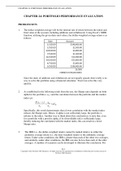
CHAPTER 24: PORTFOLIO PERFORMANCE EVALUATION
CHAPTER 24: PORTFOLIO PERFORMANCE EVALUATION
PROBLEM SETS
1. The dollar-weighted average will be the internal rate of return between the initial and
final value of the account, including additions and withdrawals. Using Excel’s XIRR
function, utilizing the given dates and values, the dollar-weighted average return is as
follows:
Date Account
1/1/2019 -$148,000.00
1/3/2019 $2,500.00
3/20/2019 $4,000.00
7/5/2019 $1,500.00
12/2/2019 $14,360.00
3/10/2020 -$23,000.00
4/7/2020 $3,000.00
5/3/2020 $198,000.00
26.99%
=XIRR(C13:C20,B13:B20)
Since the dates of additions and withdrawals are not equally spaced, there really is no
way to solve this problem using a financial calculator. Excel can solve this very
quickly.
2. As established in the following result from the text, the Sharpe ratio depends on both
alpha for the portfolio ( P ) and the correlation between the portfolio and the market
index (ρ):
E (rP − rf ) αP
= + ρS M
σP σP
Specifically, this result demonstrates that a lower correlation with the market index
reduces the Sharpe ratio. Hence, if alpha is not sufficiently large, the portfolio is
inferior to the index. Another way to think about this conclusion is to note that, even
for a portfolio with a positive alpha, if its diversifiable risk is sufficiently large,
thereby reducing the correlation with the market index, this can result in a lower
Sharpe ratio.
3. The IRR (i.e., the dollar-weighted return) cannot be ranked relative to either the
geometric average return (i.e., the time-weighted return) or the arithmetic average
return. Under some conditions, the IRR is greater than each of the other two averages,
and similarly, under other conditions, the IRR can also be less than each of the other
averages. A number of scenarios can be developed to illustrate this conclusion. For
24-1
Copyright ©2021 McGraw-Hill Education. All rights reserved. No reproduction or distribution without the prior written consent of
McGraw-Hill Education.
, CHAPTER 24: PORTFOLIO PERFORMANCE EVALUATION
example, consider a scenario where the rate of return each period consistently
increases over several time periods. If the amount invested also increases each period,
and then all of the proceeds are withdrawn at the end of several periods, the IRR is
greater than either the geometric or the arithmetic average because more money is
invested at the higher rates than at the lower rates. On the other hand, if withdrawals
gradually reduce the amount invested as the rate of return increases, then the IRR is
less than each of the other averages. (Similar scenarios are illustrated with numerical
examples in the text, where the IRR is shown to be less than the geometric average,
and in Concept Check 1, where the IRR is greater than the geometric average.)
4. It is not necessarily wise to shift resources to timing at the expense of security
selection. There is also tremendous potential value in security analysis. The decision
as to whether to shift resources has to be made on the basis of the macro, compared to
the micro, forecasting ability of the portfolio management team.
5. a. Arithmetic average: ̅rABC = 10%; ̅rXYZ = 10%
b. Dispersion: σABC = 7.07%; σXYZ = 13.91%
Stock XYZ has greater dispersion.
(Note: We used 5 degrees of freedom in calculating standard deviations.)
c. Geometric average:
rABC = (1.20 × 1.12 × 1.14 × 1.03 × 1.01)1/5 – 1 = 0.0977 = 9.77%
rXYZ = (1.30 × 1.12 × 1.18 × 1.00 × 0.90)1/5 – 1 = 0.0911 = 9.11%
Despite the fact that the two stocks have the same arithmetic average, the
geometric average for XYZ is less than the geometric average for ABC. The
reason for this result is the fact that the greater variance of XYZ drives the
geometric average further below the arithmetic average.
d. Your expected rate of return would be the arithmetic average, or 10%.
e. Even though the dispersion is greater, your expected rate of return would
still be the arithmetic average, or 10%.
f. In terms of “forward-looking” statistics, the arithmetic average is the
better estimate of expected rate of return. Therefore, if the data reflect
the probabilities of future returns, 10 percent is the expected rate of
return for both stocks.
6. a. Time-weighted average returns are based on year-by-year rates of return:
Year Return = (Capital gains + Dividend)/Price
2018 − 2019 [($120 – $100) + $4]/$100 = 24.00%
2019 – 2020 [($90 – $120) + $4]/$120 = –21.67%
24-2
Copyright ©2021 McGraw-Hill Education. All rights reserved. No reproduction or distribution without the prior written consent of
McGraw-Hill Education.
CHAPTER 24: PORTFOLIO PERFORMANCE EVALUATION
PROBLEM SETS
1. The dollar-weighted average will be the internal rate of return between the initial and
final value of the account, including additions and withdrawals. Using Excel’s XIRR
function, utilizing the given dates and values, the dollar-weighted average return is as
follows:
Date Account
1/1/2019 -$148,000.00
1/3/2019 $2,500.00
3/20/2019 $4,000.00
7/5/2019 $1,500.00
12/2/2019 $14,360.00
3/10/2020 -$23,000.00
4/7/2020 $3,000.00
5/3/2020 $198,000.00
26.99%
=XIRR(C13:C20,B13:B20)
Since the dates of additions and withdrawals are not equally spaced, there really is no
way to solve this problem using a financial calculator. Excel can solve this very
quickly.
2. As established in the following result from the text, the Sharpe ratio depends on both
alpha for the portfolio ( P ) and the correlation between the portfolio and the market
index (ρ):
E (rP − rf ) αP
= + ρS M
σP σP
Specifically, this result demonstrates that a lower correlation with the market index
reduces the Sharpe ratio. Hence, if alpha is not sufficiently large, the portfolio is
inferior to the index. Another way to think about this conclusion is to note that, even
for a portfolio with a positive alpha, if its diversifiable risk is sufficiently large,
thereby reducing the correlation with the market index, this can result in a lower
Sharpe ratio.
3. The IRR (i.e., the dollar-weighted return) cannot be ranked relative to either the
geometric average return (i.e., the time-weighted return) or the arithmetic average
return. Under some conditions, the IRR is greater than each of the other two averages,
and similarly, under other conditions, the IRR can also be less than each of the other
averages. A number of scenarios can be developed to illustrate this conclusion. For
24-1
Copyright ©2021 McGraw-Hill Education. All rights reserved. No reproduction or distribution without the prior written consent of
McGraw-Hill Education.
, CHAPTER 24: PORTFOLIO PERFORMANCE EVALUATION
example, consider a scenario where the rate of return each period consistently
increases over several time periods. If the amount invested also increases each period,
and then all of the proceeds are withdrawn at the end of several periods, the IRR is
greater than either the geometric or the arithmetic average because more money is
invested at the higher rates than at the lower rates. On the other hand, if withdrawals
gradually reduce the amount invested as the rate of return increases, then the IRR is
less than each of the other averages. (Similar scenarios are illustrated with numerical
examples in the text, where the IRR is shown to be less than the geometric average,
and in Concept Check 1, where the IRR is greater than the geometric average.)
4. It is not necessarily wise to shift resources to timing at the expense of security
selection. There is also tremendous potential value in security analysis. The decision
as to whether to shift resources has to be made on the basis of the macro, compared to
the micro, forecasting ability of the portfolio management team.
5. a. Arithmetic average: ̅rABC = 10%; ̅rXYZ = 10%
b. Dispersion: σABC = 7.07%; σXYZ = 13.91%
Stock XYZ has greater dispersion.
(Note: We used 5 degrees of freedom in calculating standard deviations.)
c. Geometric average:
rABC = (1.20 × 1.12 × 1.14 × 1.03 × 1.01)1/5 – 1 = 0.0977 = 9.77%
rXYZ = (1.30 × 1.12 × 1.18 × 1.00 × 0.90)1/5 – 1 = 0.0911 = 9.11%
Despite the fact that the two stocks have the same arithmetic average, the
geometric average for XYZ is less than the geometric average for ABC. The
reason for this result is the fact that the greater variance of XYZ drives the
geometric average further below the arithmetic average.
d. Your expected rate of return would be the arithmetic average, or 10%.
e. Even though the dispersion is greater, your expected rate of return would
still be the arithmetic average, or 10%.
f. In terms of “forward-looking” statistics, the arithmetic average is the
better estimate of expected rate of return. Therefore, if the data reflect
the probabilities of future returns, 10 percent is the expected rate of
return for both stocks.
6. a. Time-weighted average returns are based on year-by-year rates of return:
Year Return = (Capital gains + Dividend)/Price
2018 − 2019 [($120 – $100) + $4]/$100 = 24.00%
2019 – 2020 [($90 – $120) + $4]/$120 = –21.67%
24-2
Copyright ©2021 McGraw-Hill Education. All rights reserved. No reproduction or distribution without the prior written consent of
McGraw-Hill Education.