Introduction to persuasion in consumer communication for
sustainability
Lecture 1 – Introduction
Persuasion, coercion, and propaganda
- Perloff:
o Persuasion is a symbolic process in which communicators try to convince other people to
change their own attitudes or behaviours regarding an issue through the transmission of a
message in an atmosphere of free choice.
▪ It is symbolic, which means that it relies on symbols (words, signs, images)
▪ Involves a deliberative, intentional, and conscious attempt to influence
▪ Entails self-persuasion (getting people motivated to persuade themselves into change)
▪ Requires transmission of the message (through arguments and/or cues)
▪ Assumes free choice
▪ It can be transactional (not a one-way street but a two-way interaction → the
persuader addresses the needs of the persuade, and the persuade also responds to the
needs of the persuader).
o Coercion (forceful)
▪ Has a nature of psychological threat
▪ No ability to do otherwise
▪ Request runs counter to one’s preference
o Propaganda is the deliberate, systematic attempt to shape perceptions, manipulate cognitions,
and direct behaviour to achieve a response that furthers the desired intent of the propagandist.
▪ Control over the transmission of information
▪ Directed towards masses of individuals
▪ Uses covert messages that disguise the true intent (manipulation)
- Persuasion examples:
o Friend’s attempt to influence another’s opinion of the movie | loved one’s antidrug appeal |
advertising | health public service messages | political campaigns | sales and telemarketing
- Coercion examples:
o Threatening messages | employer’s directives | interrogation (ondervraging) | communication
in dangerously abusive relationships | ban on smoking | enforcement of seat belt law
- Perspectives on persuasion
o Persuasion is ubiquitous in contemporary (hedendaagse) life
o Self-persuasion is central: we convince and change ourselves in response to persuasion
o There are two very different ways people frequently process persuasion in (dual-processing)
o Adopting an ethical approach to persuasion is crucial, particularly in an era of ever-subtle
technological tricks
o Ideas and concepts shade into each other → grey zones (is it persuasion or manipulation?)
Manipulative forms of persuasion
- Deception, incentivization (offering rewards to overcome the individual’s actual belief / intrinsic
motivation), and coercion are recognizable persuasion strategies that occur across political, social and
economic events within democracies. However, existing literature only minimally engages with these
forms of persuasion, in part because it mostly focuses on largely consensual (two-way street)
persuasion.
,- Two arguments you hear, namely ‘persuasion and propaganda/manipulation are distinct’, and
‘persuasion and manipulation are synonymous’ divert PR scholars and research away from studying
manipulative forms of persuasion.
- Deception is achievable without resort to lying or so called ‘black propaganda’ (the source is concealed
or credited to a false authority and spreads lies/fabrications/deceptions).
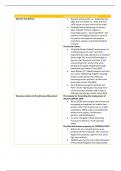
- A conceptual framework to move the persuasion field forward and also look at manipulative forms of
persuasion, has been created:
o
- Example: an anti-smoking campaign can be seen as strategic consensual persuasion. It is not deceptive
(e.g. saying “smoking is harmful” without giving arguments to support it), nor is it coercion (it invokes
fear but does not force change through threatening).
- Example: a flat-earth campaign would be deceptive if it would overrepresent the views of the few
scientists who say the earth is flat, and ignore the overwhelming scientific evidence that the earth is
round that is accepted by all other scientists.
- There are different forms of deception:
o Lying → making a statement that is known or suspected to be untrue in order to mislead
o Omission → withholding information to make the promoted viewpoint more persuasive
o Distortion → presenting a statement in a deliberately misleading way to support a viewpoint
o Misdirection → producing and disseminating true information intended to direct attention
away from problematic issues (a.k.a. pivoting)
- Note that not all acts of incentivization are non-consensual. For example, a bike-and-ride scheme
whereby people are incentivized to ride bikes, is broadly consensual as it is both positive and aligned
with the individual’s intrinsic motivation. When the extrinsic motivation conflicts with the individual’s
intrinsic motivation, the incentivization can be called manipulative.
, Lecture 2 – Rational deliberation (debat/beraad)
Ideal rational deliberation
- We learn to use communication in an instrumental (strategic) way in different roles. However, spaces
for understanding and deliberation are needed.
- Rational deliberation: Habermas
o Assumptions by Habermas: All people…
- Possess rationality | are free and equal | need to have a say in issues that affect them |
can make all decisions in a consensual and rational way
- These assumptions are influential in research on deliberative democracy
o Features of rational deliberation:
- Goal: communicative action / reaching consensus
- Procedural rules: no coercion, equality, inclusiveness
- Logical rules: no contradictions, no inconsistencies, no equivocations (using the same
word with different meanings)
o Presuppositions to agree on validity:
- Sincerity (e.g. the speaker’s intention,
seriousness, honesty)
- Truth (e.g. a fact or objective finding)
- Rightness (e.g. moral rules and
principles)
o
Types of discourses
- Types of discourses in deliberation:
o Explicative discourse: is it clear and understandable? [A]
o Practical discourse: is it relevant and justified? [B]
o Theoretical discourse: is it true? Is it effective? [C]
- Validity claims and controversies in deliberative processes lead to different types of discourses.
Habermas staircase (example sustainability labeling company):
Physical clarity Is the communication accessible? [A] “I think the criteria and procedures should
be publicly available”
Syntactic clarity Is the format understandable? [A] “Should a global sustainability label use
metric or imperial measurements?”
Semantic clarity Is the content understandable? [A] “What do you mean by indicator? It can’t
be measured so it ain’t no indicator to me”
Relevance Is the content relevant? [B] “I don’t think the diversity aspect of a
company should be a relevant criterion”
Expressive validity Do we really mean what we say? “I think it is overstated to say it actually IS
a totally sustainable product. Not buying it
is still more sustainable”
Empirical validity Is it true/fact-based what we say? [C] “Is a carbon footprint really a reliable way
to infer that a product is climate neutral?”
sustainability
Lecture 1 – Introduction
Persuasion, coercion, and propaganda
- Perloff:
o Persuasion is a symbolic process in which communicators try to convince other people to
change their own attitudes or behaviours regarding an issue through the transmission of a
message in an atmosphere of free choice.
▪ It is symbolic, which means that it relies on symbols (words, signs, images)
▪ Involves a deliberative, intentional, and conscious attempt to influence
▪ Entails self-persuasion (getting people motivated to persuade themselves into change)
▪ Requires transmission of the message (through arguments and/or cues)
▪ Assumes free choice
▪ It can be transactional (not a one-way street but a two-way interaction → the
persuader addresses the needs of the persuade, and the persuade also responds to the
needs of the persuader).
o Coercion (forceful)
▪ Has a nature of psychological threat
▪ No ability to do otherwise
▪ Request runs counter to one’s preference
o Propaganda is the deliberate, systematic attempt to shape perceptions, manipulate cognitions,
and direct behaviour to achieve a response that furthers the desired intent of the propagandist.
▪ Control over the transmission of information
▪ Directed towards masses of individuals
▪ Uses covert messages that disguise the true intent (manipulation)
- Persuasion examples:
o Friend’s attempt to influence another’s opinion of the movie | loved one’s antidrug appeal |
advertising | health public service messages | political campaigns | sales and telemarketing
- Coercion examples:
o Threatening messages | employer’s directives | interrogation (ondervraging) | communication
in dangerously abusive relationships | ban on smoking | enforcement of seat belt law
- Perspectives on persuasion
o Persuasion is ubiquitous in contemporary (hedendaagse) life
o Self-persuasion is central: we convince and change ourselves in response to persuasion
o There are two very different ways people frequently process persuasion in (dual-processing)
o Adopting an ethical approach to persuasion is crucial, particularly in an era of ever-subtle
technological tricks
o Ideas and concepts shade into each other → grey zones (is it persuasion or manipulation?)
Manipulative forms of persuasion
- Deception, incentivization (offering rewards to overcome the individual’s actual belief / intrinsic
motivation), and coercion are recognizable persuasion strategies that occur across political, social and
economic events within democracies. However, existing literature only minimally engages with these
forms of persuasion, in part because it mostly focuses on largely consensual (two-way street)
persuasion.
,- Two arguments you hear, namely ‘persuasion and propaganda/manipulation are distinct’, and
‘persuasion and manipulation are synonymous’ divert PR scholars and research away from studying
manipulative forms of persuasion.
- Deception is achievable without resort to lying or so called ‘black propaganda’ (the source is concealed
or credited to a false authority and spreads lies/fabrications/deceptions).
- A conceptual framework to move the persuasion field forward and also look at manipulative forms of
persuasion, has been created:
o
- Example: an anti-smoking campaign can be seen as strategic consensual persuasion. It is not deceptive
(e.g. saying “smoking is harmful” without giving arguments to support it), nor is it coercion (it invokes
fear but does not force change through threatening).
- Example: a flat-earth campaign would be deceptive if it would overrepresent the views of the few
scientists who say the earth is flat, and ignore the overwhelming scientific evidence that the earth is
round that is accepted by all other scientists.
- There are different forms of deception:
o Lying → making a statement that is known or suspected to be untrue in order to mislead
o Omission → withholding information to make the promoted viewpoint more persuasive
o Distortion → presenting a statement in a deliberately misleading way to support a viewpoint
o Misdirection → producing and disseminating true information intended to direct attention
away from problematic issues (a.k.a. pivoting)
- Note that not all acts of incentivization are non-consensual. For example, a bike-and-ride scheme
whereby people are incentivized to ride bikes, is broadly consensual as it is both positive and aligned
with the individual’s intrinsic motivation. When the extrinsic motivation conflicts with the individual’s
intrinsic motivation, the incentivization can be called manipulative.
, Lecture 2 – Rational deliberation (debat/beraad)
Ideal rational deliberation
- We learn to use communication in an instrumental (strategic) way in different roles. However, spaces
for understanding and deliberation are needed.
- Rational deliberation: Habermas
o Assumptions by Habermas: All people…
- Possess rationality | are free and equal | need to have a say in issues that affect them |
can make all decisions in a consensual and rational way
- These assumptions are influential in research on deliberative democracy
o Features of rational deliberation:
- Goal: communicative action / reaching consensus
- Procedural rules: no coercion, equality, inclusiveness
- Logical rules: no contradictions, no inconsistencies, no equivocations (using the same
word with different meanings)
o Presuppositions to agree on validity:
- Sincerity (e.g. the speaker’s intention,
seriousness, honesty)
- Truth (e.g. a fact or objective finding)
- Rightness (e.g. moral rules and
principles)
o
Types of discourses
- Types of discourses in deliberation:
o Explicative discourse: is it clear and understandable? [A]
o Practical discourse: is it relevant and justified? [B]
o Theoretical discourse: is it true? Is it effective? [C]
- Validity claims and controversies in deliberative processes lead to different types of discourses.
Habermas staircase (example sustainability labeling company):
Physical clarity Is the communication accessible? [A] “I think the criteria and procedures should
be publicly available”
Syntactic clarity Is the format understandable? [A] “Should a global sustainability label use
metric or imperial measurements?”
Semantic clarity Is the content understandable? [A] “What do you mean by indicator? It can’t
be measured so it ain’t no indicator to me”
Relevance Is the content relevant? [B] “I don’t think the diversity aspect of a
company should be a relevant criterion”
Expressive validity Do we really mean what we say? “I think it is overstated to say it actually IS
a totally sustainable product. Not buying it
is still more sustainable”
Empirical validity Is it true/fact-based what we say? [C] “Is a carbon footprint really a reliable way
to infer that a product is climate neutral?”