Periodicity, Group 2 and Halogens Summary
An element is classified as s, p, d or f block according to its position in
the Periodic Table, which is determined by its proton (atomic)
number:
all elements in a period have the same number of shells (not taking
into account s and p subshells)
all elements in a group have the same number of outer shell electrons.
(exception: group 0, in which helium has 2 outer shell electrons and
the rest have 8 outer shell electrons). Hence, all elements in a
particular group have similar chemical properties.
TRENDS ACROSS PERIOD 3
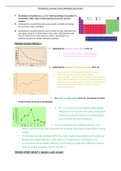
Explaining the trends in atomic radius of Na–Ar:
Across period 3, atomic radius decreases.
This is due to increased nuclear charge.
Explaining the trends in first ionisation energy of Na–Ar:
Across period 3, first ionisation energy increases.
This is also due to increased nuclear charge.
Drop from Mg – Al: Al has new 3p orbital, which has an e -
that is little further from nucleus and is shielded by the 3s 2
electrons. It is therefore easier to remove. Drop from P-S:
electron pair repulsion in sulfur means it is easier to
remove the electron.
The trends in melting points of Na–Ar, and reasons for these
trends in terms of structure and bonding:
Na – Al are metals and hence display metallic bonding.
MPs increase from Na to Al as the number of delocalised
electrons increases (ions become increasingly positive),
hence increasing the metal-metal bonds.
Si is macromolecular and a tetrahedral structure. It has
strong covalent bonds that need to be broken during melting. These require a huge amount of energy
to break.
P-S are simple molecular and display VDW forces. Sulfur is higher than phosphorus as it is larger and
therefore has stronger VDW forces. Sulfur exists as S 8, Phosphorus as P4, and Chlorine as Cl2.
Ar is monatomic and also displays VDW forces. Since it exists as a single atom, VDW forces between
atoms are weakest compared to the rest of period 3.
TRENDS DOWN GROUP 2 (alkaline earth metals)
, Periodicity, Group 2 and Halogens Summary
Explaining the trends in atomic radius of Mg–Ba:
Down group 2, atomic radius increases.
This is due to increased electron shielding as an
extra shell is added each time.
Explaining the trends in first ionisation energy of Mg–
Ba:
Down group 2, ionisation energy decreases.
This is due to increased electron shielding as an extra
shell is added each time.
It is also due to increased atomic radius.
Explaining the trends in melting point of Mg-Ba in terms of their structure and bonding:
Down group 2, melting points generally decrease.
Since they are all metals, they display metallic
bonding. Down gp 2, the metal ions get bigger but
number of delocalised (outer) electrons remains as
2.
Therefore, the ionic radius increases and makes it
easier to lose the 2 delocalised electrons.
The reactions of Mg–Ba with water:
M(s) + H20(l) M(OH)2 + H2, where ‘M’ is any of the group 2 metals.
When group 2 metals react, they become oxidised: M M2+ + 2e-
Going down the group from Mg to Ba, reactivity with water increases due to decreasing first ionisation energy.
The use of magnesium in the extraction of titanium from TiCl 4:
(The main titanium ore from which titanium is extracted is TiO 2. Firstly, TiO2 is heated with carbon in a stream
of chloride gas to form TiCl4. The TiCl4 is then purified by fractional distillation.)
Next, TiCl4 is reduced by liquid magnesium. This is done in a furnace at 1000°C.
TiCl4(g) + 2Mg (l) 2MgCl2(l) + Ti(s)
An element is classified as s, p, d or f block according to its position in
the Periodic Table, which is determined by its proton (atomic)
number:
all elements in a period have the same number of shells (not taking
into account s and p subshells)
all elements in a group have the same number of outer shell electrons.
(exception: group 0, in which helium has 2 outer shell electrons and
the rest have 8 outer shell electrons). Hence, all elements in a
particular group have similar chemical properties.
TRENDS ACROSS PERIOD 3
Explaining the trends in atomic radius of Na–Ar:
Across period 3, atomic radius decreases.
This is due to increased nuclear charge.
Explaining the trends in first ionisation energy of Na–Ar:
Across period 3, first ionisation energy increases.
This is also due to increased nuclear charge.
Drop from Mg – Al: Al has new 3p orbital, which has an e -
that is little further from nucleus and is shielded by the 3s 2
electrons. It is therefore easier to remove. Drop from P-S:
electron pair repulsion in sulfur means it is easier to
remove the electron.
The trends in melting points of Na–Ar, and reasons for these
trends in terms of structure and bonding:
Na – Al are metals and hence display metallic bonding.
MPs increase from Na to Al as the number of delocalised
electrons increases (ions become increasingly positive),
hence increasing the metal-metal bonds.
Si is macromolecular and a tetrahedral structure. It has
strong covalent bonds that need to be broken during melting. These require a huge amount of energy
to break.
P-S are simple molecular and display VDW forces. Sulfur is higher than phosphorus as it is larger and
therefore has stronger VDW forces. Sulfur exists as S 8, Phosphorus as P4, and Chlorine as Cl2.
Ar is monatomic and also displays VDW forces. Since it exists as a single atom, VDW forces between
atoms are weakest compared to the rest of period 3.
TRENDS DOWN GROUP 2 (alkaline earth metals)
, Periodicity, Group 2 and Halogens Summary
Explaining the trends in atomic radius of Mg–Ba:
Down group 2, atomic radius increases.
This is due to increased electron shielding as an
extra shell is added each time.
Explaining the trends in first ionisation energy of Mg–
Ba:
Down group 2, ionisation energy decreases.
This is due to increased electron shielding as an extra
shell is added each time.
It is also due to increased atomic radius.
Explaining the trends in melting point of Mg-Ba in terms of their structure and bonding:
Down group 2, melting points generally decrease.
Since they are all metals, they display metallic
bonding. Down gp 2, the metal ions get bigger but
number of delocalised (outer) electrons remains as
2.
Therefore, the ionic radius increases and makes it
easier to lose the 2 delocalised electrons.
The reactions of Mg–Ba with water:
M(s) + H20(l) M(OH)2 + H2, where ‘M’ is any of the group 2 metals.
When group 2 metals react, they become oxidised: M M2+ + 2e-
Going down the group from Mg to Ba, reactivity with water increases due to decreasing first ionisation energy.
The use of magnesium in the extraction of titanium from TiCl 4:
(The main titanium ore from which titanium is extracted is TiO 2. Firstly, TiO2 is heated with carbon in a stream
of chloride gas to form TiCl4. The TiCl4 is then purified by fractional distillation.)
Next, TiCl4 is reduced by liquid magnesium. This is done in a furnace at 1000°C.
TiCl4(g) + 2Mg (l) 2MgCl2(l) + Ti(s)