11.1 - The Immune System:
External defence systems:
• Many pathogens do not harm us because if we are healthy, then we have physical, chemical and cellular defences that prevent them
from entering.
◦The epithelia that cover the airways are an effective carrier to the entry of pathogens
◦Hydrochloric acid in the stomach kills many bacteria that we ingest in our food
◦Blood clotting is a defence mechanism that stops the loss of blood and prevents the entry of pathogens through wounds in the
skin.
◦The movement of air-filled pathogens by coughing or sneezing removes these bacteria from our body.
Internal defence systems:
• The immune response is the complex series of responses of the body, to the entry of a foreign antigen; it involves the activity of
lymphocytes and phagocytes.
• If pathogens enter the body, then WBCs can recognise them as something foreign and destroy them.
• They recognise the pathogens by the distinctive large molecules which cover their surfaces - any foreign molecules is an antigen.
◦Lympchytes can respond by producing antibodies or by killing cells that have become infected with pathogens.
• Antibodies - glycoprotein molecules, made by plasma cells, that bind to specific antigens in the immune response.
◦They have a variable region with differing aa chains, which provides the specificity of complementary shapes of the antigen
• Non-self - any substance or cell that is recognised by the immune system as being foreign and will stimulate an immune response
• Self - substances produced by the body, that the immune system does not recognise as foreign, so they don’t stimulate a response.
Types of cells:
Phagocytes:
• They are produced in the bone marrow, and remain there until they are distributed around the body in the
bloodstream.
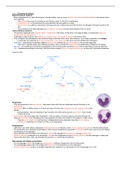
• Neutrophils (60% of WBCs) travel in the body and leave the blood by squeezing through capillary walls to the
tissues.
◦During infection, they are released in high numbers from their stores, but are short lived - have a lobed
nucleus structure.
• Macrophages are much larger than neutrophils - they are made in the bone marrow and travel through the
blood as monocytes, only developing into macrophages once they have settled in the organs or lymph nodes.
◦They are much longer-lived and are key in initiating the immune response, since they do not destroy
pathogens completely, but instead cut them up for displaying.
Phagocytosis:
• Cells which are under attack, respond by releasing histamine chemicals, which attracts passing neutrophils to the site (chemotaxis)
• The neutrophils move towards the pathogens, which may be clustered and covered in antibodies (which may cause more stimulation),
and attaches to the pathogen.
• Once attached, the neutrophil’s cell membrane engulfs the pathogen by Endocytosis, forming a phagosome.
• Digestive enzymes produced in the lysosomes, fuse with the phagosome to form a phagolysosome, and the pathogen is destroyed.
• Due to their short life’s, they may die after this and form pus at the site of infections.
Macrophage and antigen presentation:
• The macrophage engulfs the antigen by phagocytosis, creating a phagosome due to Endocytosis.
• The macrophage breaks down the antigen into fragments in the lysosome, but not destroyed.
• A class II MHC protein binds to an antigen fragment and it presents it on the exterior of the macrophage to a T cell.
External defence systems:
• Many pathogens do not harm us because if we are healthy, then we have physical, chemical and cellular defences that prevent them
from entering.
◦The epithelia that cover the airways are an effective carrier to the entry of pathogens
◦Hydrochloric acid in the stomach kills many bacteria that we ingest in our food
◦Blood clotting is a defence mechanism that stops the loss of blood and prevents the entry of pathogens through wounds in the
skin.
◦The movement of air-filled pathogens by coughing or sneezing removes these bacteria from our body.
Internal defence systems:
• The immune response is the complex series of responses of the body, to the entry of a foreign antigen; it involves the activity of
lymphocytes and phagocytes.
• If pathogens enter the body, then WBCs can recognise them as something foreign and destroy them.
• They recognise the pathogens by the distinctive large molecules which cover their surfaces - any foreign molecules is an antigen.
◦Lympchytes can respond by producing antibodies or by killing cells that have become infected with pathogens.
• Antibodies - glycoprotein molecules, made by plasma cells, that bind to specific antigens in the immune response.
◦They have a variable region with differing aa chains, which provides the specificity of complementary shapes of the antigen
• Non-self - any substance or cell that is recognised by the immune system as being foreign and will stimulate an immune response
• Self - substances produced by the body, that the immune system does not recognise as foreign, so they don’t stimulate a response.
Types of cells:
Phagocytes:
• They are produced in the bone marrow, and remain there until they are distributed around the body in the
bloodstream.
• Neutrophils (60% of WBCs) travel in the body and leave the blood by squeezing through capillary walls to the
tissues.
◦During infection, they are released in high numbers from their stores, but are short lived - have a lobed
nucleus structure.
• Macrophages are much larger than neutrophils - they are made in the bone marrow and travel through the
blood as monocytes, only developing into macrophages once they have settled in the organs or lymph nodes.
◦They are much longer-lived and are key in initiating the immune response, since they do not destroy
pathogens completely, but instead cut them up for displaying.
Phagocytosis:
• Cells which are under attack, respond by releasing histamine chemicals, which attracts passing neutrophils to the site (chemotaxis)
• The neutrophils move towards the pathogens, which may be clustered and covered in antibodies (which may cause more stimulation),
and attaches to the pathogen.
• Once attached, the neutrophil’s cell membrane engulfs the pathogen by Endocytosis, forming a phagosome.
• Digestive enzymes produced in the lysosomes, fuse with the phagosome to form a phagolysosome, and the pathogen is destroyed.
• Due to their short life’s, they may die after this and form pus at the site of infections.
Macrophage and antigen presentation:
• The macrophage engulfs the antigen by phagocytosis, creating a phagosome due to Endocytosis.
• The macrophage breaks down the antigen into fragments in the lysosome, but not destroyed.
• A class II MHC protein binds to an antigen fragment and it presents it on the exterior of the macrophage to a T cell.