7.1 Structure of Transport Tissues:
Angiosperms are the owering plants which are at the furthest point of the evolution spectrum.
Monocotyledons:
• One seeded leaves which are long and narrow and have veins running parallel to the length of the leaf.
• The owering parts are always grouped in 3’s with no leaf stalk e.g. grasses, lilies and palms.
Dicotyledons:
• Two seeded leaves with broad leaves which have branched leaf veins sprouting from the central line.
• The owering part is grouped in 4’s or 5’s e.g. beans, shrubs etc.
Cell types in plant tissues:
• Xylem (vessel and tracheid) - dead and ligni ed structure which transports water and minerals from the roots to the leaves.
• Phloem sieve element - Alive structure which transports sugars, aa and hormones round the plant, from source to sink.
• Phloem companion cells - provide metabolic support to the sieve tubes, by moving substances in and out.
• Parenchyma - storage of foods like starch and when turgid they support the plant from Wilting - they are generalised cells
and also transport water and minerals through the walls, as well as gas exchange between the cells.
• Sclerenchyma - dead and ligni ed cells which support in areas of non-active growth e.g. lignin and cellulose in cell walls.
• Collenchyma - modi ed form or parenchyma with extra cellulose in corners of the cell - provide strength and support in
areas of active growth.
• Meristem - stem cell tissue
Root:
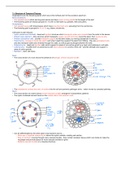
• The cross section of a root shows the presence of a single, central vascular bundle
• The endodermis controls the entry of solutes into the cell and prevents pathogen entry - water moves by symplast pathway.
Stem:
• The cross section of a stem shows several vascular bundles arranged in characteristic patterns
• The xylem is stained red and found on the central side of the cambium wall.
• Can be di erentiated to the other plant cross sections due to....
◦Fibre cap of Ligni ed sclerenchyma above the xylem vessels, creating red section.
◦Ring of cambium moving through every vascular bundle - they contain meristem tissue which can divide to make the
ring larger and provide space for more vascular bundles to grow.
◦Multiple vascular bundles in a ring-like structure.
fl
Angiosperms are the owering plants which are at the furthest point of the evolution spectrum.
Monocotyledons:
• One seeded leaves which are long and narrow and have veins running parallel to the length of the leaf.
• The owering parts are always grouped in 3’s with no leaf stalk e.g. grasses, lilies and palms.
Dicotyledons:
• Two seeded leaves with broad leaves which have branched leaf veins sprouting from the central line.
• The owering part is grouped in 4’s or 5’s e.g. beans, shrubs etc.
Cell types in plant tissues:
• Xylem (vessel and tracheid) - dead and ligni ed structure which transports water and minerals from the roots to the leaves.
• Phloem sieve element - Alive structure which transports sugars, aa and hormones round the plant, from source to sink.
• Phloem companion cells - provide metabolic support to the sieve tubes, by moving substances in and out.
• Parenchyma - storage of foods like starch and when turgid they support the plant from Wilting - they are generalised cells
and also transport water and minerals through the walls, as well as gas exchange between the cells.
• Sclerenchyma - dead and ligni ed cells which support in areas of non-active growth e.g. lignin and cellulose in cell walls.
• Collenchyma - modi ed form or parenchyma with extra cellulose in corners of the cell - provide strength and support in
areas of active growth.
• Meristem - stem cell tissue
Root:
• The cross section of a root shows the presence of a single, central vascular bundle
• The endodermis controls the entry of solutes into the cell and prevents pathogen entry - water moves by symplast pathway.
Stem:
• The cross section of a stem shows several vascular bundles arranged in characteristic patterns
• The xylem is stained red and found on the central side of the cambium wall.
• Can be di erentiated to the other plant cross sections due to....
◦Fibre cap of Ligni ed sclerenchyma above the xylem vessels, creating red section.
◦Ring of cambium moving through every vascular bundle - they contain meristem tissue which can divide to make the
ring larger and provide space for more vascular bundles to grow.
◦Multiple vascular bundles in a ring-like structure.
fl