Basic Textiles VI
Knitting Technology
Flatbed knitting machines (lesson 1)
1. LL flat bed (2 needle beds with purl needles)
2. V-bed (2 needle beds 90-104 degrees to each other, cylinder and dial)
3. X-bed (4 needle beds)
Cotton Machine (combination weft and warp knitting)
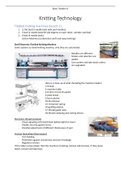
Stoll Electronic Flat Bed Knitting Machine
Same systems as hand knitting machine, only they are automated.
Needles are different.
Sinkers and selectors are
added.
Cam system and take down rollers
are upgraded.
Here is a close-up of what threading the machine implies.
1-thread
2-machine table
3,9,10,11,12,14,15-eyelet
4-plate break
5-knot catcher
10-fournisseur
13- tensioner spring
16-guiding eyelets
17-thread guide nose
18-thread clamping and cutting device
Electronic thread tensioner
- Visual signaling at thread break (yellow light for issue)
- Double security against knots
- Possible adjustment of different thicknesses of yarn
Friction feed wheel (fournisseur)
- Yarn feeding
- Protection against unevenness and yarn breakage
- Regulates tension
If the rollers move slower than the machine is knitting, tension will increase. If they move
faster, tension will decrease.
, Basic Textiles VI
Side springs (tension)
When carrier changes direction, springs handle changes in tension of yarn and pull it
back.
Thread guide types
4 rails placed on the side of needlebeds. Each rail carries 2 thread guides (1
on each side).
To produce a 2 color sample, more than 5 yarn guides are necessary.
Plating thread guides
Intarsia thread guides (up to 40)
Special needles
1. LL needles (slider releases needle, from one needlebed to the other
2. CMS needles (pelerine spring-transfer needle with spring-loaded latch and conical
hook. For tight knitting, high running safety. Low needle consumption. Resistant t o
war, less risk of loosing stitches at transfer).
Centrifugal forces
Have impact on needles (bending) → made new needle that has latch already bent, after
forces, latch in right position. Other defects: stress on hooks, deformed transfer lamella.
Latch: flat bed knitting
Spring: Rachel
Compound: warp knitting
Sinkers
placed at edge of needlebeds next to the teeth.
Shoulder pushes knitted fabric away to avoid
getting stuck. Rotate around an axis so each row
they push fabric down.
Carriage & cams
Electrical carrier (3 cams in stead of 1)
Needlebed is wider (for placement cam system for
individual selection of needles)
Platine (7) makes sure needle is pushed in right
position.
Fabric take-down
1. Main take-down
2. Upper take-down
, Basic Textiles VI
3. Take-down comb
Roller segments
Comb come up, open teeth, catches elastic yarn, teeth go back (upper take-down system →
pulls on fabric until rollers (main take-down system) take over
Patterning possibilities (Stoll & ADF) (Lesson 2)
ADF = Automatic Direct Feeding
Upgraded Stoll machine.
- Gauge: CMS has 7”-18” gauge, ADF produces fine gauge fabrics,
14” with hook of 10”-18”.
- Shape of upper part (ADF) is bent instead of straight.
- Number of feeders is almost double (ADF 16 on each side, instead
12).
- Feeder handles elastic yarns (ADF).
- Threads go straight down rails instead of on the side. More rails (manual: 2 rails, 2
thread guides, Stoll: 4 rails, 8 carriers each side, ADF: 8 rails, 16 thread guides each
side).
- Rails are not covered (ADF).
- User interface is different (ADF).
- Carriers don’t have contact with carriers (ADF).
Automatic thread guides
More thread guides on ADF. They are moved with 2 belts (one helps yarn carrier to the left
and right, other helps up and down). Belts are electronically controlled by motors.
Stoll in Saxion → only left-right. ADF left-right and up-down.
Presser foot and belt take down
Manual machine: reed, pin and weight.
Stoll CMS: reed, friction take-down system.
Stoll ADF: belt rollers under needlebed → set-up knit will be a bit longer.
Knitting methods
Piece goods
Advantages: quick knitting, no borderpieces, panels are cut and locked. A lot of waste for
garment (fabric comes out continuously).
Disadvantages: much waste during cutting and sewing (fabric comes out continuously).
Difficult to handle
Measured goods
With borderpiece, less waste. Panels are knitted with border piece, as close as possible to
needed size. Requires finishing after knitting.
Fully fashioned
In specific shape and measurement. There will be waste fabric.
, Basic Textiles VI
Seamless
Mostly associated with circular knitting (tubular fabric created, no side seam). Sleeves need
to be added later on, not making it seamless.
3D knitting (shell knitting)
Shaping on side of panel and on inside. Requires finishing. Product is 3D but not closed on
the edges. Only computer controlled machines knit shirts and underwear.
Ready to wear/ wholegarment
Whole product is knitted in one go, basically 3D. only threads and knots need to be
removed. For gloves, sweaters, socks and underwear.
Cut & sew method (simples and cheapest way of constructing knitwear produced
commercially).
For lowest price: quick manufacturing processes, yarns are easily washable (acrylic blends,
cotton and polyester mixes, acrylic wool and polyester combinations). Knitted on a V bed or
flatbed. Also circular knitting machine. Automatic cutters and then overlocking.
Knits 3 components at once. After the underarm point, only 1 thread guide for shoulder
area and neckline.
Basic stitches in knitting
Knitting Technology
Flatbed knitting machines (lesson 1)
1. LL flat bed (2 needle beds with purl needles)
2. V-bed (2 needle beds 90-104 degrees to each other, cylinder and dial)
3. X-bed (4 needle beds)
Cotton Machine (combination weft and warp knitting)
Stoll Electronic Flat Bed Knitting Machine
Same systems as hand knitting machine, only they are automated.
Needles are different.
Sinkers and selectors are
added.
Cam system and take down rollers
are upgraded.
Here is a close-up of what threading the machine implies.
1-thread
2-machine table
3,9,10,11,12,14,15-eyelet
4-plate break
5-knot catcher
10-fournisseur
13- tensioner spring
16-guiding eyelets
17-thread guide nose
18-thread clamping and cutting device
Electronic thread tensioner
- Visual signaling at thread break (yellow light for issue)
- Double security against knots
- Possible adjustment of different thicknesses of yarn
Friction feed wheel (fournisseur)
- Yarn feeding
- Protection against unevenness and yarn breakage
- Regulates tension
If the rollers move slower than the machine is knitting, tension will increase. If they move
faster, tension will decrease.
, Basic Textiles VI
Side springs (tension)
When carrier changes direction, springs handle changes in tension of yarn and pull it
back.
Thread guide types
4 rails placed on the side of needlebeds. Each rail carries 2 thread guides (1
on each side).
To produce a 2 color sample, more than 5 yarn guides are necessary.
Plating thread guides
Intarsia thread guides (up to 40)
Special needles
1. LL needles (slider releases needle, from one needlebed to the other
2. CMS needles (pelerine spring-transfer needle with spring-loaded latch and conical
hook. For tight knitting, high running safety. Low needle consumption. Resistant t o
war, less risk of loosing stitches at transfer).
Centrifugal forces
Have impact on needles (bending) → made new needle that has latch already bent, after
forces, latch in right position. Other defects: stress on hooks, deformed transfer lamella.
Latch: flat bed knitting
Spring: Rachel
Compound: warp knitting
Sinkers
placed at edge of needlebeds next to the teeth.
Shoulder pushes knitted fabric away to avoid
getting stuck. Rotate around an axis so each row
they push fabric down.
Carriage & cams
Electrical carrier (3 cams in stead of 1)
Needlebed is wider (for placement cam system for
individual selection of needles)
Platine (7) makes sure needle is pushed in right
position.
Fabric take-down
1. Main take-down
2. Upper take-down
, Basic Textiles VI
3. Take-down comb
Roller segments
Comb come up, open teeth, catches elastic yarn, teeth go back (upper take-down system →
pulls on fabric until rollers (main take-down system) take over
Patterning possibilities (Stoll & ADF) (Lesson 2)
ADF = Automatic Direct Feeding
Upgraded Stoll machine.
- Gauge: CMS has 7”-18” gauge, ADF produces fine gauge fabrics,
14” with hook of 10”-18”.
- Shape of upper part (ADF) is bent instead of straight.
- Number of feeders is almost double (ADF 16 on each side, instead
12).
- Feeder handles elastic yarns (ADF).
- Threads go straight down rails instead of on the side. More rails (manual: 2 rails, 2
thread guides, Stoll: 4 rails, 8 carriers each side, ADF: 8 rails, 16 thread guides each
side).
- Rails are not covered (ADF).
- User interface is different (ADF).
- Carriers don’t have contact with carriers (ADF).
Automatic thread guides
More thread guides on ADF. They are moved with 2 belts (one helps yarn carrier to the left
and right, other helps up and down). Belts are electronically controlled by motors.
Stoll in Saxion → only left-right. ADF left-right and up-down.
Presser foot and belt take down
Manual machine: reed, pin and weight.
Stoll CMS: reed, friction take-down system.
Stoll ADF: belt rollers under needlebed → set-up knit will be a bit longer.
Knitting methods
Piece goods
Advantages: quick knitting, no borderpieces, panels are cut and locked. A lot of waste for
garment (fabric comes out continuously).
Disadvantages: much waste during cutting and sewing (fabric comes out continuously).
Difficult to handle
Measured goods
With borderpiece, less waste. Panels are knitted with border piece, as close as possible to
needed size. Requires finishing after knitting.
Fully fashioned
In specific shape and measurement. There will be waste fabric.
, Basic Textiles VI
Seamless
Mostly associated with circular knitting (tubular fabric created, no side seam). Sleeves need
to be added later on, not making it seamless.
3D knitting (shell knitting)
Shaping on side of panel and on inside. Requires finishing. Product is 3D but not closed on
the edges. Only computer controlled machines knit shirts and underwear.
Ready to wear/ wholegarment
Whole product is knitted in one go, basically 3D. only threads and knots need to be
removed. For gloves, sweaters, socks and underwear.
Cut & sew method (simples and cheapest way of constructing knitwear produced
commercially).
For lowest price: quick manufacturing processes, yarns are easily washable (acrylic blends,
cotton and polyester mixes, acrylic wool and polyester combinations). Knitted on a V bed or
flatbed. Also circular knitting machine. Automatic cutters and then overlocking.
Knits 3 components at once. After the underarm point, only 1 thread guide for shoulder
area and neckline.
Basic stitches in knitting