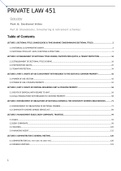
PRIVATE LAW 451
Overview :
Part A: Sectional titles
Part B: Shareblocks, timesharing & retirement schemes
Table of Contents
LECTURE 1: SECTIONAL TITLES, SHARE BLOCKS & TIME-SHARING CONDOMINIUMS (SECTIONAL TITLES)...................................2
1.1 HISTORICAL & COMPARATIVE SURVEY....................................................................................................................................2
1.2 SECTIONAL TITLES ACT: AIMS, FUNCTIONS & STRUCTURE......................................................................................................5
LECTURE 2: ESTABLISHMENT OF SECTIONAL TITLES SCHEME, PARTICIPATION QUOTA, & TENANT PROTECTION......................16
2.1 ESTABLISHMENT OF SECTIONAL TITLES SCHEME...................................................................................................................16
2.2 PARTICIPATION QUOTA.........................................................................................................................................................25
2.3 TENANT PROTECTION............................................................................................................................................................34
LECTURE 3, PART 1: RIGHTS OF USE & ENJOYMENT WITH REGARDS TO THE SECTION & COMMON PROPERTY........................42
3.1 POWER OF USE: SECTION...................................................................................................................................................... 42
3.2 POWER OF USE: COMMON PROPERTY..................................................................................................................................52
LECTURE 3, PART 2: RIGHTS OF DISPOSAL REGARDING UNIT & COMMON PROPERTY.............................................................56
3.1 RIGHTS OF DISPOSAL WITH REGARD TO UNIT.......................................................................................................................56
3.2 LEGAL TRANSACTIONS WITH REGARDS TO COMMON PROPERTY.........................................................................................58
LECTURE 4: ENFORCEMENT OF OBLIGATIONS OF SECTIONAL OWNERS & THE COMMUNITY SCHEMES OBUD SERVICES...........71
4.1 ENFORCEMENT OF OBLIGATIONS OF SECTIONAL OWNERS...................................................................................................71
4.2 COMMUNITY SCHEMES OMBUD SERVICE ACT......................................................................................................................84
LECTURE 5: MANAGEMENT (RULES, BODY CORPORATE, TRUSTEES)........................................................................................ 94
5.1 RULES..................................................................................................................................................................................... 94
5.2 BODY CORPORATE................................................................................................................................................................. 96
5.3 TRUSTEES.............................................................................................................................................................................109
5.4 MANAGING AGENT..............................................................................................................................................................115
LECTURE 6: ADMINISTRATOR & GENERAL MEETING............................................................................................................. 120
6.1 ADMINISTRATOR (WILL MOST LIKELY BE ASKED THIS)..................................................................................................................120
6.2 GENERAL MEETINGS............................................................................................................................................................123
1
,LECTURE 1: SECTIONAL TITLES, SHARE BLOCKS & TIME-
SHARING CONDOMINIUMS (Sectional Titles)
1.1 HISTORICAL & COMPARATIVE SURVEY
*Everything under 1.1 is merely informative & is not required to be studied for the test.
I. Ancient institutions of condominium (sectional titles)
o 500 BC Elephantine
Elephantine was the capital of an administrative district in Upper Egypt, on
an island, occupied till the Arab period, as a military post on the frontier
with Nubia.
C Van Der Merwe European Condominium Law
o Superficies solo cedit
Famous principle dating back to Roman law. It means everything that
has been erected or planted on a piece of land becomes, as an integral
part of the land, the property of the owner of the land.
o Acute housing shortage
One of the causes of the creation of sectional titles. The acute housing
shortage forced citizens to erect multistoried buildings.
o Middle Ages (12th century)
‘Stockwerkseigentum’
Stockwerkseigentum refers to the German condominium ownership
law.
Civil Codes of the Netherlands (1838), Germany (1899), Switzerland
(1908), France (1838) art 664, Italy, Spain
II. Modern statutes on condominium
o The world needed condominium statutes in order to legitimise condominiums, to
breach the principle of superficies solo cedit & to regulate the complex institution
of condominium in more detail.
o European states – World Wars – Belgium (1924), Greece (1929), Italy (1935),
France (1938), Spain (1939), Austria (1948), Netherlands (1951), Germany
(1951), Portugal (1955), Switzerland (1963), Turkey (1965), Denmark (1965)
Norway (1983), Croatia (1996), Estonia (2000), Slovenia (2002), Catalonia Act
(2007) + second and third generation statutes.
o British Commonwealth – Australia: New South Wales Conveyancing (Strata
Titles) Act (1961), [Strata Schemes Development Act 51 of 2015 and the Strata
Schemes Management Act 2015 plus Strata Schemes Management Regulation
2
, 501 of 2016)] Canada (1966), Singapore (1967),[Land Titles (Strata) Act
1988,1999; Building Maintenance and Strata Management Act 2004] South Africa
(1971, 1986, 2011), Hong Kong (1972,1997) (Building Management Ordinance),
New Zealand (1972, 2010), Unit Titles Act; Malaysia Strata Titles Act (1985),
England (Commonhold & Leasehold Reform Act (2002), Scotland (Tenement
(Scotland) Act 2004, Ireland Multi-Unit Developments Act 2011.
o United States – Puerto Rico (1958); Federal Housing Act (1961) (model); first
generation statutes (1969 all 50 states); shortcomings (terminology, diversity,
skeletal); Uniform Condominium Act (1977); Minor amendments (1980:
Conformity with Uniform Planned Unit Dev. Act)) Uniform Common Interest
Ownership Act (1982, 1994, 2008, 2014)
o Latin America – Brazil (1928), Chile (1937), Argentina (1948), Cuba (1952),
Mexico (1954), Venezuela (1958), Bahamas (1965), Nicaragua (1971), El
Salvador (1972), Haiti (1975)
o Socialist Europe: Hungary (1924), Poland (1934),(1994), Yugoslavia (1959),
Soviet Union (1961), Czech Republic, Slovakia (1966), Slovenia (1991), Croatia
(1996)
o Africa: Kenia (1987) Zambia (1994), Botswana (2003), Tanzania (2008), Namibia
(2009)
o Other countries - Israel (1952, 1961, 1969), Lebanon (1962), Japan (1962),
Zaire (1977), Thailand (1979), Korea (1984), United Arab Emirates (Strata Title
Act 2007), Dubai (2007), China (New Property Code 2007)
III. Basic structure of condominium
o Three-fold legal relationship (unity)
(1) Owner of unit
(2) Joint owner (co-owner undivided shares) common property
(3) Member of management corporation
IV. Reasons for introducing condominium
1. To alleviate the housing shortage
Housing shortage created by:
A rapid increase in population,
Growing urbanisation
Building costs were escalating
There was a scarcity of land in the vicinity of major city centers.
2. Better utilization of land resources
Condominiums offered:
Optimum use of available land
3
, o As instead of having stand-alone houses, buildings would go
up in the air (cf Mandela houses)
As well as a spreading out of the high costs of construction, due to
there being common walls, pipes, cables, sewerage.
However, construction costs are still higher the higher up you go up
3. Fulfil psychological need for a home
Social status of homeownership spread to a larger segment of the
population.
It binds people to a fixed abode which contributes to economic,
psychological, social, and political stability
Which was much need post-war, especially in Europe where one could see
the resettling of refugees and homeless families (Weitnauer Barmann
WEG)
4. Hedge against inflation
It didn’t result in money going down the drain as owners could lease &
could sell at a profit
5. Closer social life, additional amenities, security
Wet place: basement, Singapore; swimming pool, squash court, sauna,
Switzerland crèche; lock door and go on vacation
6. Replanning, redevelopment of city centers
New highway, underground system; Olympic stadium: Beijing
7. Public housing, housing for employees
Mercedes Benz, Toyota, Hyundai
8. Alternatives unsatisfactory
Rental bocks, share blocks and property estates managed by homeowners
associations (De Salze) unsatisfactory
V. Uses of condominium (different kinds of sectional title schemes)
1. Residential condominiums
High-rise, low-rise; maisonettes, duplex apartments; semi-detached
housing; conversion of old rental apartments and houses into
condominiums; duo’s and trio’s
2. Commercial condominiums
Shops, warehouses, motels, parking garages (Chicago); Sao Paulo, Rio De
Janeiro 80% apartments commercial; Singapore: Lucky Plaza Orchard
Street
Dockominiums
Boutiques
3. Industrial condominiums
4
, Each floor different industry: chemical substances; engineering tools;
medical instruments
4. Professional (office) condominiums
Doctors, lawyers, architects, engineers, printers, graphic designers,
interior decorator
5. Mixed-use condominiums
Multiple use: residential, professional, industrial, commercial; one building
not undertaker and medical clinic; clients: sitting ducks; combine carefree
lifestyle with convenience of in-house shops, offices and restaurants
(Indian go-downs tuck shops)
6. Resort condominiums: rental pools, time-sharing
Coast, mountains, national parks; time-sharing based on condo concept;
from horizontal ownership to cubic ownership to interval ownership;
recreational facilities, golf, swimming ‘rental pools’; capital investment as
opposed to buying time-share units
Condominium statutes geared to residential schemes: boundaries;
allocation of quotas; termination of schemes; improvements &
modernization; reorganisation of units; conduct rules (but see s 1-207:
non-residential schemes may opt out of UCIOA)
1.2 SECTIONAL TITLES ACT: AIMS, FUNCTIONS & STRUCTURE
1.2.1 Short title
o Sectional Titles Act
Date of commencement 1 June 1988
o Sec 61 Short title and commencement
“This Act shall be called the Sectional Titles Act, 1986, and shall come into
operation on a date to be fixed by the State President by proclamation in
the Gazette.”
1.2.2 Long title
The purpose of this Act is to provide for:
a. The division of buildings into sections and common property and for the
acquisition of separate ownership in sections coupled with joint ownership in
common property,
b. The control of certain incidents attaching to separate ownership in sections and
joint ownership in common property,
c. The transfer of ownership of sections and the registration of sectional mortgage
bonds over, and real rights in, sections,
5
, d. The conferring and registration of rights in, and the disposal of, common
property, and the establishment of a sectional titles regulation board, and
e. to provide for incidental matters.
1.2.3 Section 2
Sec 2 provides for ownership & real rights in or over parts of buildings, and
registration of title to ownership or other real rights in or over such parts
o Notwithstanding any statute or the common law (for eg. superficies solo cedit
which provides that whatever is built on the land, belongs to the owner of the
land)
(a) Buildings and land can be divided into: Sections and common property
This gets rid of the superficies solo cedit rule
(b) Individual ownership or undivided share (co-ownership) in section may be
acquired
Can have separate ownership
Can get a lease or have mortgage on the apartment – bank will then
provide you with money
Can get an usufruct over the unit
From 1971 in SA you could divide and sell a building in terms of the
STA
(c) Undivided share in common property
Owners of the sections will own the common property in undivided
shares
(d) Real rights
Any real rights may be acquired in or over such section/ undivided
share therein or common property
(e) Registrar: title deeds: ownership, lease, other real rights
A registrar may register in a deeds registry, a title deed whereby
ownership in, or any lease of, or any other real right in or over, any
such section or an undivided share therein or common property is
acquired.
1.2.4 Basic concepts
Unit [LAWSA 306]
o S 1:
A unit consists of a section together with its undivided share in the
common property apportioned in accordance with the participation quota
of the scheme.
Component parts of a unit is indivisible
6
Overview :
Part A: Sectional titles
Part B: Shareblocks, timesharing & retirement schemes
Table of Contents
LECTURE 1: SECTIONAL TITLES, SHARE BLOCKS & TIME-SHARING CONDOMINIUMS (SECTIONAL TITLES)...................................2
1.1 HISTORICAL & COMPARATIVE SURVEY....................................................................................................................................2
1.2 SECTIONAL TITLES ACT: AIMS, FUNCTIONS & STRUCTURE......................................................................................................5
LECTURE 2: ESTABLISHMENT OF SECTIONAL TITLES SCHEME, PARTICIPATION QUOTA, & TENANT PROTECTION......................16
2.1 ESTABLISHMENT OF SECTIONAL TITLES SCHEME...................................................................................................................16
2.2 PARTICIPATION QUOTA.........................................................................................................................................................25
2.3 TENANT PROTECTION............................................................................................................................................................34
LECTURE 3, PART 1: RIGHTS OF USE & ENJOYMENT WITH REGARDS TO THE SECTION & COMMON PROPERTY........................42
3.1 POWER OF USE: SECTION...................................................................................................................................................... 42
3.2 POWER OF USE: COMMON PROPERTY..................................................................................................................................52
LECTURE 3, PART 2: RIGHTS OF DISPOSAL REGARDING UNIT & COMMON PROPERTY.............................................................56
3.1 RIGHTS OF DISPOSAL WITH REGARD TO UNIT.......................................................................................................................56
3.2 LEGAL TRANSACTIONS WITH REGARDS TO COMMON PROPERTY.........................................................................................58
LECTURE 4: ENFORCEMENT OF OBLIGATIONS OF SECTIONAL OWNERS & THE COMMUNITY SCHEMES OBUD SERVICES...........71
4.1 ENFORCEMENT OF OBLIGATIONS OF SECTIONAL OWNERS...................................................................................................71
4.2 COMMUNITY SCHEMES OMBUD SERVICE ACT......................................................................................................................84
LECTURE 5: MANAGEMENT (RULES, BODY CORPORATE, TRUSTEES)........................................................................................ 94
5.1 RULES..................................................................................................................................................................................... 94
5.2 BODY CORPORATE................................................................................................................................................................. 96
5.3 TRUSTEES.............................................................................................................................................................................109
5.4 MANAGING AGENT..............................................................................................................................................................115
LECTURE 6: ADMINISTRATOR & GENERAL MEETING............................................................................................................. 120
6.1 ADMINISTRATOR (WILL MOST LIKELY BE ASKED THIS)..................................................................................................................120
6.2 GENERAL MEETINGS............................................................................................................................................................123
1
,LECTURE 1: SECTIONAL TITLES, SHARE BLOCKS & TIME-
SHARING CONDOMINIUMS (Sectional Titles)
1.1 HISTORICAL & COMPARATIVE SURVEY
*Everything under 1.1 is merely informative & is not required to be studied for the test.
I. Ancient institutions of condominium (sectional titles)
o 500 BC Elephantine
Elephantine was the capital of an administrative district in Upper Egypt, on
an island, occupied till the Arab period, as a military post on the frontier
with Nubia.
C Van Der Merwe European Condominium Law
o Superficies solo cedit
Famous principle dating back to Roman law. It means everything that
has been erected or planted on a piece of land becomes, as an integral
part of the land, the property of the owner of the land.
o Acute housing shortage
One of the causes of the creation of sectional titles. The acute housing
shortage forced citizens to erect multistoried buildings.
o Middle Ages (12th century)
‘Stockwerkseigentum’
Stockwerkseigentum refers to the German condominium ownership
law.
Civil Codes of the Netherlands (1838), Germany (1899), Switzerland
(1908), France (1838) art 664, Italy, Spain
II. Modern statutes on condominium
o The world needed condominium statutes in order to legitimise condominiums, to
breach the principle of superficies solo cedit & to regulate the complex institution
of condominium in more detail.
o European states – World Wars – Belgium (1924), Greece (1929), Italy (1935),
France (1938), Spain (1939), Austria (1948), Netherlands (1951), Germany
(1951), Portugal (1955), Switzerland (1963), Turkey (1965), Denmark (1965)
Norway (1983), Croatia (1996), Estonia (2000), Slovenia (2002), Catalonia Act
(2007) + second and third generation statutes.
o British Commonwealth – Australia: New South Wales Conveyancing (Strata
Titles) Act (1961), [Strata Schemes Development Act 51 of 2015 and the Strata
Schemes Management Act 2015 plus Strata Schemes Management Regulation
2
, 501 of 2016)] Canada (1966), Singapore (1967),[Land Titles (Strata) Act
1988,1999; Building Maintenance and Strata Management Act 2004] South Africa
(1971, 1986, 2011), Hong Kong (1972,1997) (Building Management Ordinance),
New Zealand (1972, 2010), Unit Titles Act; Malaysia Strata Titles Act (1985),
England (Commonhold & Leasehold Reform Act (2002), Scotland (Tenement
(Scotland) Act 2004, Ireland Multi-Unit Developments Act 2011.
o United States – Puerto Rico (1958); Federal Housing Act (1961) (model); first
generation statutes (1969 all 50 states); shortcomings (terminology, diversity,
skeletal); Uniform Condominium Act (1977); Minor amendments (1980:
Conformity with Uniform Planned Unit Dev. Act)) Uniform Common Interest
Ownership Act (1982, 1994, 2008, 2014)
o Latin America – Brazil (1928), Chile (1937), Argentina (1948), Cuba (1952),
Mexico (1954), Venezuela (1958), Bahamas (1965), Nicaragua (1971), El
Salvador (1972), Haiti (1975)
o Socialist Europe: Hungary (1924), Poland (1934),(1994), Yugoslavia (1959),
Soviet Union (1961), Czech Republic, Slovakia (1966), Slovenia (1991), Croatia
(1996)
o Africa: Kenia (1987) Zambia (1994), Botswana (2003), Tanzania (2008), Namibia
(2009)
o Other countries - Israel (1952, 1961, 1969), Lebanon (1962), Japan (1962),
Zaire (1977), Thailand (1979), Korea (1984), United Arab Emirates (Strata Title
Act 2007), Dubai (2007), China (New Property Code 2007)
III. Basic structure of condominium
o Three-fold legal relationship (unity)
(1) Owner of unit
(2) Joint owner (co-owner undivided shares) common property
(3) Member of management corporation
IV. Reasons for introducing condominium
1. To alleviate the housing shortage
Housing shortage created by:
A rapid increase in population,
Growing urbanisation
Building costs were escalating
There was a scarcity of land in the vicinity of major city centers.
2. Better utilization of land resources
Condominiums offered:
Optimum use of available land
3
, o As instead of having stand-alone houses, buildings would go
up in the air (cf Mandela houses)
As well as a spreading out of the high costs of construction, due to
there being common walls, pipes, cables, sewerage.
However, construction costs are still higher the higher up you go up
3. Fulfil psychological need for a home
Social status of homeownership spread to a larger segment of the
population.
It binds people to a fixed abode which contributes to economic,
psychological, social, and political stability
Which was much need post-war, especially in Europe where one could see
the resettling of refugees and homeless families (Weitnauer Barmann
WEG)
4. Hedge against inflation
It didn’t result in money going down the drain as owners could lease &
could sell at a profit
5. Closer social life, additional amenities, security
Wet place: basement, Singapore; swimming pool, squash court, sauna,
Switzerland crèche; lock door and go on vacation
6. Replanning, redevelopment of city centers
New highway, underground system; Olympic stadium: Beijing
7. Public housing, housing for employees
Mercedes Benz, Toyota, Hyundai
8. Alternatives unsatisfactory
Rental bocks, share blocks and property estates managed by homeowners
associations (De Salze) unsatisfactory
V. Uses of condominium (different kinds of sectional title schemes)
1. Residential condominiums
High-rise, low-rise; maisonettes, duplex apartments; semi-detached
housing; conversion of old rental apartments and houses into
condominiums; duo’s and trio’s
2. Commercial condominiums
Shops, warehouses, motels, parking garages (Chicago); Sao Paulo, Rio De
Janeiro 80% apartments commercial; Singapore: Lucky Plaza Orchard
Street
Dockominiums
Boutiques
3. Industrial condominiums
4
, Each floor different industry: chemical substances; engineering tools;
medical instruments
4. Professional (office) condominiums
Doctors, lawyers, architects, engineers, printers, graphic designers,
interior decorator
5. Mixed-use condominiums
Multiple use: residential, professional, industrial, commercial; one building
not undertaker and medical clinic; clients: sitting ducks; combine carefree
lifestyle with convenience of in-house shops, offices and restaurants
(Indian go-downs tuck shops)
6. Resort condominiums: rental pools, time-sharing
Coast, mountains, national parks; time-sharing based on condo concept;
from horizontal ownership to cubic ownership to interval ownership;
recreational facilities, golf, swimming ‘rental pools’; capital investment as
opposed to buying time-share units
Condominium statutes geared to residential schemes: boundaries;
allocation of quotas; termination of schemes; improvements &
modernization; reorganisation of units; conduct rules (but see s 1-207:
non-residential schemes may opt out of UCIOA)
1.2 SECTIONAL TITLES ACT: AIMS, FUNCTIONS & STRUCTURE
1.2.1 Short title
o Sectional Titles Act
Date of commencement 1 June 1988
o Sec 61 Short title and commencement
“This Act shall be called the Sectional Titles Act, 1986, and shall come into
operation on a date to be fixed by the State President by proclamation in
the Gazette.”
1.2.2 Long title
The purpose of this Act is to provide for:
a. The division of buildings into sections and common property and for the
acquisition of separate ownership in sections coupled with joint ownership in
common property,
b. The control of certain incidents attaching to separate ownership in sections and
joint ownership in common property,
c. The transfer of ownership of sections and the registration of sectional mortgage
bonds over, and real rights in, sections,
5
, d. The conferring and registration of rights in, and the disposal of, common
property, and the establishment of a sectional titles regulation board, and
e. to provide for incidental matters.
1.2.3 Section 2
Sec 2 provides for ownership & real rights in or over parts of buildings, and
registration of title to ownership or other real rights in or over such parts
o Notwithstanding any statute or the common law (for eg. superficies solo cedit
which provides that whatever is built on the land, belongs to the owner of the
land)
(a) Buildings and land can be divided into: Sections and common property
This gets rid of the superficies solo cedit rule
(b) Individual ownership or undivided share (co-ownership) in section may be
acquired
Can have separate ownership
Can get a lease or have mortgage on the apartment – bank will then
provide you with money
Can get an usufruct over the unit
From 1971 in SA you could divide and sell a building in terms of the
STA
(c) Undivided share in common property
Owners of the sections will own the common property in undivided
shares
(d) Real rights
Any real rights may be acquired in or over such section/ undivided
share therein or common property
(e) Registrar: title deeds: ownership, lease, other real rights
A registrar may register in a deeds registry, a title deed whereby
ownership in, or any lease of, or any other real right in or over, any
such section or an undivided share therein or common property is
acquired.
1.2.4 Basic concepts
Unit [LAWSA 306]
o S 1:
A unit consists of a section together with its undivided share in the
common property apportioned in accordance with the participation quota
of the scheme.
Component parts of a unit is indivisible
6