Overview English Literary History
Professor R. Ingelbien – 2022-2023 – by Eileen Gysels
(linker kolom gebruiken als inhoudstafel)
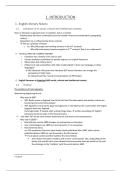
Session one - introduction
Who? What? When? What? What? Why?
Augustinus from 597 Comes to Britannia to Christen people and founded the church of England
Canterburry ‘Beginning’ Manuscripts must be written down: oral history written history
1800 Change in view of what literature is
Start Romantic area ‘End’ Jane Austen: transitional figure wrote during Romantic area but it very critical of it
Bias towards ‘innovators’
in Literary History:
stressing both change&
continuinity
History is a series of events who ‘build’ on one another writers get inspired by previous writers
Continuity
It can’t always be the same compare texts to see differences and similarities
Change
Writers who keep on writing the same things are not interesting enough to study: ex: Sonnets are
Innovators usually about unavailable girls – Shakespeare writes about boys and changes the form narrative
development
‘Literature’ There is no consensus to what Literature is. Definitions vary trough history:
Shakespeare: called it poesy (poems, …) and described ‘having read a lot about warfare’, literature
Roland Barthes: “Literature is what gets taught” Whose authority decides what gets taught = is
literature? – Who decides what the canon contains?
History of writing vs reading What doesn’t get read, doesn’t become famous and disappears
But: often writers’ work becomes popular after they’ve already passed away:
- ex: many books had references from Beowulf, which tells us that Beowulf was very popular in oral
tradition – but Beowulf was not popular anymore, because it was written in old English and
incomprehensible to people from 1000-1800 (1800: philology = studying languages and knowing
enough about them to understand Beowulf). This is when Beowulf became Literature again.
- ex: Jane Austen was popular, but certainly not the most read author – the most read author of her
time, is nowadays not taught in class anymore
‘English’ =“Hedendaagse Books that come from England or English-speaking books? it’s impossible to study everything that’s
Contemporary literature literatuur” – nu written in English, since English is used in a whole variety of countries.
‘English’ 600-1800 Is American and Irish Literature also a part of ‘English Literature’?
, English Literature 600-1800 Everyone who wrote 600-1800 called themselves an English writer
There were also other languages in the British Isles, like Keltic are Keltic books part of English
Literature?
Nation state and the rise of 19th century Age of the historical imagination: people want to rediscover their own history
Literary history (1800) English literature started being taught in universities; starting to teach modern languages (not just
Latin, …)
- ex: Erasmus studied Literature in Latin, Greek and Hebrew – he had read in other languages, but
hadn’t started studying these till the 19th century
Equation nation: Poeple = culture = language
‘People = culture = Everyone should belong to a particular nation (based on politics):
language’ People: that nation should correspond to particular people
Culture: these people share a culture
Language: what typifies a culture is language
It is the people who should determine the nation, not a king or queen or emperor
Due to nationalistion, states become smaller and smaller – the groups of people who stay together
have the same culture and language
Hippolyte Taine: 1821-✟1893 Hippolyte Taine: French philosopher & literary historian: every literary product of the human mind is
‘Race, moment, determined by 3 factors:
environment’ A Literary piece is the gathering of race, moment, environment
Histoire de la Litterature anglaise: published in 5 volumes where he illustrates his literary view
Beowulf & Chaucer Ca. Beowulf:
Problems with the equation The text had been written in 1000, but was already in oral tradition since ca. 750
The text was incomprehensible for ages
Has many Germanic aspects
14th century Was found in England
(1300) can we call this text the first ‘great text’ of English Literature?
Chaucer:
Chaucer with his Canterbury Tales does come from the original English ground, and is written in a
language that is closer to English than Beowulf:
English language changes – Normans invade and French influences English a lot.
Chaucer is the product of the mixture of this new language
Chaucer is interested in poetry – French, English, Latin are models for the English language
Some say that if no one had ever written any poetry in English before Chaucer, he would still have
written what he wrote and would not have sounded very different.
Professor R. Ingelbien – 2022-2023 – by Eileen Gysels
(linker kolom gebruiken als inhoudstafel)
Session one - introduction
Who? What? When? What? What? Why?
Augustinus from 597 Comes to Britannia to Christen people and founded the church of England
Canterburry ‘Beginning’ Manuscripts must be written down: oral history written history
1800 Change in view of what literature is
Start Romantic area ‘End’ Jane Austen: transitional figure wrote during Romantic area but it very critical of it
Bias towards ‘innovators’
in Literary History:
stressing both change&
continuinity
History is a series of events who ‘build’ on one another writers get inspired by previous writers
Continuity
It can’t always be the same compare texts to see differences and similarities
Change
Writers who keep on writing the same things are not interesting enough to study: ex: Sonnets are
Innovators usually about unavailable girls – Shakespeare writes about boys and changes the form narrative
development
‘Literature’ There is no consensus to what Literature is. Definitions vary trough history:
Shakespeare: called it poesy (poems, …) and described ‘having read a lot about warfare’, literature
Roland Barthes: “Literature is what gets taught” Whose authority decides what gets taught = is
literature? – Who decides what the canon contains?
History of writing vs reading What doesn’t get read, doesn’t become famous and disappears
But: often writers’ work becomes popular after they’ve already passed away:
- ex: many books had references from Beowulf, which tells us that Beowulf was very popular in oral
tradition – but Beowulf was not popular anymore, because it was written in old English and
incomprehensible to people from 1000-1800 (1800: philology = studying languages and knowing
enough about them to understand Beowulf). This is when Beowulf became Literature again.
- ex: Jane Austen was popular, but certainly not the most read author – the most read author of her
time, is nowadays not taught in class anymore
‘English’ =“Hedendaagse Books that come from England or English-speaking books? it’s impossible to study everything that’s
Contemporary literature literatuur” – nu written in English, since English is used in a whole variety of countries.
‘English’ 600-1800 Is American and Irish Literature also a part of ‘English Literature’?
, English Literature 600-1800 Everyone who wrote 600-1800 called themselves an English writer
There were also other languages in the British Isles, like Keltic are Keltic books part of English
Literature?
Nation state and the rise of 19th century Age of the historical imagination: people want to rediscover their own history
Literary history (1800) English literature started being taught in universities; starting to teach modern languages (not just
Latin, …)
- ex: Erasmus studied Literature in Latin, Greek and Hebrew – he had read in other languages, but
hadn’t started studying these till the 19th century
Equation nation: Poeple = culture = language
‘People = culture = Everyone should belong to a particular nation (based on politics):
language’ People: that nation should correspond to particular people
Culture: these people share a culture
Language: what typifies a culture is language
It is the people who should determine the nation, not a king or queen or emperor
Due to nationalistion, states become smaller and smaller – the groups of people who stay together
have the same culture and language
Hippolyte Taine: 1821-✟1893 Hippolyte Taine: French philosopher & literary historian: every literary product of the human mind is
‘Race, moment, determined by 3 factors:
environment’ A Literary piece is the gathering of race, moment, environment
Histoire de la Litterature anglaise: published in 5 volumes where he illustrates his literary view
Beowulf & Chaucer Ca. Beowulf:
Problems with the equation The text had been written in 1000, but was already in oral tradition since ca. 750
The text was incomprehensible for ages
Has many Germanic aspects
14th century Was found in England
(1300) can we call this text the first ‘great text’ of English Literature?
Chaucer:
Chaucer with his Canterbury Tales does come from the original English ground, and is written in a
language that is closer to English than Beowulf:
English language changes – Normans invade and French influences English a lot.
Chaucer is the product of the mixture of this new language
Chaucer is interested in poetry – French, English, Latin are models for the English language
Some say that if no one had ever written any poetry in English before Chaucer, he would still have
written what he wrote and would not have sounded very different.