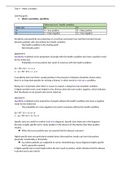
Task 4 – What a mistake!
Learning goals:
1. What is sensitivity, specificity
Reference test / health condition
Index test D+ D-
D+ A = true positive B = false positive
D- C = false negative D = true negative
Sensitivity and specificity are properties of a test that summarize how well the test discriminate
between patients with and without the health condition.
- The health condition is the starting point
- Not clinically useful
SENSITIVITY
Sensitivity is defined as the proportion of people with the health condition who have a positive result
for the index test.
- Probability of a true positive test result in someone with the health condition
Sn = P(T+ D+) = a / a +c
1 – sn = P(T- D+) = c / a +c
A sensitivity test (one that is usually positive in the presence of disease) should be chosen when
there is an important penalty for missing a disease, in other words to rule out a condition.
Ruling out is important when there is reason to suspect a dangerous but treatable condition.
A highly sensitive test is most helpful to the clinician when the test result is negative, which indicates
that the disease is not present and can be ruled out.
SPECIFICITY
Specificity is defined as the proportion of people without the health condition who have a negative
result for the index test.
- The probability of a true negative test result in someone without the health condition
Sp = P(T- D-) = d / b + d
1 – sp = P(T+ D-) = b / b + d
Specific tests are useful to confirm (rule in) a diagnosis. Specific tests help rule in the diagnosis
because a highly specific test is rarely positive in the absence of the disease (few false-positive
results).
When the test is positive you can assume that the disease is present
Highly specific tests are particularly needed when false-positives results can harm the patient
physically, emotionally or financially.
E.g. before patients are subjected to cancer chemotherapy, tissue diagnosis (highly specific
test) is generally required.
A highly specific test is most helpful when the test result is positive, which indicates that the disease
is present and ca be ruled in.
, Task 4 – What a mistake!
EXAMPLE
Sn = 45/119 = 0.38
Interpretation = 38% of people with the health condition have a positive index test
SnNout
Sp = 1061/1137 = 0.93
Interpretation = 93% of people without the health condition have a negative index test
SpPin
Using this cut-off, the index test is better for ruling in than ruling out the health condition
Because the specificity is higher than the sensitivity
2. What is PPV, NPV
The probability of disease, given the results of a test, is called the predictive value of the test.
- Index test result is the starting point
Predictive value answers the question
- If my patient’s test result is positive, what are the chances that my patient does have the
disease = PPV
- If my patient’s test result is negative, what are the chances that my patient does not have the
disease = NPV
POSITIVE PREDICTIVE VALUE
The positive predictive value is the probability of disease in a patient with a positive test result.
PPV = P(D+ T+) = a / a + b
1-PVV = P(D- T+) = b / a + b
NEGATIVE PREDICTIVE VALUE
The negative predictive value is the probability of not having the disease when the test result is
negative.
NPV = P(D- T-) = d / c +d
1-NPV = P(D+ T-) = c / c + d
The term accuracy is sometimes used to summarize the overall value of a test. Accuracy is the
proportion of all test result, both positive and negative, that is correct.
EXAMPLE
PVV = 45/121 = 0.37
Interpretation = 37% of people with a positive index test have the health condition
NPV = 1061/1135 = 0.93
93% of the people with a negative index test do not have the health condition
Learning goals:
1. What is sensitivity, specificity
Reference test / health condition
Index test D+ D-
D+ A = true positive B = false positive
D- C = false negative D = true negative
Sensitivity and specificity are properties of a test that summarize how well the test discriminate
between patients with and without the health condition.
- The health condition is the starting point
- Not clinically useful
SENSITIVITY
Sensitivity is defined as the proportion of people with the health condition who have a positive result
for the index test.
- Probability of a true positive test result in someone with the health condition
Sn = P(T+ D+) = a / a +c
1 – sn = P(T- D+) = c / a +c
A sensitivity test (one that is usually positive in the presence of disease) should be chosen when
there is an important penalty for missing a disease, in other words to rule out a condition.
Ruling out is important when there is reason to suspect a dangerous but treatable condition.
A highly sensitive test is most helpful to the clinician when the test result is negative, which indicates
that the disease is not present and can be ruled out.
SPECIFICITY
Specificity is defined as the proportion of people without the health condition who have a negative
result for the index test.
- The probability of a true negative test result in someone without the health condition
Sp = P(T- D-) = d / b + d
1 – sp = P(T+ D-) = b / b + d
Specific tests are useful to confirm (rule in) a diagnosis. Specific tests help rule in the diagnosis
because a highly specific test is rarely positive in the absence of the disease (few false-positive
results).
When the test is positive you can assume that the disease is present
Highly specific tests are particularly needed when false-positives results can harm the patient
physically, emotionally or financially.
E.g. before patients are subjected to cancer chemotherapy, tissue diagnosis (highly specific
test) is generally required.
A highly specific test is most helpful when the test result is positive, which indicates that the disease
is present and ca be ruled in.
, Task 4 – What a mistake!
EXAMPLE
Sn = 45/119 = 0.38
Interpretation = 38% of people with the health condition have a positive index test
SnNout
Sp = 1061/1137 = 0.93
Interpretation = 93% of people without the health condition have a negative index test
SpPin
Using this cut-off, the index test is better for ruling in than ruling out the health condition
Because the specificity is higher than the sensitivity
2. What is PPV, NPV
The probability of disease, given the results of a test, is called the predictive value of the test.
- Index test result is the starting point
Predictive value answers the question
- If my patient’s test result is positive, what are the chances that my patient does have the
disease = PPV
- If my patient’s test result is negative, what are the chances that my patient does not have the
disease = NPV
POSITIVE PREDICTIVE VALUE
The positive predictive value is the probability of disease in a patient with a positive test result.
PPV = P(D+ T+) = a / a + b
1-PVV = P(D- T+) = b / a + b
NEGATIVE PREDICTIVE VALUE
The negative predictive value is the probability of not having the disease when the test result is
negative.
NPV = P(D- T-) = d / c +d
1-NPV = P(D+ T-) = c / c + d
The term accuracy is sometimes used to summarize the overall value of a test. Accuracy is the
proportion of all test result, both positive and negative, that is correct.
EXAMPLE
PVV = 45/121 = 0.37
Interpretation = 37% of people with a positive index test have the health condition
NPV = 1061/1135 = 0.93
93% of the people with a negative index test do not have the health condition