Task 6 - Biomarkers
Learning goals:
1. What is a biomarker and what are characteristics of a good biomarker? What are types of
biomarkers?
A biomarker is a characteristic that can be objectively measured and evaluated as an indicator of
normal biological processes, pathogenic processes or pharmacological responses to a therapeutic
intervention.
A biomarkers is any substance, structure or process that can be measured in the human body or its
products and may influence or predict the incidence or outcome of a disease.
Other words for biomarkers:
- Biological markers
- Surrogate markers
- Surrogate end points
- Intermediate end points
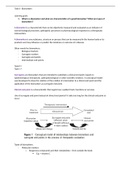
Type 0 =
Type 1 =
Surrogates are biomarkers that are intended to substitute a clinical end point, based on
epidemiological, therapeutic, pathophysiological or other scientific evidence. A conceptual model
was developed to show the relation of the relation of a biomarker to a clinical end point and the
application of the biomarkers as surrogate end point.
Clinical end point is a characteristic that regels how a patient feels, functions or survives.
Use of surrogate end point instead of clinical end points if it take too long for the clinical end point to
occur.
Types of biomarkers:
- Molecular markers
o Exogenous compounds and their metabolites = from outside the body
E.g. = vitamin C
, Task 6 - Biomarkers
o Normal body constituents
E.g. = estrogen
o Endogenous compounds not present under normal conditions
E.g. = cytokine profiles
o Abnormalities of body chemistry, structure of function
E.g. = mutations
- Imaging (MRI / ECG)
- Functional measurements
Characteristics of a good biomarkers:
- Easy to measure
- Add new information on top of traditional risk factors
- Potential for changing patients management
- Cost-effective
- Safe
- Predictive value replicated in different populations
2. When/how to use biomarkers? And compared to a questionnaire? What are the
(dis)advantages of using biomarkers?
Biomarkers are useful in:
- Early disease detection
- Monitoring of health status
- Assessment of prognosis
- Prediction of risk
Multiple roles of biomarkers:
- Antecedent = identifying the risk of developing an illness
- Screening = screening for subclinical disease
- Diagnostic = recognising overt disease
- Staging = categorising disease severity
- Prognostic = predicting future disease course / response to therapy
- Monitoring
Areas in which biomarkers can be used:
- Clinical practice
- Research
CLINICAL PRACTICE
Usage in clinical practice:
- Indicator or surrogate endpoint
- Early diagnosis
- Prognosis
- Effect of treatment
RESEARCH
Usage in research:
Learning goals:
1. What is a biomarker and what are characteristics of a good biomarker? What are types of
biomarkers?
A biomarker is a characteristic that can be objectively measured and evaluated as an indicator of
normal biological processes, pathogenic processes or pharmacological responses to a therapeutic
intervention.
A biomarkers is any substance, structure or process that can be measured in the human body or its
products and may influence or predict the incidence or outcome of a disease.
Other words for biomarkers:
- Biological markers
- Surrogate markers
- Surrogate end points
- Intermediate end points
Type 0 =
Type 1 =
Surrogates are biomarkers that are intended to substitute a clinical end point, based on
epidemiological, therapeutic, pathophysiological or other scientific evidence. A conceptual model
was developed to show the relation of the relation of a biomarker to a clinical end point and the
application of the biomarkers as surrogate end point.
Clinical end point is a characteristic that regels how a patient feels, functions or survives.
Use of surrogate end point instead of clinical end points if it take too long for the clinical end point to
occur.
Types of biomarkers:
- Molecular markers
o Exogenous compounds and their metabolites = from outside the body
E.g. = vitamin C
, Task 6 - Biomarkers
o Normal body constituents
E.g. = estrogen
o Endogenous compounds not present under normal conditions
E.g. = cytokine profiles
o Abnormalities of body chemistry, structure of function
E.g. = mutations
- Imaging (MRI / ECG)
- Functional measurements
Characteristics of a good biomarkers:
- Easy to measure
- Add new information on top of traditional risk factors
- Potential for changing patients management
- Cost-effective
- Safe
- Predictive value replicated in different populations
2. When/how to use biomarkers? And compared to a questionnaire? What are the
(dis)advantages of using biomarkers?
Biomarkers are useful in:
- Early disease detection
- Monitoring of health status
- Assessment of prognosis
- Prediction of risk
Multiple roles of biomarkers:
- Antecedent = identifying the risk of developing an illness
- Screening = screening for subclinical disease
- Diagnostic = recognising overt disease
- Staging = categorising disease severity
- Prognostic = predicting future disease course / response to therapy
- Monitoring
Areas in which biomarkers can be used:
- Clinical practice
- Research
CLINICAL PRACTICE
Usage in clinical practice:
- Indicator or surrogate endpoint
- Early diagnosis
- Prognosis
- Effect of treatment
RESEARCH
Usage in research: