Case 1: The building blocks of a health system: from theory to
practice
Debate question: Using health system classifications and ideal types is unreliable and has
limited public health policy relevance.
World Health Organisation (2010). Monitoring the building blocks of health systems: a
handbook of indicators and their measurement strategies.
https://apps.who.int/iris/bitstream/handle/10665/258734/9789241564052-eng.pdf
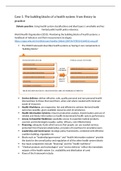
The WHO framework describes health systems as having 6 core components or
‘building blocks’:
Service delivery: deliver effective, safe, quality personal and non personal health
interventions to those that need them, when and where needed with minimum
waste of resources
Health Workforce: are responsive, fair and efficient to achieve the best health
outcomes possible, given available resources and circumstances
Health Information Systems: ensures production analysis, dissemination and use of
reliable and timely information on health determinants/health system performance
Access to Essential Medicines: equitable access to essential medical products,
vaccines and technologies (quality, safety, efficacy, cost-effectiveness)
Financing: adequate funds which ensure that people can use needed services,
protected from financial catastrophes, provision of incentives for providers/users
Leadership and Governance: strategic policy frameworks, combined with effective
coalition building, regulation etc
Blocks such as “leadership/governance” and “health information systems” provide
the basis for the overall policy and regulation of all the other health system blocks
Key input components include “financing” and the “health workforce”
“Medical products and technologies” and “service delivery” reflect the immediate
outputs of the health system (i.e. availability and distribution of care)
Flaws of the framework include:
, o It focuses on health sector actions and underplays the importance of actions
in other sectors
o Does not account for actions that influence behaviour, such as health
promotion and protection or use of health-care services
o Does not address underlying socioeconomic determinants of health (e.g.
gender inequities or education)
o Does not address the substantial and dynamic links and interactions between
components
Benefits of the framework include:
o Helps achieves a harmonised approach to health systems monitoring and
evaluation, reducing transaction costs, increasing efficiency and diminishing
pressure on countries
o It provides a simple and widely understood foundation for researchers
o Allows for better monitoring of clearly defined elements
A strength is that identifying 6 core components allows for identifying indicators and
strategies to measure their progress
,Jarvis, T., Scott, F., El-Jardali, F., Alvarez, E., 2020. Defining and classifying public health
systems: a critical interpretive synthesis. Health Research Policy and Systems 18..
doi:10.1186/s12961-020-00583-z
https://link.springer.com/content/pdf/10.1186/s12961-020-00583-z.pdf
Defining public health and public health systems
o “Public health was described as a multidisciplinary area of practice, concept
and set of values that engaged in a larger population health perspective”
o Many different definitions of Public Health can be found and are utilised
o Public health “was largely seen as a governmental responsibility” but
“included partnerships between formal (government) and informal (private
sectors, volunteer) organisations”
o Public health systems are “all levels of governmental and non-governmental
entities which share in the responsibility for ensuring healthy social and
physical environments, and consist of a variety of organisations that
contribute to the core functions of public health to protect and promote
health within the community”
o Of 20 articles used in this paper there were 10 unique definitions of public
health systems, again indicating varied definitions in use
Roles and functions of public health
o The most frequently mentioned frameworks for public health systems
incorporated the three ‘core’ functions of assessment, policy development
and assurance
o The most commonly mentioned functions and roles of public health were (in
order):
Health promotion
, Health protection (including air, water & food inspection and
environmental and occupational health activities)
Investigation and surveillance
Emergency planning, preparedness and response
Health assessment and monitoring
Injury and chronic disease prevention and management
Linking services with targeted and/or vulnerable populations
Public health systems
Böhm, K., Schmid, A., Götze, R., Landwehr, C., Rothgang, H., 2013. Five types of OECD
healthcare systems: Empirical results of a deductive classification. Health Policy 113, 258–
269.. doi:10.1016/j.healthpol.2013.09.003
https://www-sciencedirect-com.mu.idm.oclc.org/science/article/pii/S0168851013002285
Three core dimensions of the healthcare system: regulation, financing, and service
provision
o Healthcare systems are hierarchical led by regulation, followed by financing
and finally service provision, where the “superior dimension restricts the
nature of subordinate dimensions”
Three type of actors: state, societal, and private actors
Three possible dimensions combined with three possible actors mathematically
leads to 27 different combinations of systems (each with a different dimension or
actors ranked as high, medium, and low in a hierarchical order)
Applying these hierarchies to 30 OECD healthcare systems identifies 5 system types:
o National Health Service (8 cases)
, o National Health Insurance (5 cases)
o Social Health Insurance (4 cases)
o Etatist Social Health Insurance (11 cases)
o Private Health System (1 case)
Regarding the debate topic, the above table emphasises that health system
classifications can clearly be useful. Of the 30 OECD countries, 29 of them fit into
only 5 classification types of the 27 possible classifications (and 28 countries fit into
only 4 classifications when the USA is excluded).
Furthermore, there are noticeable similarities within the classifications. For example,
the Social Health Insurance system type is dominated by German-speaking nations,
while the National Health Service type is dominated by Scandinavia and the
somewhat isolated UK and Iberian Peninsula. Also noteworthy is the absence of
former USSR countries in these classifications, who all fall in the Etatist Social Health
Insurance classification (Estonia, Czechia, Hungary, Poland).
Healthcare systems classification
The principal question when classifying health systems is the “extend of state control
over health programmes”
Among OECD (wealthy western) countries, researchers regularly use 3 systems for
comparison:
practice
Debate question: Using health system classifications and ideal types is unreliable and has
limited public health policy relevance.
World Health Organisation (2010). Monitoring the building blocks of health systems: a
handbook of indicators and their measurement strategies.
https://apps.who.int/iris/bitstream/handle/10665/258734/9789241564052-eng.pdf
The WHO framework describes health systems as having 6 core components or
‘building blocks’:
Service delivery: deliver effective, safe, quality personal and non personal health
interventions to those that need them, when and where needed with minimum
waste of resources
Health Workforce: are responsive, fair and efficient to achieve the best health
outcomes possible, given available resources and circumstances
Health Information Systems: ensures production analysis, dissemination and use of
reliable and timely information on health determinants/health system performance
Access to Essential Medicines: equitable access to essential medical products,
vaccines and technologies (quality, safety, efficacy, cost-effectiveness)
Financing: adequate funds which ensure that people can use needed services,
protected from financial catastrophes, provision of incentives for providers/users
Leadership and Governance: strategic policy frameworks, combined with effective
coalition building, regulation etc
Blocks such as “leadership/governance” and “health information systems” provide
the basis for the overall policy and regulation of all the other health system blocks
Key input components include “financing” and the “health workforce”
“Medical products and technologies” and “service delivery” reflect the immediate
outputs of the health system (i.e. availability and distribution of care)
Flaws of the framework include:
, o It focuses on health sector actions and underplays the importance of actions
in other sectors
o Does not account for actions that influence behaviour, such as health
promotion and protection or use of health-care services
o Does not address underlying socioeconomic determinants of health (e.g.
gender inequities or education)
o Does not address the substantial and dynamic links and interactions between
components
Benefits of the framework include:
o Helps achieves a harmonised approach to health systems monitoring and
evaluation, reducing transaction costs, increasing efficiency and diminishing
pressure on countries
o It provides a simple and widely understood foundation for researchers
o Allows for better monitoring of clearly defined elements
A strength is that identifying 6 core components allows for identifying indicators and
strategies to measure their progress
,Jarvis, T., Scott, F., El-Jardali, F., Alvarez, E., 2020. Defining and classifying public health
systems: a critical interpretive synthesis. Health Research Policy and Systems 18..
doi:10.1186/s12961-020-00583-z
https://link.springer.com/content/pdf/10.1186/s12961-020-00583-z.pdf
Defining public health and public health systems
o “Public health was described as a multidisciplinary area of practice, concept
and set of values that engaged in a larger population health perspective”
o Many different definitions of Public Health can be found and are utilised
o Public health “was largely seen as a governmental responsibility” but
“included partnerships between formal (government) and informal (private
sectors, volunteer) organisations”
o Public health systems are “all levels of governmental and non-governmental
entities which share in the responsibility for ensuring healthy social and
physical environments, and consist of a variety of organisations that
contribute to the core functions of public health to protect and promote
health within the community”
o Of 20 articles used in this paper there were 10 unique definitions of public
health systems, again indicating varied definitions in use
Roles and functions of public health
o The most frequently mentioned frameworks for public health systems
incorporated the three ‘core’ functions of assessment, policy development
and assurance
o The most commonly mentioned functions and roles of public health were (in
order):
Health promotion
, Health protection (including air, water & food inspection and
environmental and occupational health activities)
Investigation and surveillance
Emergency planning, preparedness and response
Health assessment and monitoring
Injury and chronic disease prevention and management
Linking services with targeted and/or vulnerable populations
Public health systems
Böhm, K., Schmid, A., Götze, R., Landwehr, C., Rothgang, H., 2013. Five types of OECD
healthcare systems: Empirical results of a deductive classification. Health Policy 113, 258–
269.. doi:10.1016/j.healthpol.2013.09.003
https://www-sciencedirect-com.mu.idm.oclc.org/science/article/pii/S0168851013002285
Three core dimensions of the healthcare system: regulation, financing, and service
provision
o Healthcare systems are hierarchical led by regulation, followed by financing
and finally service provision, where the “superior dimension restricts the
nature of subordinate dimensions”
Three type of actors: state, societal, and private actors
Three possible dimensions combined with three possible actors mathematically
leads to 27 different combinations of systems (each with a different dimension or
actors ranked as high, medium, and low in a hierarchical order)
Applying these hierarchies to 30 OECD healthcare systems identifies 5 system types:
o National Health Service (8 cases)
, o National Health Insurance (5 cases)
o Social Health Insurance (4 cases)
o Etatist Social Health Insurance (11 cases)
o Private Health System (1 case)
Regarding the debate topic, the above table emphasises that health system
classifications can clearly be useful. Of the 30 OECD countries, 29 of them fit into
only 5 classification types of the 27 possible classifications (and 28 countries fit into
only 4 classifications when the USA is excluded).
Furthermore, there are noticeable similarities within the classifications. For example,
the Social Health Insurance system type is dominated by German-speaking nations,
while the National Health Service type is dominated by Scandinavia and the
somewhat isolated UK and Iberian Peninsula. Also noteworthy is the absence of
former USSR countries in these classifications, who all fall in the Etatist Social Health
Insurance classification (Estonia, Czechia, Hungary, Poland).
Healthcare systems classification
The principal question when classifying health systems is the “extend of state control
over health programmes”
Among OECD (wealthy western) countries, researchers regularly use 3 systems for
comparison: