
Seminar 2
The article
- Indefinite article (a in English) does not exist in Old Irish a man = fer
- Only the definite article exists in Old Irish & it comes before the noun
- The article has to be in the same case, gender & number as the noun
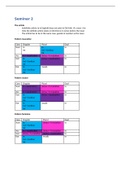
Pattern masculine
Case Singular Plural Dual
Nom In In In
Int Ind + lenition
Int
Acc In + nasalization (in)na + h-mutation In
Gen In (in)na + nasalization In
Ind + lenition
Int
Dat In Innaib In
Ind + lenition
Int
Pattern neuter
Case Singular Plural Dual
Nom A + nasalization (in)na + h-mutation In
Acc A + nasalization (in)na + h-mutation In
Gen In (in)na + nasalization In
Ind + lenition
Int
Dat In Innaib In
Ind + lenition
Int
Pattern feminine
Case Singular Plural Dual
Nom In (in)na + h-mutation In
Ind + lenition
Int
Acc In + nasalization (in)na + h-mutation In
Gen (in)na + h-mutation (in)na + nasalization In
Dat In Innaib In
Ind + lenition
Int
, The double article rule
If you want to translate a sentence from English into Old Irish, which consists of definite article +
noun followed by definite article + genitive, you only use ONE definite article in Old Irish. This article
stands before the second element!
The article may also be omitted if the next element is very specific, like a personal name.
The combination preposition + article
In Old Irish, when a preposition is followed by an article, the preposition and article are combined.
- Don vs lasin
o Do causes lenition s ṡ it disappears don
o If a preposition causes h-mutation or nasalization, the s will remain
o La causes h-mutation s lasin
- Some prepositions can be followed by either dative or accusative case
o Accusative case to express motion
o Dative case to express rest
- Sometimes there are two forms of the preposition+article
o Form ending in –(i)n if followed by a feminine or masculine noun
o Form ending in -a if followed by a neuter noun
o If there is only one form, it is used by all 3 genders
Most common prepositions + article
Meaning Mutation Followed by Prep + art sg Prep + art pl
A Out of h-mutation Dative Asin(d/t) Asnaib
Ar For, on Lenition Dative Arin(d/t) Arnaib
For, onto Lenition Accusative Arin, ara Arna
Co With Nasalization Dative Cosin(d/t) Cosnaib
Co To h-mutation Accusative Cosin, cosa Cosna
Do For, to Lenition Dative Don(d/t) Donaib
Fo Under Lenition Dative Fon(d/t) Fonaib
Lenition Accusative Fon Fona
For On h-mutation Dative Forsin(d/t) Forsnaib
Onto h-mutation Accusative Forsin, forsa Forsna*
Fri Against h-mutation Accusative Frisin, frisa Frisna
I In Nasalization Dative Isin(d/t) Isnaib
Into Nasalization Accusative Isin, isa Isna
La With h-mutation Accusative Lasin, lasa Lasna
Ó From Lenition Dative Ón(d/t) Ónaib
- Leniting preposition + article no -s-
- Other preposition + article -s-
Length mark on first vowel (e/i) palatalized consonants before
Trén [d’r’e:n]
Dond aitiu thréun [dond ad’u θ’r’e:un]
If you have lθ or nθ, delenition takes place! (They are homorganic consonants)
The article
- Indefinite article (a in English) does not exist in Old Irish a man = fer
- Only the definite article exists in Old Irish & it comes before the noun
- The article has to be in the same case, gender & number as the noun
Pattern masculine
Case Singular Plural Dual
Nom In In In
Int Ind + lenition
Int
Acc In + nasalization (in)na + h-mutation In
Gen In (in)na + nasalization In
Ind + lenition
Int
Dat In Innaib In
Ind + lenition
Int
Pattern neuter
Case Singular Plural Dual
Nom A + nasalization (in)na + h-mutation In
Acc A + nasalization (in)na + h-mutation In
Gen In (in)na + nasalization In
Ind + lenition
Int
Dat In Innaib In
Ind + lenition
Int
Pattern feminine
Case Singular Plural Dual
Nom In (in)na + h-mutation In
Ind + lenition
Int
Acc In + nasalization (in)na + h-mutation In
Gen (in)na + h-mutation (in)na + nasalization In
Dat In Innaib In
Ind + lenition
Int
, The double article rule
If you want to translate a sentence from English into Old Irish, which consists of definite article +
noun followed by definite article + genitive, you only use ONE definite article in Old Irish. This article
stands before the second element!
The article may also be omitted if the next element is very specific, like a personal name.
The combination preposition + article
In Old Irish, when a preposition is followed by an article, the preposition and article are combined.
- Don vs lasin
o Do causes lenition s ṡ it disappears don
o If a preposition causes h-mutation or nasalization, the s will remain
o La causes h-mutation s lasin
- Some prepositions can be followed by either dative or accusative case
o Accusative case to express motion
o Dative case to express rest
- Sometimes there are two forms of the preposition+article
o Form ending in –(i)n if followed by a feminine or masculine noun
o Form ending in -a if followed by a neuter noun
o If there is only one form, it is used by all 3 genders
Most common prepositions + article
Meaning Mutation Followed by Prep + art sg Prep + art pl
A Out of h-mutation Dative Asin(d/t) Asnaib
Ar For, on Lenition Dative Arin(d/t) Arnaib
For, onto Lenition Accusative Arin, ara Arna
Co With Nasalization Dative Cosin(d/t) Cosnaib
Co To h-mutation Accusative Cosin, cosa Cosna
Do For, to Lenition Dative Don(d/t) Donaib
Fo Under Lenition Dative Fon(d/t) Fonaib
Lenition Accusative Fon Fona
For On h-mutation Dative Forsin(d/t) Forsnaib
Onto h-mutation Accusative Forsin, forsa Forsna*
Fri Against h-mutation Accusative Frisin, frisa Frisna
I In Nasalization Dative Isin(d/t) Isnaib
Into Nasalization Accusative Isin, isa Isna
La With h-mutation Accusative Lasin, lasa Lasna
Ó From Lenition Dative Ón(d/t) Ónaib
- Leniting preposition + article no -s-
- Other preposition + article -s-
Length mark on first vowel (e/i) palatalized consonants before
Trén [d’r’e:n]
Dond aitiu thréun [dond ad’u θ’r’e:un]
If you have lθ or nθ, delenition takes place! (They are homorganic consonants)




