Formulas Supply chain management
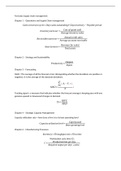
Chapter 1 – Operations and Supply Chain management
Cash conversion cycle=Days sales outstanding+ Daysinventory −Payable period
Cost of goods sold
Inventory turnover =
Average inventory value
Annual credit sales
Receivables turnover=
Average accounts receivable
Revenue( for sales)
Asset turnover=
Total assets
Chapter 2 – Strategy and Sustainability
Outputs
Productivity=
Inputs
Chapter 3 – Forecasting
MAD = The average of all the forecast errors (disregarding whether the deviations are positive or
negative). It is the average of the absolute deviations.
N
∑ ¿ A t−F t ∨¿
t =1
MAD= ¿
N
Tracking signal = a measure that indicates whether the forecast average is keeping pace with any
genuine upward or downward changes in demand.
RSFE
TS=
MAD
Chapter 4 – Strategic Capacity Management
Capacity utilization rate = how close a firm is to its best operating level
Capcity used
Capacity utilization level=
Best operating level
Chapter 6 – Manufacturing Processes
Inventory=Throughput rate x Flow time
Workstation cycle time (C):
Production time per day
C=
Required output per day (¿units)
Chapter 1 – Operations and Supply Chain management
Cash conversion cycle=Days sales outstanding+ Daysinventory −Payable period
Cost of goods sold
Inventory turnover =
Average inventory value
Annual credit sales
Receivables turnover=
Average accounts receivable
Revenue( for sales)
Asset turnover=
Total assets
Chapter 2 – Strategy and Sustainability
Outputs
Productivity=
Inputs
Chapter 3 – Forecasting
MAD = The average of all the forecast errors (disregarding whether the deviations are positive or
negative). It is the average of the absolute deviations.
N
∑ ¿ A t−F t ∨¿
t =1
MAD= ¿
N
Tracking signal = a measure that indicates whether the forecast average is keeping pace with any
genuine upward or downward changes in demand.
RSFE
TS=
MAD
Chapter 4 – Strategic Capacity Management
Capacity utilization rate = how close a firm is to its best operating level
Capcity used
Capacity utilization level=
Best operating level
Chapter 6 – Manufacturing Processes
Inventory=Throughput rate x Flow time
Workstation cycle time (C):
Production time per day
C=
Required output per day (¿units)