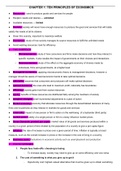
CHAPTER 1: TEN PRINCIPLES OF ECONOMICS
● Resources - used to produce goods and services for people
● People’s needs and desires --- unlimited
● Available resources --- limited
● Scarcity: society will never have enough resources to produce the good and services that will totally
satisfy the needs of all its citizens
● Given this scarcity, important to maximize welfare
● Economics: study of how society manages its scarce resources to fulfill the unlimited needs
● Avoid wasting resources: look for efficiency
● TWO SUBFIELDS
○ Microeconomics: study of how consumers and firms make decisions and how they interact in
specific markets. It also studies the impact of governments on their choices and interactions
○ Macroeconomics: study of the effect on the aggregate economy of choices made by
individuals, firms and governments, at a higher level
● Managerial economics: applying microeconomic theory to management decisions, however a
manager should be aware of macroeconomic trends to take optimal decisions
● rationality: assumes that consumers and producers will make optimal decisions
● optimal decisions: the ones who lead to maximum profit, rationality has boundaries
● efficiency: society gets most from scarce resources
● equity: benefits of those resources are distributed fairly among the members of society
● marginal changes: small incremental adjustments to a plan of action
● Market economy: economy that allocates resources through the decentralized decisions of many
firms and households as they interact in markets for goods and services
● externality: impact of one person or firm’s action on the well-being of a bystander (third party)
● market power: ability of a single person or firm to unduly influence market prices
● Gross Domestic product per capita: market value of all goods and services produced within a
country in a given period of time divided by the population of a country to give a per capita figure
● Inflation: the rate of increase in prices over a given period of time. Inflation is typically a broad
measure, such as the overall increase in prices or the increase in the cost of living in a country.
● Business cycle: fluctuations in economic activity such as unemployment and production
● Important principles
1. People face trade-offs: choosing is losing
- To increase equity, society may need to give up on some efficiency and vice versa
2. The cost of something is what you give up to get it
- Opportunity cost: highest valued alternative that must be given up to obtain something
, - oc=implicit (what you lose) and explicit (direct cost)
3. Rational people think at the margin
4. People respond to incentives
5. Trade can make everyone better off
6. Markets are usually a good way to organize economic activity
7. Government interferes
- needed when invisible hand of Adam Smith fails to achieve:
- equity
- efficiency (might be caused by externality or market power)
8. An economy’s standard of living depends on its ability to produce goods and services
- GDPC gives an idea of a country’s standard of living
- Living standard’s differences depend on the country’s productivity
9. Prices rise when the government prints too much money
- inflation
10. Society faces a short-run trade-off between inflation and unemployment
- In the short-term inflation reduces unemployment (Phillips curve)
- crucial for understanding business cycles
MCQ PLATFORM
- The opportunity cost in making the best choice increases as: the revenues of the second
best choice option increase
- Rational economic agents choose options for which the revenues exceed the opportunity
cost.
CHAPTER 2: THINKING LIKE AN ECONOMIST
● Economists trying to explain the world --- scientists
, ● Economists trying to change the world --- policy advisors
● POSITIVE STATEMENTS
○ describe the world as it is --- objective
○ descriptive analysis
○ can be tested, confirmed, and refuted
● NORMATIVE STATEMENTS
○ how the world should be --- subjective
○ prescriptive analysis
○ include opinion
○ not possible to test it
● Resources - used to produce goods and services for people
● People’s needs and desires --- unlimited
● Available resources --- limited
● Scarcity: society will never have enough resources to produce the good and services that will totally
satisfy the needs of all its citizens
● Given this scarcity, important to maximize welfare
● Economics: study of how society manages its scarce resources to fulfill the unlimited needs
● Avoid wasting resources: look for efficiency
● TWO SUBFIELDS
○ Microeconomics: study of how consumers and firms make decisions and how they interact in
specific markets. It also studies the impact of governments on their choices and interactions
○ Macroeconomics: study of the effect on the aggregate economy of choices made by
individuals, firms and governments, at a higher level
● Managerial economics: applying microeconomic theory to management decisions, however a
manager should be aware of macroeconomic trends to take optimal decisions
● rationality: assumes that consumers and producers will make optimal decisions
● optimal decisions: the ones who lead to maximum profit, rationality has boundaries
● efficiency: society gets most from scarce resources
● equity: benefits of those resources are distributed fairly among the members of society
● marginal changes: small incremental adjustments to a plan of action
● Market economy: economy that allocates resources through the decentralized decisions of many
firms and households as they interact in markets for goods and services
● externality: impact of one person or firm’s action on the well-being of a bystander (third party)
● market power: ability of a single person or firm to unduly influence market prices
● Gross Domestic product per capita: market value of all goods and services produced within a
country in a given period of time divided by the population of a country to give a per capita figure
● Inflation: the rate of increase in prices over a given period of time. Inflation is typically a broad
measure, such as the overall increase in prices or the increase in the cost of living in a country.
● Business cycle: fluctuations in economic activity such as unemployment and production
● Important principles
1. People face trade-offs: choosing is losing
- To increase equity, society may need to give up on some efficiency and vice versa
2. The cost of something is what you give up to get it
- Opportunity cost: highest valued alternative that must be given up to obtain something
, - oc=implicit (what you lose) and explicit (direct cost)
3. Rational people think at the margin
4. People respond to incentives
5. Trade can make everyone better off
6. Markets are usually a good way to organize economic activity
7. Government interferes
- needed when invisible hand of Adam Smith fails to achieve:
- equity
- efficiency (might be caused by externality or market power)
8. An economy’s standard of living depends on its ability to produce goods and services
- GDPC gives an idea of a country’s standard of living
- Living standard’s differences depend on the country’s productivity
9. Prices rise when the government prints too much money
- inflation
10. Society faces a short-run trade-off between inflation and unemployment
- In the short-term inflation reduces unemployment (Phillips curve)
- crucial for understanding business cycles
MCQ PLATFORM
- The opportunity cost in making the best choice increases as: the revenues of the second
best choice option increase
- Rational economic agents choose options for which the revenues exceed the opportunity
cost.
CHAPTER 2: THINKING LIKE AN ECONOMIST
● Economists trying to explain the world --- scientists
, ● Economists trying to change the world --- policy advisors
● POSITIVE STATEMENTS
○ describe the world as it is --- objective
○ descriptive analysis
○ can be tested, confirmed, and refuted
● NORMATIVE STATEMENTS
○ how the world should be --- subjective
○ prescriptive analysis
○ include opinion
○ not possible to test it