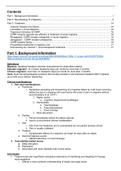
Contents
Part 1: Background Information..................................................................................................................... 1
Part 2: Neurobiology of a Migraine................................................................................................................2
Part 3: Treatment......................................................................................................................................... 14
Vascular Disease and Ditans.................................................................................................................. 16
Lasmiditan in Acute Migraine.................................................................................................................. 16
Trigeminal Activation & CGRP................................................................................................................ 16
CGRP receptor agonists are effective in treatment of acute migraine.....................................................16
Rimegepant, CGRP receptor antagonist, in acute migraine....................................................................16
Ubrogepant – CGRP receptor antaogonist..............................................................................................16
CGRP receptor family............................................................................................................................. 16
Preventative treatments in migraine now................................................................................................17
Acid-sensing ion channel 1: novel therapeutic treatment........................................................................17
Part 1: Background Information
https://www.ncbi.nlm.nih.gov/pmc/articles/PMC5539409/#sec10title review with EVERYTHING
https://pubmed.ncbi.nlm.nih.gov/22348935/
Definitions
Migraine: disabling headache disorder characterised by intermittent attacks
Episodic migraine: 14 or fewer headache days per month for more than 3 months
Chronic migraine: more than 14 headache days per month for more than 3 months
Aura: focal neurophysiological symptom that usually precede or accompanies headache BUT migraine
aura CAN occur without headaches
Clinical manifestations
1. Peri-ictal manifestations
a. Prodromal
i. Symptoms preceding and forewarning of a migraine attack by 2-48 hours occurring
before the aura in migraine with aura before the onset of pain in migraine without
aura (Goadsby et al., 2017)
1. Higher centre
a. Cognitive impairment/mood/fatigue
2. Homeostatic
a. Yawning/sleep
b. Polyuria/polydipsia
c. Food cravings
3. Neck discomfort
b. Preictal
i. Period immediately before the attack episode
ii. Aura is a pre-eminent clinical manifestation
c. Ictal
i. Pain from the headache and is exacerbated by non-painful sensory stimuli
ii. Pain is usually unilateral
d. Postictal
i. Symptomatic effects of a migraine can linger for days after an attack
e. Interictal migraine events
i. Altered behaviour or mood changes
2. Comorbidity-related issues
a. Sleep disruption
b. Depression
c. Associated with brain diseases that involve stress
Conclusion
Trigeminovascular hypothesis anticipated importance of identifying and targeting for therapy
neuromediators
o Offered a more coherent understanding of triptan and ergot action
, o Reinforced notion that clinically effective drugs do not require BBB penetration
o Novel concepts concerning activation and sensitisation of trigeminal afferents by meningeal
inflammatory stimuli + endogenous brain activity
o Emphasised trigeminal nerve as target
Future studies
1. Define role of candidate mutations or polumorphisms
2. Initiating or suppressing mechanisms in trigeminovascular system leading to headache
3. Drugs for ion channels on trigeminovascular afferents or in meningeal tissues
Part 2: Neurobiology of a Migraine
Life of a migraine
1. Initiator (evoked or spontaneous) unknown root cause
a. Causes abnormal cortical activity wave of
depolarisation and increased bloodflow matching
metabolic demand
b. Depolarising wave spreads to other cortical
regions and blood flow + cortical activity
decreases in the original location
2. Clinical or subclinical spreading depression
a. Creates auras via unknown mechanism speed
of depolarising wave matches the rate auras move
across the body
3. Activation of trigeminovascular nerves by the depolarising
wave triggers release of neuropeptides antidromically
4. Neuropeptides cause neurogenic inflammation on the caudal trigeminal nucleus
a. Cause central sensitisation
, b. Brain perceives referred pain from the face
c. Facial allodynia
5. Neuroepptides cause neurogenic inflammation on the dural blood vessels
a. Cause peripheral sensitisation
b. Normal pulsation of intravascular pressure will activate dural nociceptors
c. Unilateral throbbing headache
“Current evidence indicates that cortical spreading depression (CSD) is the most probable primary event in
trigeminovascular system (TGVS) activation in migraine with aura and, perhaps, also migraine without
aura. Dysfunctional brainstem nuclei involved in the central control of pain might exert a permissive role by
favouring central trigeminal hyperexcitability. Abnormal cortical activity might lead to CSD when enhanced
activation coincides with other triggering factors. The relationship between abnormal cortical activity and
abnormal brainstem function remains hypothetical and unclear”
Step 1 Argument: initiators are what triggers the onset of a migraine, but there is much debate
over what these initiators are
Debate over pathophysiology is centred on neural or vascular mechanisms
1. Neural mechanisms
a. Edward Living described migraines as a nerve storm or a neurosal seizure
2. Vascular mechanisms
a. Peter Wallwork Latham described migraines as occurring through vasodilation triggered by
aura
i. Used experimental observations in labs and migraine triggers
ii. Trailblazer
b. Wolff et al., 1940s
i. Studies on cranial blood vessels in conscious patients
ii. Concept persisted for 5 decades untle development of sumatriptan which supported
this finding (Feniuk et al., 1991) but also added controversy (Humphrey and
Goadsby, 1994)
iii. Sumatriptan has BOTH vascular and neural effects
3. New idea that it is due to sterile inflammation of dural meninges caused by antifromic activation of
the trigeminal nerve (Markowitz et al., 1987)
Migraine aura provoke experimentally
Lindblad et al., 2017
Aim The nature of the migraine aura and its role in migraine pathophysiology is
incompletely understood.
In particular, the mechanisms underlying aura initiation and the causal relation
between aura and headache are unknown.
The scientific investigation of aura in patients is only possible if aura can be
triggered. This paper reviews potential methods for the experimental provocation of
migraine aura.
Method Systematic review of PubMed
Results We identified 21 provocation studies, using 13 different prospective provocation methods,
and 34 case reports. In the prospective studies, aura were reported following the
administration of intravenous and sublingual glyceryl trinitrate, visual stimulation, physical
activity, calcitonin gene-related peptide infusion, chocolate ingestion, and the intravenous
injection of insulin. In addition, carotid artery puncture has consistently been reported as a
trigger of aura.
Conclusio No safe and efficient method for aura provocation exists at present, but several
n approaches could prove useful for this purpose.
Provoking migraine with aura using natural trigger factors
Hougaard et al., 2013
Aim It is well-known that migraine attacks can be precipitated by various stimuli. More than
50% of patients with migraine with aura (MA) know of at least one stimulus that always or
often triggers their MA attacks. The objective of this study was to expose patients with MA
to their self-reported trigger factors in order to assess the causal relation between trigger
factors and attacks.
Method We recruited 27 patients with MA who reported that bright or flickering light or strenuous
Part 1: Background Information..................................................................................................................... 1
Part 2: Neurobiology of a Migraine................................................................................................................2
Part 3: Treatment......................................................................................................................................... 14
Vascular Disease and Ditans.................................................................................................................. 16
Lasmiditan in Acute Migraine.................................................................................................................. 16
Trigeminal Activation & CGRP................................................................................................................ 16
CGRP receptor agonists are effective in treatment of acute migraine.....................................................16
Rimegepant, CGRP receptor antagonist, in acute migraine....................................................................16
Ubrogepant – CGRP receptor antaogonist..............................................................................................16
CGRP receptor family............................................................................................................................. 16
Preventative treatments in migraine now................................................................................................17
Acid-sensing ion channel 1: novel therapeutic treatment........................................................................17
Part 1: Background Information
https://www.ncbi.nlm.nih.gov/pmc/articles/PMC5539409/#sec10title review with EVERYTHING
https://pubmed.ncbi.nlm.nih.gov/22348935/
Definitions
Migraine: disabling headache disorder characterised by intermittent attacks
Episodic migraine: 14 or fewer headache days per month for more than 3 months
Chronic migraine: more than 14 headache days per month for more than 3 months
Aura: focal neurophysiological symptom that usually precede or accompanies headache BUT migraine
aura CAN occur without headaches
Clinical manifestations
1. Peri-ictal manifestations
a. Prodromal
i. Symptoms preceding and forewarning of a migraine attack by 2-48 hours occurring
before the aura in migraine with aura before the onset of pain in migraine without
aura (Goadsby et al., 2017)
1. Higher centre
a. Cognitive impairment/mood/fatigue
2. Homeostatic
a. Yawning/sleep
b. Polyuria/polydipsia
c. Food cravings
3. Neck discomfort
b. Preictal
i. Period immediately before the attack episode
ii. Aura is a pre-eminent clinical manifestation
c. Ictal
i. Pain from the headache and is exacerbated by non-painful sensory stimuli
ii. Pain is usually unilateral
d. Postictal
i. Symptomatic effects of a migraine can linger for days after an attack
e. Interictal migraine events
i. Altered behaviour or mood changes
2. Comorbidity-related issues
a. Sleep disruption
b. Depression
c. Associated with brain diseases that involve stress
Conclusion
Trigeminovascular hypothesis anticipated importance of identifying and targeting for therapy
neuromediators
o Offered a more coherent understanding of triptan and ergot action
, o Reinforced notion that clinically effective drugs do not require BBB penetration
o Novel concepts concerning activation and sensitisation of trigeminal afferents by meningeal
inflammatory stimuli + endogenous brain activity
o Emphasised trigeminal nerve as target
Future studies
1. Define role of candidate mutations or polumorphisms
2. Initiating or suppressing mechanisms in trigeminovascular system leading to headache
3. Drugs for ion channels on trigeminovascular afferents or in meningeal tissues
Part 2: Neurobiology of a Migraine
Life of a migraine
1. Initiator (evoked or spontaneous) unknown root cause
a. Causes abnormal cortical activity wave of
depolarisation and increased bloodflow matching
metabolic demand
b. Depolarising wave spreads to other cortical
regions and blood flow + cortical activity
decreases in the original location
2. Clinical or subclinical spreading depression
a. Creates auras via unknown mechanism speed
of depolarising wave matches the rate auras move
across the body
3. Activation of trigeminovascular nerves by the depolarising
wave triggers release of neuropeptides antidromically
4. Neuropeptides cause neurogenic inflammation on the caudal trigeminal nucleus
a. Cause central sensitisation
, b. Brain perceives referred pain from the face
c. Facial allodynia
5. Neuroepptides cause neurogenic inflammation on the dural blood vessels
a. Cause peripheral sensitisation
b. Normal pulsation of intravascular pressure will activate dural nociceptors
c. Unilateral throbbing headache
“Current evidence indicates that cortical spreading depression (CSD) is the most probable primary event in
trigeminovascular system (TGVS) activation in migraine with aura and, perhaps, also migraine without
aura. Dysfunctional brainstem nuclei involved in the central control of pain might exert a permissive role by
favouring central trigeminal hyperexcitability. Abnormal cortical activity might lead to CSD when enhanced
activation coincides with other triggering factors. The relationship between abnormal cortical activity and
abnormal brainstem function remains hypothetical and unclear”
Step 1 Argument: initiators are what triggers the onset of a migraine, but there is much debate
over what these initiators are
Debate over pathophysiology is centred on neural or vascular mechanisms
1. Neural mechanisms
a. Edward Living described migraines as a nerve storm or a neurosal seizure
2. Vascular mechanisms
a. Peter Wallwork Latham described migraines as occurring through vasodilation triggered by
aura
i. Used experimental observations in labs and migraine triggers
ii. Trailblazer
b. Wolff et al., 1940s
i. Studies on cranial blood vessels in conscious patients
ii. Concept persisted for 5 decades untle development of sumatriptan which supported
this finding (Feniuk et al., 1991) but also added controversy (Humphrey and
Goadsby, 1994)
iii. Sumatriptan has BOTH vascular and neural effects
3. New idea that it is due to sterile inflammation of dural meninges caused by antifromic activation of
the trigeminal nerve (Markowitz et al., 1987)
Migraine aura provoke experimentally
Lindblad et al., 2017
Aim The nature of the migraine aura and its role in migraine pathophysiology is
incompletely understood.
In particular, the mechanisms underlying aura initiation and the causal relation
between aura and headache are unknown.
The scientific investigation of aura in patients is only possible if aura can be
triggered. This paper reviews potential methods for the experimental provocation of
migraine aura.
Method Systematic review of PubMed
Results We identified 21 provocation studies, using 13 different prospective provocation methods,
and 34 case reports. In the prospective studies, aura were reported following the
administration of intravenous and sublingual glyceryl trinitrate, visual stimulation, physical
activity, calcitonin gene-related peptide infusion, chocolate ingestion, and the intravenous
injection of insulin. In addition, carotid artery puncture has consistently been reported as a
trigger of aura.
Conclusio No safe and efficient method for aura provocation exists at present, but several
n approaches could prove useful for this purpose.
Provoking migraine with aura using natural trigger factors
Hougaard et al., 2013
Aim It is well-known that migraine attacks can be precipitated by various stimuli. More than
50% of patients with migraine with aura (MA) know of at least one stimulus that always or
often triggers their MA attacks. The objective of this study was to expose patients with MA
to their self-reported trigger factors in order to assess the causal relation between trigger
factors and attacks.
Method We recruited 27 patients with MA who reported that bright or flickering light or strenuous