Sales and operation planning (S&OP)
Collaborative planning can be referred to as sales and operations planning (S&OP)
processes. The purpose of sales and operation planning can be described as follows:
The need for cross-functional coordination arises from functional conflicts among areas
such as sales, marketing, logistics, finance, and operations. These conflicts are rooted in
structural causes, such as contradictory reward and evaluation systems, product and
production complexities, market orientation, and experience and culture, and are often
aggravated by capital constraints and technological changes.
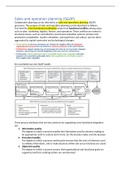
Een voorbeeld van een S&OP model:
Three process attributes that are key construct for supporting cross-functional integration
are:
1. Information quality
The degree to which a process enables the information used for decision making to
be appropriate, both in content and in form, for the decision maker and the decision.
2. Procedural quality
The degree to which a process continuously ensures that the rules of inference used
to validate information, and to make decisions within and across functions are sound
3. Alignment quality
The degree to which a process ensures that organizational and functional goals are
supported and that resulting actions are synchronized
Collaborative planning can be referred to as sales and operations planning (S&OP)
processes. The purpose of sales and operation planning can be described as follows:
The need for cross-functional coordination arises from functional conflicts among areas
such as sales, marketing, logistics, finance, and operations. These conflicts are rooted in
structural causes, such as contradictory reward and evaluation systems, product and
production complexities, market orientation, and experience and culture, and are often
aggravated by capital constraints and technological changes.
Een voorbeeld van een S&OP model:
Three process attributes that are key construct for supporting cross-functional integration
are:
1. Information quality
The degree to which a process enables the information used for decision making to
be appropriate, both in content and in form, for the decision maker and the decision.
2. Procedural quality
The degree to which a process continuously ensures that the rules of inference used
to validate information, and to make decisions within and across functions are sound
3. Alignment quality
The degree to which a process ensures that organizational and functional goals are
supported and that resulting actions are synchronized