Marketing Channel Management Lectures
Module 1: Setting the Scene
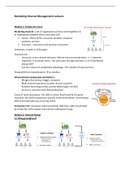
Marketing channel: a set of organizations (I) that work together (II)
to make goods available (III) for end users (IV).
• Goods : FMCG (CPG), consumer durables, industrial
products, services
• End users : consumers and business consumers
Customers: retailer in CPG jargon.
Channels are:
- Universal, so are channel decisions. Behind every service/product: >= 1 channels.
- Important in economic terms. The total sales through channels is 1/3 of worldwide
annual GDP.
- Can be a source of competitive advantage. The creation of entry barriers.
Powershift from manufacturers → to retailers.
What fuels the rising power of retailers?:
- Mergers (becoming a bigger company)
- Multi-channel operations (Jumbo → pick-up point)
- Retailers becoming brands: private labels (eigen merken)
- Access to consumer data (klantenkaarten)
Cause of retail apocalypse: the shift to online. Reinforced by the great
recession, the shift to experience and the Covid-19 pandemic. And Amazon.
20% of all retail sales are occurring online.
Consumers 2.0: consumers want everything, right here, right now (fueled
by Covid-19), at the lowest cost and zero willingness to pay.
Module 2: Channel Design
2.1 Why go (in)direct?
,Why go direct?
→ Higher (gross) profit margin for manufacturer (even at a lower consumer price)
Why not go direct?
Why go indirect (middleman can add value)?
- Bulk breaking: allow buying in small lots.
- Time convenience: reduce waiting times.
- Assortment convenience: offer a wide variety of goods.
- Impact on sale
- Distribution costs: with middleman, the number of contact lines reduces, there is a
cost for each contact line.
You can do away with the middleman, but you can’t do away with the middleman’s
functions.
Not online / brick-and-mortar or direct / indirect, but find the right balance.
, 2.2 3P Marketplaces
Third party.
Online retailer:
- Gross profit: Gross margin * units sold
- Costs: inventory + fulfillment costs
Marketplace:
- Gross profit: commission * units sold
Step-in fee (minimal)
- Costs: administrative costs
Why do manufacturers sell on marketplaces?
- Huge consumer traffic: long-tail products, cross-border selling
- Quick launch: low set-up costs, no digital worries
3P marketplaces are larger and growing faster than omnichannel and pureplay business
models.
Pitfalls for retailers when expanding marketplaces:
- No control over prices
- No control over fulfillment
May lead to inconsistent delivery times, fees & return policies.
- No control over product presentation (manufacturers decide on this)
Module 1: Setting the Scene
Marketing channel: a set of organizations (I) that work together (II)
to make goods available (III) for end users (IV).
• Goods : FMCG (CPG), consumer durables, industrial
products, services
• End users : consumers and business consumers
Customers: retailer in CPG jargon.
Channels are:
- Universal, so are channel decisions. Behind every service/product: >= 1 channels.
- Important in economic terms. The total sales through channels is 1/3 of worldwide
annual GDP.
- Can be a source of competitive advantage. The creation of entry barriers.
Powershift from manufacturers → to retailers.
What fuels the rising power of retailers?:
- Mergers (becoming a bigger company)
- Multi-channel operations (Jumbo → pick-up point)
- Retailers becoming brands: private labels (eigen merken)
- Access to consumer data (klantenkaarten)
Cause of retail apocalypse: the shift to online. Reinforced by the great
recession, the shift to experience and the Covid-19 pandemic. And Amazon.
20% of all retail sales are occurring online.
Consumers 2.0: consumers want everything, right here, right now (fueled
by Covid-19), at the lowest cost and zero willingness to pay.
Module 2: Channel Design
2.1 Why go (in)direct?
,Why go direct?
→ Higher (gross) profit margin for manufacturer (even at a lower consumer price)
Why not go direct?
Why go indirect (middleman can add value)?
- Bulk breaking: allow buying in small lots.
- Time convenience: reduce waiting times.
- Assortment convenience: offer a wide variety of goods.
- Impact on sale
- Distribution costs: with middleman, the number of contact lines reduces, there is a
cost for each contact line.
You can do away with the middleman, but you can’t do away with the middleman’s
functions.
Not online / brick-and-mortar or direct / indirect, but find the right balance.
, 2.2 3P Marketplaces
Third party.
Online retailer:
- Gross profit: Gross margin * units sold
- Costs: inventory + fulfillment costs
Marketplace:
- Gross profit: commission * units sold
Step-in fee (minimal)
- Costs: administrative costs
Why do manufacturers sell on marketplaces?
- Huge consumer traffic: long-tail products, cross-border selling
- Quick launch: low set-up costs, no digital worries
3P marketplaces are larger and growing faster than omnichannel and pureplay business
models.
Pitfalls for retailers when expanding marketplaces:
- No control over prices
- No control over fulfillment
May lead to inconsistent delivery times, fees & return policies.
- No control over product presentation (manufacturers decide on this)