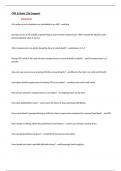
NUR 352 Exam 2 Latest updated with
complete solution
(10 questions on neuro, 8 questions on skincare, 5-8 on safety, 5-8 on falls, 2 on HEENT,
3 on Musculoskeletal, 10 on Medication Safety)
What must be met before physical and psychological needs according to Maslow's
hierarchy of needs? - ANSWER oxygen, proper nutrition,
Most common injuries to toddlers, infants & preschoolers. - ANSWER poisoning,
choking, riding unrestrained in motor vehicle, drowning, head trauma,
Most common injuries for school-aged kids - ANSWER head injuries, bicycle accidents,
sports injuries, not wearing a seat belt
Most common injuries for adolescent - ANSWER risk taking behaviors, alcohol, drugs,
drowning, motor vehicle accidents, suicide
Most common injuries for an adult - ANSWER lifestyle habits (smoking= lung problems
& nicotine's effect on the heart, stress= headaches & GI problems), childbirth, stress,
inadequate nutrition, excessive alcohol intake, substance abuse
Most common injuries for an older adult - ANSWER falls (wandering), poly pharmacy,
What are two individual risk factors to safety? - ANSWER impaired mobility (paralysis &
muscle weakness), lack of safety awareness
The Joint Commission's standards for National Patient Safety in Hospitals. - ANSWER
(1) patient identification
(2) improve staff communication
(3) Use medicines safely
(4) Use alarms safely
(5) Prevent Infection
(6) Prevent mistakes in surgery
What are some of the serious reportable events? - ANSWER (1) surgical events
(adverse)
(2) patient protection events (ex: infant discharged to wrong people)
(3) care-management events (pressure ulcers, medication errors)
(4) product or device events
(5) environmental events
(6) criminal events (impersonation of doctor)
What cultivates a culture of safety in the hospital setting? - ANSWER focusing on the
root cause of an event, and not the individual's mistake
, When does a fall risk assessment need to be completed? - ANSWER admission,
following a change in condition, after a fall, & when transferred
Who is at risk for falls? (Hendrich II Fall Risk Assessment) - ANSWER
Confusion/Disorientation/Impulsivity= 4
Symptomatic Depression= 2
Altered Elimination= 1
Dizziness/Vertigo= 1
Gender (male)= 1
any administered anticonvulsants= 2
any administered benzodiazepines= 1
Get up & go assessment
score above 5= fall risk!
Get Up & Go Assessment criteria - ANSWER "rising from a chair"
0= ability to rise in one single movement
1= pushes up successfully in one attempt
3= multiple attempts but successful
4= unable to rise w assistance
Besides the Hendrich fall assessment, what are other risk factors for falling? - ANSWER
being over 65, history of falling, reduced vision, orthostatic hypertension, lower-
extremity weakness, gait/balance problems, urinary incontinence, improper use of
walking aids, and effects of medications
What are some Fall Prevention Strategies? - ANSWER have bed in low-locked position,
non-slip footwear, orient to surroundings, have call light nearby, establish their mobility
restrictions, remove supplies/clutter, well light/clear path to bathroom, clean up spills
promptly, arrange personal items within arms reach
Braden Scale Categories - ANSWER (1) Sensory Perception
(2) Moisture
(3) Activity
(4) Mobility
(5) Nutrition
(6) Friction & Shear
Braden Scale Specific Ratings - ANSWER (1) Sensory Perception: 4= no impairment &
1= completely limited
(2) Moisture: 4= rarely moist & 1= always moist
(3) Activity: 4=walks frequently & 1= bedfast
(4) Mobility: 4= no limitation & 1= completely immobile
(5) Nutrition: 4=excellent & 1= very poor
(6) Friction & Shear: 3= no apparent problem & 1= problem
complete solution
(10 questions on neuro, 8 questions on skincare, 5-8 on safety, 5-8 on falls, 2 on HEENT,
3 on Musculoskeletal, 10 on Medication Safety)
What must be met before physical and psychological needs according to Maslow's
hierarchy of needs? - ANSWER oxygen, proper nutrition,
Most common injuries to toddlers, infants & preschoolers. - ANSWER poisoning,
choking, riding unrestrained in motor vehicle, drowning, head trauma,
Most common injuries for school-aged kids - ANSWER head injuries, bicycle accidents,
sports injuries, not wearing a seat belt
Most common injuries for adolescent - ANSWER risk taking behaviors, alcohol, drugs,
drowning, motor vehicle accidents, suicide
Most common injuries for an adult - ANSWER lifestyle habits (smoking= lung problems
& nicotine's effect on the heart, stress= headaches & GI problems), childbirth, stress,
inadequate nutrition, excessive alcohol intake, substance abuse
Most common injuries for an older adult - ANSWER falls (wandering), poly pharmacy,
What are two individual risk factors to safety? - ANSWER impaired mobility (paralysis &
muscle weakness), lack of safety awareness
The Joint Commission's standards for National Patient Safety in Hospitals. - ANSWER
(1) patient identification
(2) improve staff communication
(3) Use medicines safely
(4) Use alarms safely
(5) Prevent Infection
(6) Prevent mistakes in surgery
What are some of the serious reportable events? - ANSWER (1) surgical events
(adverse)
(2) patient protection events (ex: infant discharged to wrong people)
(3) care-management events (pressure ulcers, medication errors)
(4) product or device events
(5) environmental events
(6) criminal events (impersonation of doctor)
What cultivates a culture of safety in the hospital setting? - ANSWER focusing on the
root cause of an event, and not the individual's mistake
, When does a fall risk assessment need to be completed? - ANSWER admission,
following a change in condition, after a fall, & when transferred
Who is at risk for falls? (Hendrich II Fall Risk Assessment) - ANSWER
Confusion/Disorientation/Impulsivity= 4
Symptomatic Depression= 2
Altered Elimination= 1
Dizziness/Vertigo= 1
Gender (male)= 1
any administered anticonvulsants= 2
any administered benzodiazepines= 1
Get up & go assessment
score above 5= fall risk!
Get Up & Go Assessment criteria - ANSWER "rising from a chair"
0= ability to rise in one single movement
1= pushes up successfully in one attempt
3= multiple attempts but successful
4= unable to rise w assistance
Besides the Hendrich fall assessment, what are other risk factors for falling? - ANSWER
being over 65, history of falling, reduced vision, orthostatic hypertension, lower-
extremity weakness, gait/balance problems, urinary incontinence, improper use of
walking aids, and effects of medications
What are some Fall Prevention Strategies? - ANSWER have bed in low-locked position,
non-slip footwear, orient to surroundings, have call light nearby, establish their mobility
restrictions, remove supplies/clutter, well light/clear path to bathroom, clean up spills
promptly, arrange personal items within arms reach
Braden Scale Categories - ANSWER (1) Sensory Perception
(2) Moisture
(3) Activity
(4) Mobility
(5) Nutrition
(6) Friction & Shear
Braden Scale Specific Ratings - ANSWER (1) Sensory Perception: 4= no impairment &
1= completely limited
(2) Moisture: 4= rarely moist & 1= always moist
(3) Activity: 4=walks frequently & 1= bedfast
(4) Mobility: 4= no limitation & 1= completely immobile
(5) Nutrition: 4=excellent & 1= very poor
(6) Friction & Shear: 3= no apparent problem & 1= problem