Lang. Change Research
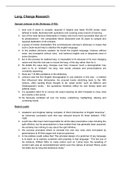
Samuel Johnson & His Dictionary (1755):
1. took over 8 years to compile, required 6 helpers and listed 40,000 words, each
defined in detail, illustrated with quotations and covering every branch of learning.
2. one of the most famous dictionaries in history and much more successful than any of
its predecessors - the comparable french dictionaire took 55 years to compile and
required dedication of 40 scholars.
3. a group of london booksellers first commissioned Johnson's dictionary in hopes that
such a book would help to stabilize the english language.
4. In the preface johnsons explains he found the english language “copious without
order, and energetick without rules,” and believed english was in desperate need of
some discipline.
5. but in the process he realized lang. is impossible to fix because of its ever changing
nature and that this role was to record the lang. of the day rather than for it.
6. He details the ways lang. changes over time; however much a lexicographer may
want to fix or “embalm” his lang. new words, phrases and pronunciations are
constantly appearing.
7. there are 114,000 quotations in the dictionary
8. Johnson was the first English lexicographer to use citations in this way - a method
that influenced later dictionaries. He scoured books stretching back to the 16th
century, often quoting those thought to be “great works” such as Milton’s and
Shakespeare's works. - the quotations therefore reflect his own literary taste and
political views.
9. If a quotation didn’t fit or convey the exact meaning he didn’t hesitate to chop, twist
and rewrite a few words.
10. He famously scribbled all over his books, underlining, highlighting, altering and
correcting words.
Robert Lowth
1. Academic and Anglican bishop compiled ‘A Short Introduction to English Grammar’ ,
an extremely successful work that was reissued around 45 times between 1762-
1800.
2. Lowth has often been held responsible for all the later prescriptive rules including the
split infinitive, but his prescriptivism is less evident than has generally been assumed.
He certainly has nothing to say about the split infinitive.
3. His success prompted others to emulate him and new rules were formulated by
grammarians to fill their pages and improve grammar.
4. In his preface Lowth writes that “The principal design of a grammar of any language
is to teach us to express ourselves with propriety in that language.” This led one of
his imitators, William Milns to make claims such as “Latine loqui, the speaking of
correct Latin was an accomplishment which even the natives of ancient Rome could
not attain but by long and assiduous study.”
Samuel Johnson & His Dictionary (1755):
1. took over 8 years to compile, required 6 helpers and listed 40,000 words, each
defined in detail, illustrated with quotations and covering every branch of learning.
2. one of the most famous dictionaries in history and much more successful than any of
its predecessors - the comparable french dictionaire took 55 years to compile and
required dedication of 40 scholars.
3. a group of london booksellers first commissioned Johnson's dictionary in hopes that
such a book would help to stabilize the english language.
4. In the preface johnsons explains he found the english language “copious without
order, and energetick without rules,” and believed english was in desperate need of
some discipline.
5. but in the process he realized lang. is impossible to fix because of its ever changing
nature and that this role was to record the lang. of the day rather than for it.
6. He details the ways lang. changes over time; however much a lexicographer may
want to fix or “embalm” his lang. new words, phrases and pronunciations are
constantly appearing.
7. there are 114,000 quotations in the dictionary
8. Johnson was the first English lexicographer to use citations in this way - a method
that influenced later dictionaries. He scoured books stretching back to the 16th
century, often quoting those thought to be “great works” such as Milton’s and
Shakespeare's works. - the quotations therefore reflect his own literary taste and
political views.
9. If a quotation didn’t fit or convey the exact meaning he didn’t hesitate to chop, twist
and rewrite a few words.
10. He famously scribbled all over his books, underlining, highlighting, altering and
correcting words.
Robert Lowth
1. Academic and Anglican bishop compiled ‘A Short Introduction to English Grammar’ ,
an extremely successful work that was reissued around 45 times between 1762-
1800.
2. Lowth has often been held responsible for all the later prescriptive rules including the
split infinitive, but his prescriptivism is less evident than has generally been assumed.
He certainly has nothing to say about the split infinitive.
3. His success prompted others to emulate him and new rules were formulated by
grammarians to fill their pages and improve grammar.
4. In his preface Lowth writes that “The principal design of a grammar of any language
is to teach us to express ourselves with propriety in that language.” This led one of
his imitators, William Milns to make claims such as “Latine loqui, the speaking of
correct Latin was an accomplishment which even the natives of ancient Rome could
not attain but by long and assiduous study.”