Computer Performance and Reliability
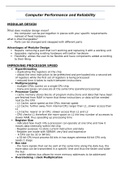
MODULAR DESIGN
What does modular design mean?
- the computer can be put together in pieces with your specific requirements
instead of fixed hardware
what is interchangeable?
- Parts can be changed and swapped with different parts
Advantages of Modular Design
Repairs: removing a part that isn’t working and replacing it with a working unit
Upgrades: replacing existing hardware with better hardware
Flexibility: allows the user to be flexible and have components added according
to their liking
IMPROVING PROCESSOR SPEED
Hyperthreading
- duplicating the registers on the chip
- allows the next instruction to be prefetched and pre-loaded into a second set
of registers while the first set of registers is being processed
- reduced time it takes to switch between instructions
Multiprocessing
- multiple CPUs (cores) on a single CPU chip
- many processes can execute at the same time (parallel processing)
Processor Cache
- cache memory stores blocks of program instructions and data that have been
pre-fetched from RAM in home that these instructions or data will be needed
next by the CPU
- L1 Cache: same speed as the CPUs internal speed
- L2 Cache: further away from internal CPU, larger than L1, slower access than
L1
- L3 Cache: nearer or on CPU, slower access than L1 and L2
- CPU checks L1 therefore the more space on L1 the less number of accesses to
slower RAM, thus speeding up processing time
Register Size
- indicated how much info a processor can operate at one time and how it
moves data internally within the chip
- Register purpose: to store current instruction and data
- Register are made with SDRAM: very fast and expensive
- A CPU can be 32 or 64 bits
- a 32-bit CPU must process 64 bits in two stages whereas 64-bit CPU only
needs 1 stage
Bus size
- the more signals that can be sent at the same time along the data bus, the
more data can be transmitted in a specific time and thus the faster and wider
the bus
- a wider address bus allows for more memory addresses to be addressed
Overclocking / clock Multiplication
MODULAR DESIGN
What does modular design mean?
- the computer can be put together in pieces with your specific requirements
instead of fixed hardware
what is interchangeable?
- Parts can be changed and swapped with different parts
Advantages of Modular Design
Repairs: removing a part that isn’t working and replacing it with a working unit
Upgrades: replacing existing hardware with better hardware
Flexibility: allows the user to be flexible and have components added according
to their liking
IMPROVING PROCESSOR SPEED
Hyperthreading
- duplicating the registers on the chip
- allows the next instruction to be prefetched and pre-loaded into a second set
of registers while the first set of registers is being processed
- reduced time it takes to switch between instructions
Multiprocessing
- multiple CPUs (cores) on a single CPU chip
- many processes can execute at the same time (parallel processing)
Processor Cache
- cache memory stores blocks of program instructions and data that have been
pre-fetched from RAM in home that these instructions or data will be needed
next by the CPU
- L1 Cache: same speed as the CPUs internal speed
- L2 Cache: further away from internal CPU, larger than L1, slower access than
L1
- L3 Cache: nearer or on CPU, slower access than L1 and L2
- CPU checks L1 therefore the more space on L1 the less number of accesses to
slower RAM, thus speeding up processing time
Register Size
- indicated how much info a processor can operate at one time and how it
moves data internally within the chip
- Register purpose: to store current instruction and data
- Register are made with SDRAM: very fast and expensive
- A CPU can be 32 or 64 bits
- a 32-bit CPU must process 64 bits in two stages whereas 64-bit CPU only
needs 1 stage
Bus size
- the more signals that can be sent at the same time along the data bus, the
more data can be transmitted in a specific time and thus the faster and wider
the bus
- a wider address bus allows for more memory addresses to be addressed
Overclocking / clock Multiplication