Biology A Level
Year 1
Module 2: Foundations in Biology
2.1.3: Nucleotides and nucleic acids
● Nucleic acids are large polymers formed from many nucleotides (monomers) linked in a
chain.
● They contain the elements carbon, hydrogen, oxygen, nitrogen and phosphorus.
● There are 2 types of nucleic acid: DNA and RNA. These are vital molecules because they
carry the genetic code in all living things and are important in controlling cellular
activity and protein synthesis.
The structure of a nucleotide as the monomer from which nucleic acids are made
To include the differences between RNA and DNA nucleotides, the identification of the purines
and pyrimidines and the type of pentose sugar.
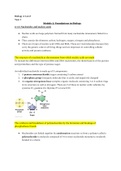
An individual nucleotide is made up of 3 components:
1. A pentose monosaccharide (sugar containing 5 carbon atoms)
2. A phosphate group (inorganic molecule that is acidic and negatively charged)
3. An organic nitrogenous base (complex organic molecule containing 1 or 2 carbon rings
in its structure as well as nitrogen). There are 5 of these in nucleic acids: adenine (A),
cytosine (C), guanine (G), thymine (T) or uracil (U)
The synthesis and breakdown of polynucleotides by the formation and breakage of
phosphodiester bonds
● Nucleotides are linked together by condensation reactions to form a polymer called a
polynucleotide (a molecule composed of 13 or more nucleotide monomers covalently
bonded in a chain).
, ● Covalent bonds called phosphodiester bonds link the
phosphate group at the 5th carbon (5’) of the pentose sugar of
one nucleotide to the hydroxyl group at the 3rd carbon (3’) of
the pentose sugar of an adjacent nucleotide. Two
condensation reactions occur with the formation of one
phosphodiester bond, so two water molecules are released.
● Only nucleotides of the same pentose sugar are
attached to each other to form the polynucleotide chain
● This forms a long, strong ‘sugar-phosphate
backbone’, which also has a base attached to each sugar.
These bases project out from the chain.
● The phosphodiester bonds are broken by hydrolysis, which
releases the individual nucleotides
The structure of DNA (deoxyribonucleic acid)
● The sugar (pentose monosaccharide) in DNA is deoxyribose -
has 1 less oxygen atom than ribose
● The nucleotides in DNA have 1 of 4 different organic nitrogenous bases. These 4 bases
can be divided into 2 groups:
1. Pyrimidines - the smaller bases, as they contain single carbon ring structures
- Thymine (T)
- Cytosine (C)
2. Purines - the larger bases, as they contain double carbon ring structures
- Adenine (A)
- Guanine (G)
- Purines always pair with pyrimidines; a
small pyrimidine base always binds to a
larger purine base. TIB only this pairing
allows hydrogen bonds to form between
the bases.
- [the sugar deoxyribose and the base
thymine can be used to identify DNA]
Year 1
Module 2: Foundations in Biology
2.1.3: Nucleotides and nucleic acids
● Nucleic acids are large polymers formed from many nucleotides (monomers) linked in a
chain.
● They contain the elements carbon, hydrogen, oxygen, nitrogen and phosphorus.
● There are 2 types of nucleic acid: DNA and RNA. These are vital molecules because they
carry the genetic code in all living things and are important in controlling cellular
activity and protein synthesis.
The structure of a nucleotide as the monomer from which nucleic acids are made
To include the differences between RNA and DNA nucleotides, the identification of the purines
and pyrimidines and the type of pentose sugar.
An individual nucleotide is made up of 3 components:
1. A pentose monosaccharide (sugar containing 5 carbon atoms)
2. A phosphate group (inorganic molecule that is acidic and negatively charged)
3. An organic nitrogenous base (complex organic molecule containing 1 or 2 carbon rings
in its structure as well as nitrogen). There are 5 of these in nucleic acids: adenine (A),
cytosine (C), guanine (G), thymine (T) or uracil (U)
The synthesis and breakdown of polynucleotides by the formation and breakage of
phosphodiester bonds
● Nucleotides are linked together by condensation reactions to form a polymer called a
polynucleotide (a molecule composed of 13 or more nucleotide monomers covalently
bonded in a chain).
, ● Covalent bonds called phosphodiester bonds link the
phosphate group at the 5th carbon (5’) of the pentose sugar of
one nucleotide to the hydroxyl group at the 3rd carbon (3’) of
the pentose sugar of an adjacent nucleotide. Two
condensation reactions occur with the formation of one
phosphodiester bond, so two water molecules are released.
● Only nucleotides of the same pentose sugar are
attached to each other to form the polynucleotide chain
● This forms a long, strong ‘sugar-phosphate
backbone’, which also has a base attached to each sugar.
These bases project out from the chain.
● The phosphodiester bonds are broken by hydrolysis, which
releases the individual nucleotides
The structure of DNA (deoxyribonucleic acid)
● The sugar (pentose monosaccharide) in DNA is deoxyribose -
has 1 less oxygen atom than ribose
● The nucleotides in DNA have 1 of 4 different organic nitrogenous bases. These 4 bases
can be divided into 2 groups:
1. Pyrimidines - the smaller bases, as they contain single carbon ring structures
- Thymine (T)
- Cytosine (C)
2. Purines - the larger bases, as they contain double carbon ring structures
- Adenine (A)
- Guanine (G)
- Purines always pair with pyrimidines; a
small pyrimidine base always binds to a
larger purine base. TIB only this pairing
allows hydrogen bonds to form between
the bases.
- [the sugar deoxyribose and the base
thymine can be used to identify DNA]