PROPERTY AND CONVEYANCE
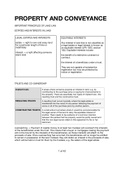
IMPORTANT PRINCIPLES OF LAND LAW
ESTATES AND INTERESTS IN LAND
LEGAL ESTATES AND INTERESTS EQUITABLE INTERESTS
estate -> right to own and enjoy land Any interest in land that is not classi ed as
for a particular length of time or a legal estate or legal interest is known as
inde nitely an equitable interest (LPA 1925, section
1(3)). Equitable interests include:
interest -> a right a ecting someone
else’s land the bene t of a restrictive covenant or
contract;
the interest of a bene ciary under a trust.
They are not capable of substantive
registration but may be protected by
notice or registration.
TRUSTS AND CO-OWNERSHIP
implied trusts It arises where someone acquires an interest in land, e.g. by
contributing to the purchase price or paying for improvements to
the property. There are essentially two types of implied trust—the
resulting trust and the constructive trust.
RESULTING TRUSTS A resulting trust occurs typically where the legal estate is
transferred into the name of one person following the payment of
some or all of the purchase price by another person.
CONSTRUCTIVE TRUSTS A constructive trust arises where it would be unconscionable for
the legal owner of the land to deny the equitable interest of
another. There needs to be evidence of a common intention
between the parties that the property would be jointly owned and
that the non-legal owner relied on this agreement to his or her
detriment
overreaching -> Payment of capital money to at least two trustees will overreach the interests
of the ben ciaries under the trust. This means that a buyer or mortgagee making the payment
will not be bound by the interests of the bene ciaries, as those interests will attach to the
proceeds of sale. Once overreaching has occurred, the bene ciaries will no longer be entitled
to remain in possession of the land. Instead, they will obtain an interest in the proceeds of sale,
which will be held on trust for them by the trustees, e.g. the sellers of the legal estate.
1 of 42
fi fi efi ff fi fi fi fi
, co-ownership -> The legal estate can be held under a joint tenancy but not a tenancy in
common. The bene ciaries holding the equitable estate can hold either under a joint tenancy or
a tenancy in common.The crucial distinction between these two types of co-ownership is that
the survivorship principle applies to a joint tenancy but not a tenancy in common.
JOINT TENANCY TENANCY IN COMMON
the co-owners own the whole of the land together Only applicable to the equitable estate.
and all joint tenants have the same interest in the
land irrespective of their respective contributions Each co-owner owns speci c shares in the land,
to the purchase price either equally or unequally. Only unity of
possession is necessary for a tenancy in common.
1.unity of possession, i.e. all joint tenants are
entitled to possess every part of the land;
2.unity of interest, e.g. the land is all freehold or all
leasehold;
3.unity of title, i.e. title acquired under the same
document or transaction;
4.unity of time, i.e. all co-owners acquired their
interest at the same time.
The di erent methods of severance are:
written notice under LPA 1925, section 36(2) given
by one or more joint tenants to all the other joint
tenants;
selling or charging the bene cial interest (including
a charging order made by a court);
bankruptcy—the bankrupt’s severed bene cial
interest vests in the trustee in bankruptcy.
4 number of trustees of the legal estate
EASEMENTS
-> a right attached to one piece of land (the dominant tenement), which gives the owner of that
land a right to use another person’s land (the servient tenement).
Re Ellenborough Park [1956] Ch 131
1.There must be a dominant and a servient tenement. Note that a public right of way is not an
easement because it does not bene t speci c land, i.e. there is no dominant tenement.
2.The dominant and servient tenements must be owned or occupied by di erent persons.
3.The right must bene t the dominant tenement, i.e. it cannot be purely a personal right in
favour of the occupier.
2 of 42
ff fi fi fifi fi fi fi ff
, 4.The right must be capable of forming the subject matter of a grant, i.e. granted by deed and
su ciently de nite. In addition, no exclusive possession must be conferred.
An easement becomes one when it's created either through a grant or a reservation.
grant -> given to a buyer over land that is retained by a seller
- express -> by deed (legal easement)
- implied (legal easement)
- presumed -> by prescription (legal easement)
reservation -> occurs where an easement is retained by a seller over land that is sold to a
buyer.
- express (legal easement)
- implied by necessity/common intention (legal easement)
IMPLIED GRANT IMPLIED RESERVATION PRESUMED/PRESCRIPTIVE
EASEMENTS
necessity -> where land is land- If an easement is not expressly This is the grant of an easement
locked (see Nickerson v reserved it can only be implied through long usage. It applies
Barraclough [1981] Ch 426). by necessity or common only to freehold land, except for
Mere inconvenience is intention, i.e. not by the rule in easements of light.
insu cient to create an Wheeldon v Burrows or section
easement of necessity 62 of the LPA 1925.
common intention of the Prescription Act 1832
parties
on a sale of part ,Wheeldon v lost modern grant:
Burrows [1879]:
one person owned and occupied the easement must have been
the whole of the land; exercised as of right, i.e. not by
force, not in secret, and not with
the owner previously exercised a permission;
quasi-easement over the land;
there must have been
the right is continuous and continuous and unbroken use of
apparent, i.e. obvious; the easement for the prescribed
period; and
the right is necessary for the
reasonable enjoyment of the the use was by a freehold owner
land; of the dominant tenement
against a freehold owner of the
3 of 42
ffiffi fi
, IMPLIED GRANT IMPLIED RESERVATION PRESUMED/PRESCRIPTIVE
EASEMENTS
against a freehold owner of the
section 62 of the LPA 1925. servient tenement.
This converts mere permissions
into easements if the following
conditions are met:
there should usually be diversity
of ownership and occupation,
e.g. landlord and tenant;
there was a ‘conveyance’, i.e. a
transfer of legal title to the
occupier, e.g. a lease (see Wright
v Macadam [1949] 2 KB 744).
- an express easement over registered land must be completed by registration
- This applies even in respect of estates not capable of substantive registration, e.g. a lease
for a term not exceeding seven years. In this case, the easement must be registered even
though the lease itself cannot be registered.
Under Schedule 3 of the LRA 2002, since 13 October 2006 any legal easement arising through
implied grant or reservation or prescription is an overriding interest binding on a buyer, only if:
it is known to the buyer; or
it would have been obvious to the buyer on a reasonably careful inspection; or
it has been exercised in the 12 months prior to the disposition.
In registered land, equitable easements can be protected by the entry of a notice under section
34 of the LRA 2002. In unregistered land, equitable easements can be protected by registering
a D(iii) land charge against the name of the estate owner.
pro ts a prendre -> it is a right for one person to remove something from land belonging to
another person, e.g. wood, grass, or sh
COVENANTS
4 of 42
fi fi
IMPORTANT PRINCIPLES OF LAND LAW
ESTATES AND INTERESTS IN LAND
LEGAL ESTATES AND INTERESTS EQUITABLE INTERESTS
estate -> right to own and enjoy land Any interest in land that is not classi ed as
for a particular length of time or a legal estate or legal interest is known as
inde nitely an equitable interest (LPA 1925, section
1(3)). Equitable interests include:
interest -> a right a ecting someone
else’s land the bene t of a restrictive covenant or
contract;
the interest of a bene ciary under a trust.
They are not capable of substantive
registration but may be protected by
notice or registration.
TRUSTS AND CO-OWNERSHIP
implied trusts It arises where someone acquires an interest in land, e.g. by
contributing to the purchase price or paying for improvements to
the property. There are essentially two types of implied trust—the
resulting trust and the constructive trust.
RESULTING TRUSTS A resulting trust occurs typically where the legal estate is
transferred into the name of one person following the payment of
some or all of the purchase price by another person.
CONSTRUCTIVE TRUSTS A constructive trust arises where it would be unconscionable for
the legal owner of the land to deny the equitable interest of
another. There needs to be evidence of a common intention
between the parties that the property would be jointly owned and
that the non-legal owner relied on this agreement to his or her
detriment
overreaching -> Payment of capital money to at least two trustees will overreach the interests
of the ben ciaries under the trust. This means that a buyer or mortgagee making the payment
will not be bound by the interests of the bene ciaries, as those interests will attach to the
proceeds of sale. Once overreaching has occurred, the bene ciaries will no longer be entitled
to remain in possession of the land. Instead, they will obtain an interest in the proceeds of sale,
which will be held on trust for them by the trustees, e.g. the sellers of the legal estate.
1 of 42
fi fi efi ff fi fi fi fi
, co-ownership -> The legal estate can be held under a joint tenancy but not a tenancy in
common. The bene ciaries holding the equitable estate can hold either under a joint tenancy or
a tenancy in common.The crucial distinction between these two types of co-ownership is that
the survivorship principle applies to a joint tenancy but not a tenancy in common.
JOINT TENANCY TENANCY IN COMMON
the co-owners own the whole of the land together Only applicable to the equitable estate.
and all joint tenants have the same interest in the
land irrespective of their respective contributions Each co-owner owns speci c shares in the land,
to the purchase price either equally or unequally. Only unity of
possession is necessary for a tenancy in common.
1.unity of possession, i.e. all joint tenants are
entitled to possess every part of the land;
2.unity of interest, e.g. the land is all freehold or all
leasehold;
3.unity of title, i.e. title acquired under the same
document or transaction;
4.unity of time, i.e. all co-owners acquired their
interest at the same time.
The di erent methods of severance are:
written notice under LPA 1925, section 36(2) given
by one or more joint tenants to all the other joint
tenants;
selling or charging the bene cial interest (including
a charging order made by a court);
bankruptcy—the bankrupt’s severed bene cial
interest vests in the trustee in bankruptcy.
4 number of trustees of the legal estate
EASEMENTS
-> a right attached to one piece of land (the dominant tenement), which gives the owner of that
land a right to use another person’s land (the servient tenement).
Re Ellenborough Park [1956] Ch 131
1.There must be a dominant and a servient tenement. Note that a public right of way is not an
easement because it does not bene t speci c land, i.e. there is no dominant tenement.
2.The dominant and servient tenements must be owned or occupied by di erent persons.
3.The right must bene t the dominant tenement, i.e. it cannot be purely a personal right in
favour of the occupier.
2 of 42
ff fi fi fifi fi fi fi ff
, 4.The right must be capable of forming the subject matter of a grant, i.e. granted by deed and
su ciently de nite. In addition, no exclusive possession must be conferred.
An easement becomes one when it's created either through a grant or a reservation.
grant -> given to a buyer over land that is retained by a seller
- express -> by deed (legal easement)
- implied (legal easement)
- presumed -> by prescription (legal easement)
reservation -> occurs where an easement is retained by a seller over land that is sold to a
buyer.
- express (legal easement)
- implied by necessity/common intention (legal easement)
IMPLIED GRANT IMPLIED RESERVATION PRESUMED/PRESCRIPTIVE
EASEMENTS
necessity -> where land is land- If an easement is not expressly This is the grant of an easement
locked (see Nickerson v reserved it can only be implied through long usage. It applies
Barraclough [1981] Ch 426). by necessity or common only to freehold land, except for
Mere inconvenience is intention, i.e. not by the rule in easements of light.
insu cient to create an Wheeldon v Burrows or section
easement of necessity 62 of the LPA 1925.
common intention of the Prescription Act 1832
parties
on a sale of part ,Wheeldon v lost modern grant:
Burrows [1879]:
one person owned and occupied the easement must have been
the whole of the land; exercised as of right, i.e. not by
force, not in secret, and not with
the owner previously exercised a permission;
quasi-easement over the land;
there must have been
the right is continuous and continuous and unbroken use of
apparent, i.e. obvious; the easement for the prescribed
period; and
the right is necessary for the
reasonable enjoyment of the the use was by a freehold owner
land; of the dominant tenement
against a freehold owner of the
3 of 42
ffiffi fi
, IMPLIED GRANT IMPLIED RESERVATION PRESUMED/PRESCRIPTIVE
EASEMENTS
against a freehold owner of the
section 62 of the LPA 1925. servient tenement.
This converts mere permissions
into easements if the following
conditions are met:
there should usually be diversity
of ownership and occupation,
e.g. landlord and tenant;
there was a ‘conveyance’, i.e. a
transfer of legal title to the
occupier, e.g. a lease (see Wright
v Macadam [1949] 2 KB 744).
- an express easement over registered land must be completed by registration
- This applies even in respect of estates not capable of substantive registration, e.g. a lease
for a term not exceeding seven years. In this case, the easement must be registered even
though the lease itself cannot be registered.
Under Schedule 3 of the LRA 2002, since 13 October 2006 any legal easement arising through
implied grant or reservation or prescription is an overriding interest binding on a buyer, only if:
it is known to the buyer; or
it would have been obvious to the buyer on a reasonably careful inspection; or
it has been exercised in the 12 months prior to the disposition.
In registered land, equitable easements can be protected by the entry of a notice under section
34 of the LRA 2002. In unregistered land, equitable easements can be protected by registering
a D(iii) land charge against the name of the estate owner.
pro ts a prendre -> it is a right for one person to remove something from land belonging to
another person, e.g. wood, grass, or sh
COVENANTS
4 of 42
fi fi