Bill Child - Wittgenstein
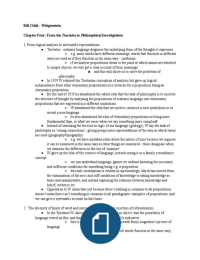
Chapter Four: From the Tractatus to Philosophical Investigations
1. From logical analysis to surveyable representation
● Tractatus - ordinary language disguises the underlying form of the thoughts it expresses
○ e.g. same words have different meanings, words that function in different
ways are used as if they function in the same way - confusion
○ if we analyse propositions down to the point at which names are attached
to simple objects, we will get a clear account of their meanings
■ and this will allow us to solve the problems of
philosophy
● In 1929 W retained the Tractarian conception of analysis but gave up logical
independence from other elementary propositions as a criterion for a proposition being an
elementary proposition
● By the end of 1929 he abandoned the whole idea that the task of philosophy is to uncover
the structure of thought by analysing the propositions of ordinary language into elementary
propositions that are expressed in a different symbolism
○ W abandoned the idea that we need to construct a new symbolism or to
invent a new language
○ he also abandoned the idea of elementary propositions as being more
fundamental than, or what we mean when we say something more complex#
● Instead of searching for the root in logic of our language (geology), W say the task of
philosophy as ‘seeing connections’, giving perspicuous representations of the way in which terms
are used (geography/topography)
○ e.g. we have mistaken ideas about the nature of time because we suppose
it can be measured in the same way as other things are measured - these disappear when
we examine the differences in the use of ‘measure’
● W gave up the idea of the essence of language, instead seeing it as a family resemblance
concept
○ we can understand language, games etc without knowing the necessary
and sufficient conditions for something being e.g. a proposition
○ this anti-essentialism is evident in epistemology, which has moved from
the examination of the necc and suff conditions of knowledge to taking knowledge as
basic and unanalysable, and instead exploring the relations between knowledge and
belief, evidence etc
● Opposition to W claim that just because there’s nothing in common to all propositions,
doesn’t mean there isn’t something in common to all paradigmatic examples of propositions, and
we can give a systematic account on this basis
2. ‘The diversity of kinds of word and sentence’: Wittgenstein’s rejection of referentialism
● In the Tractatus W claimed that a word stands for an object, that the possibility of
language rested on this, and that propositions were essentially indicative
○ this is similar to (or at least an outgrowth from) Augustine’s picture of
language
■ but it implies that all words function in the same way,
, and ‘five’, ‘red’ and ‘apples’ don’t function in the same way
● understanding words such as ‘red’
doesn’t involve knowing objects, but knowing how they are used,
including purpose, response, in what circumstances they are appropriate
■ W argues that the signifying model works perfectly well
in stating the function, or role, of names, but not every word is a name
● we can claim that all words signify
objects (i.e. are names), but if we do so we will have to have a very
differential account of what signification is (for different types of words)
- this just pushes back the problem, so that saying ‘every word in the
language signifies something’ tells us nothing whatever (PI 13)
● alternatively we retain some content to
the concept of signification, in which case not all words can signify
● How radical is this? Who would deny it?
○ orthodox view - meaning = reference of words and truth conditions of
propositions
■ ‘Julia is tall’ has the meaning it does in virtue of the
person referred to and the property of being tall, and these are the truth
conditions
■ on this view, W just reminds us that we need a
substantive account of what makes it the case that a word has a particular
referent, and that many expressions don’t refer in the same way
● In fact W is claiming that a referentialist account of language is impoverished, one-sided
and inaccurate
○ there is no reason to thing of words that refer as paradigmatic and others
as secondary
○ there is no reason to think of indicative/descriptive propositions as
primary/central - many uses of language don’t involve uttering sentences that are true or
false
■ the orthodox views respond to this by claiming that the
indicative form is fundamental, and questions, orders, stories jokes and riddles
use indicative propositions in different forms
● W disputes that the indicative form is
fundamental - there is no reason to think it has any privileged role
relative to others uses/forms
● So the orthodox view doesn’t take the diversity of language to be a barrier to a systematic
account of meaning - reference is seen as fundamental
○ on W’s view, a systematic account is made impossible by this diversity:
there is no one basic feature of words and no systematic account of what determines the
meaning of a proposition
■ who is right? can the orthodox guys accommodate all
language into their systems?
3. Meaning and use
● Three features of propositions:
○ truth condition - what has to be the case for it to be true
■ e.g. ‘animals feel pain’ is true iff animals experience the
Chapter Four: From the Tractatus to Philosophical Investigations
1. From logical analysis to surveyable representation
● Tractatus - ordinary language disguises the underlying form of the thoughts it expresses
○ e.g. same words have different meanings, words that function in different
ways are used as if they function in the same way - confusion
○ if we analyse propositions down to the point at which names are attached
to simple objects, we will get a clear account of their meanings
■ and this will allow us to solve the problems of
philosophy
● In 1929 W retained the Tractarian conception of analysis but gave up logical
independence from other elementary propositions as a criterion for a proposition being an
elementary proposition
● By the end of 1929 he abandoned the whole idea that the task of philosophy is to uncover
the structure of thought by analysing the propositions of ordinary language into elementary
propositions that are expressed in a different symbolism
○ W abandoned the idea that we need to construct a new symbolism or to
invent a new language
○ he also abandoned the idea of elementary propositions as being more
fundamental than, or what we mean when we say something more complex#
● Instead of searching for the root in logic of our language (geology), W say the task of
philosophy as ‘seeing connections’, giving perspicuous representations of the way in which terms
are used (geography/topography)
○ e.g. we have mistaken ideas about the nature of time because we suppose
it can be measured in the same way as other things are measured - these disappear when
we examine the differences in the use of ‘measure’
● W gave up the idea of the essence of language, instead seeing it as a family resemblance
concept
○ we can understand language, games etc without knowing the necessary
and sufficient conditions for something being e.g. a proposition
○ this anti-essentialism is evident in epistemology, which has moved from
the examination of the necc and suff conditions of knowledge to taking knowledge as
basic and unanalysable, and instead exploring the relations between knowledge and
belief, evidence etc
● Opposition to W claim that just because there’s nothing in common to all propositions,
doesn’t mean there isn’t something in common to all paradigmatic examples of propositions, and
we can give a systematic account on this basis
2. ‘The diversity of kinds of word and sentence’: Wittgenstein’s rejection of referentialism
● In the Tractatus W claimed that a word stands for an object, that the possibility of
language rested on this, and that propositions were essentially indicative
○ this is similar to (or at least an outgrowth from) Augustine’s picture of
language
■ but it implies that all words function in the same way,
, and ‘five’, ‘red’ and ‘apples’ don’t function in the same way
● understanding words such as ‘red’
doesn’t involve knowing objects, but knowing how they are used,
including purpose, response, in what circumstances they are appropriate
■ W argues that the signifying model works perfectly well
in stating the function, or role, of names, but not every word is a name
● we can claim that all words signify
objects (i.e. are names), but if we do so we will have to have a very
differential account of what signification is (for different types of words)
- this just pushes back the problem, so that saying ‘every word in the
language signifies something’ tells us nothing whatever (PI 13)
● alternatively we retain some content to
the concept of signification, in which case not all words can signify
● How radical is this? Who would deny it?
○ orthodox view - meaning = reference of words and truth conditions of
propositions
■ ‘Julia is tall’ has the meaning it does in virtue of the
person referred to and the property of being tall, and these are the truth
conditions
■ on this view, W just reminds us that we need a
substantive account of what makes it the case that a word has a particular
referent, and that many expressions don’t refer in the same way
● In fact W is claiming that a referentialist account of language is impoverished, one-sided
and inaccurate
○ there is no reason to thing of words that refer as paradigmatic and others
as secondary
○ there is no reason to think of indicative/descriptive propositions as
primary/central - many uses of language don’t involve uttering sentences that are true or
false
■ the orthodox views respond to this by claiming that the
indicative form is fundamental, and questions, orders, stories jokes and riddles
use indicative propositions in different forms
● W disputes that the indicative form is
fundamental - there is no reason to think it has any privileged role
relative to others uses/forms
● So the orthodox view doesn’t take the diversity of language to be a barrier to a systematic
account of meaning - reference is seen as fundamental
○ on W’s view, a systematic account is made impossible by this diversity:
there is no one basic feature of words and no systematic account of what determines the
meaning of a proposition
■ who is right? can the orthodox guys accommodate all
language into their systems?
3. Meaning and use
● Three features of propositions:
○ truth condition - what has to be the case for it to be true
■ e.g. ‘animals feel pain’ is true iff animals experience the