Taylor’s Notes Safety and Separation
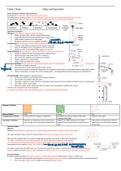
Atoms, Elements, Mixtures and Compounds
An element is a substance made from only one type of atom
The definition for a mixture is that it contains different substances that are not chemically bonded to each other
A compound is a substance made from two or more elements that have chemically bonded together
Element Mixture Element Compound
Separation Techniques
Filtration This separate insoluble solids from liquids
Mixture is poured into a funnel containing filter paper
Liquid (filtrate) passes through the filter paper into the flask
Solid (residue) remains on the filter paper
Residue is washed to ensure complete separation
Crystallisation This separates solutes (solids dissolved in solution) from a solution
Solution is warmed to remove some, but not all, of the water
Once crystals begin to form, the solution is left to evaporate
Crystals are then dried between filter papers or in an oven
Simple Distillation This separates a solvent (the liquid that solutes are dissolved in)
Solution is boiled with anti- bumping granules (boiling stones)
Solvent becomes a gas which passes to a condenser
Gas cools in the condenser and condenses to a liquid
Liquid is collected in a receiver flask
Solute is left in the flask that is heated
Fractional Distillation This separates miscible liquids (liquids that mix) with different boiling points:
The mixture of liquids is warmed
The temperature that the thermometer reads increases
When the thermometer shows the boiling point of component of the mixture, a fresh flask is used to collect that fraction
Mixture components are given off in order of boiling point – the liquid with the lowest boiling point is collected first
Chromatography This separates a mixture of dyes:
A pencil line is drawn near the bottom of the paper (baseline)
The samples are spotted on the pencil line
The paper is placed in a sealed container containing a small amount of solvent (which isn’t higher than the sample spots)
The solvent ‘climbs’ up the paper
When the solvent nearly reaches the top of the paper, mark the position reached by the solvent
The Rf can be calculated from chromatography:
Rf = distance travelled by solute from baseline distance / travelled by solvent from baseline
Diagram of Particles
States of Matter Solid Liquid Gas
Arrangement of Particles Closely packed in a regular arrangement Disordered arrangement but are still mainly Particles are far apart
touching (some gaps)
Movement of Particles Particles can vibrate but cannot move as they Particles can slowly slide past one another The particles can move fast as there is
have strong forces of attraction between them because forces of attraction are weaker than in a almost no forces of attraction between
solid the particles
States of matter
Diffusion
Diffusion is the movement of particles from a region of high concentration to a region of low concentration
The white solid forms closer to the HCL than the NM3 as the ammonia is lighter and so travels faster
Why does the solid take time to form even though the gas particles are moving at 100s of metres/second?
It takes a long time to form the white ring die to the random Brownian motion of the gas particles
A large amount of Ammonium chloride is required to be visible so lots of NH3 and HCL must react
The equation for the reaction: NH3(g) + HCL NH4Cl(s)
At a higher temperature the solid forms faster because the particles have more KE, and so travel faster, and so there are more
collisions and because their energy is higher, they are more likely to react to react as the energy > activation energy required
Brownian Motion
Brownian motion describes the random movement of observable particles Pollen grains in water or smoke in air
The particle takes the path shown because invisible particles exist in the medium (substance the particle is travelling through)
The visible and invisible particles collide and constantly change direction
Atoms, Elements, Mixtures and Compounds
An element is a substance made from only one type of atom
The definition for a mixture is that it contains different substances that are not chemically bonded to each other
A compound is a substance made from two or more elements that have chemically bonded together
Element Mixture Element Compound
Separation Techniques
Filtration This separate insoluble solids from liquids
Mixture is poured into a funnel containing filter paper
Liquid (filtrate) passes through the filter paper into the flask
Solid (residue) remains on the filter paper
Residue is washed to ensure complete separation
Crystallisation This separates solutes (solids dissolved in solution) from a solution
Solution is warmed to remove some, but not all, of the water
Once crystals begin to form, the solution is left to evaporate
Crystals are then dried between filter papers or in an oven
Simple Distillation This separates a solvent (the liquid that solutes are dissolved in)
Solution is boiled with anti- bumping granules (boiling stones)
Solvent becomes a gas which passes to a condenser
Gas cools in the condenser and condenses to a liquid
Liquid is collected in a receiver flask
Solute is left in the flask that is heated
Fractional Distillation This separates miscible liquids (liquids that mix) with different boiling points:
The mixture of liquids is warmed
The temperature that the thermometer reads increases
When the thermometer shows the boiling point of component of the mixture, a fresh flask is used to collect that fraction
Mixture components are given off in order of boiling point – the liquid with the lowest boiling point is collected first
Chromatography This separates a mixture of dyes:
A pencil line is drawn near the bottom of the paper (baseline)
The samples are spotted on the pencil line
The paper is placed in a sealed container containing a small amount of solvent (which isn’t higher than the sample spots)
The solvent ‘climbs’ up the paper
When the solvent nearly reaches the top of the paper, mark the position reached by the solvent
The Rf can be calculated from chromatography:
Rf = distance travelled by solute from baseline distance / travelled by solvent from baseline
Diagram of Particles
States of Matter Solid Liquid Gas
Arrangement of Particles Closely packed in a regular arrangement Disordered arrangement but are still mainly Particles are far apart
touching (some gaps)
Movement of Particles Particles can vibrate but cannot move as they Particles can slowly slide past one another The particles can move fast as there is
have strong forces of attraction between them because forces of attraction are weaker than in a almost no forces of attraction between
solid the particles
States of matter
Diffusion
Diffusion is the movement of particles from a region of high concentration to a region of low concentration
The white solid forms closer to the HCL than the NM3 as the ammonia is lighter and so travels faster
Why does the solid take time to form even though the gas particles are moving at 100s of metres/second?
It takes a long time to form the white ring die to the random Brownian motion of the gas particles
A large amount of Ammonium chloride is required to be visible so lots of NH3 and HCL must react
The equation for the reaction: NH3(g) + HCL NH4Cl(s)
At a higher temperature the solid forms faster because the particles have more KE, and so travel faster, and so there are more
collisions and because their energy is higher, they are more likely to react to react as the energy > activation energy required
Brownian Motion
Brownian motion describes the random movement of observable particles Pollen grains in water or smoke in air
The particle takes the path shown because invisible particles exist in the medium (substance the particle is travelling through)
The visible and invisible particles collide and constantly change direction