Taylor’s Notes Alcohols and Optical Isomerism
Nomenclature
Alcohols contain the functional group R-OH
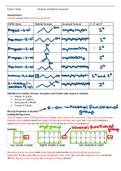
IUPAC Name Skeletal Formula Structural Formula 1°, 2° and 3°
Definition of a Methyl, Primary, Secondary and Tertiary with respect to Alcohols
Methyl CH3OH
Primary CH2ROH
Secondary CHR2OH
Tertiary CR3OH
Physical Properties of Alcohols
Melting/Boiling Points
Alcohols have a higher melting/boiling point than hydrocarbons of comparable molar mass as alcohols can
hydrogen bond as they contain an oxygen bonded to a hydrogen as oxygen has 2 lone pairs whereas a
typical hydrocarbon can only do dispersion forces which are weaker in comparison
Solubility
The alkyl chain is non-polar which is hydrophobic whereas the alcohol functional group is very
hydrophilic The longer the non-polar hydrophobic alkyl chain, the more the dispersion forces dominate
IMFs or dispersion forces disrupt the hydrogen bonding network
, Taylor’s Notes Alcohols and Optical Isomerism
Hydrogen Bonding between Methanol + Water
Optical Isomerism
Optical isomerism occurs when two compounds have the same molecular formula and structural formula
but are not superimposable on each other
If a compound contains a carbon atom bonded to four different groups or atoms it can exist in two forms
which are non-superimposable mirror images of each other
The carbon atom with four different groups around it (the chiral centre) is said to be asymmetric
The two mirror image molecules are said to be chiral
The two isomers affect plane polarised light by rotating the plane in opposite directions which is where the
word ‘optical’ comes
Optical isomers exist in two forms called enantiomers
An equimolar mixture does not rotate light at all as equal and opposite rotations cancel This optically
inactive mixture is called the racemic mixture or racemate
Optical isomers are important as biological systems only use one form of a given compound, the other may
have side effects, such as observed with Thalidomide
Nomenclature
Alcohols contain the functional group R-OH
IUPAC Name Skeletal Formula Structural Formula 1°, 2° and 3°
Definition of a Methyl, Primary, Secondary and Tertiary with respect to Alcohols
Methyl CH3OH
Primary CH2ROH
Secondary CHR2OH
Tertiary CR3OH
Physical Properties of Alcohols
Melting/Boiling Points
Alcohols have a higher melting/boiling point than hydrocarbons of comparable molar mass as alcohols can
hydrogen bond as they contain an oxygen bonded to a hydrogen as oxygen has 2 lone pairs whereas a
typical hydrocarbon can only do dispersion forces which are weaker in comparison
Solubility
The alkyl chain is non-polar which is hydrophobic whereas the alcohol functional group is very
hydrophilic The longer the non-polar hydrophobic alkyl chain, the more the dispersion forces dominate
IMFs or dispersion forces disrupt the hydrogen bonding network
, Taylor’s Notes Alcohols and Optical Isomerism
Hydrogen Bonding between Methanol + Water
Optical Isomerism
Optical isomerism occurs when two compounds have the same molecular formula and structural formula
but are not superimposable on each other
If a compound contains a carbon atom bonded to four different groups or atoms it can exist in two forms
which are non-superimposable mirror images of each other
The carbon atom with four different groups around it (the chiral centre) is said to be asymmetric
The two mirror image molecules are said to be chiral
The two isomers affect plane polarised light by rotating the plane in opposite directions which is where the
word ‘optical’ comes
Optical isomers exist in two forms called enantiomers
An equimolar mixture does not rotate light at all as equal and opposite rotations cancel This optically
inactive mixture is called the racemic mixture or racemate
Optical isomers are important as biological systems only use one form of a given compound, the other may
have side effects, such as observed with Thalidomide