Taylor’s Notes Periodicity Notes
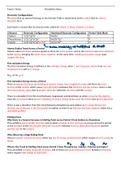
Electronic Configurations
The block that an element belongs in the Periodic Table is determined by the orbital that its valance
electrons lie in
Each block is named after its characteristic orbital S-block, P-block, D-block or F-block
Element Electronic Configuration Shorthand Electronic Configuration Period Table Block
Sodium 1s22s22p63s1 [Ne]3s1 S
Phosphorous 1s22s22p63s23p3 [Ne]3s23p3 P
Copper 1s22s22p63s23p64s13d10 [Ar]4s13d10 D
Atomic Radius Trend Across a Period
Atomic radius decreases across a period as there are more protons and so the electrons are more attracted
to the nucleus bringing the shells closer together, at the same time, shielding of nuclear charge stays
roughly the same
First Ionisation Energy
The First Ionisation Energy is defined as the enthalpy change when 1 mol of gaseous atoms form one mol
of gaseous ions with a 1+ charge
Na(g) Na+(g) + e-
First Ionisation Energy Across a Period
There is a general increase as shielding of nuclear charge stays roughly the same and there are more
protons in the nucleus which cause more attractions between the electrons and the nucleus, there is also
decreased atomic radius due to greater attraction between electrons and the nucleus
There is a deviation from this trend between magnesium and aluminium as when removing the electron
from the 3p subshell there is more shielding of nuclear charge so its easier to remove due to less attraction
There is also a deviation from this trend between phosphorous and sulphur as it’s easier to lose one
electron out of the pair in the 3p subshell in sulphur as there is an electron-electron repulsion which has a
destabilising effect
Melting Point
Why there is a General Increase in Melting Point across Period 3 from Sodium to Aluminium
They exhibit a giant metallic structure and so when a charge of ions increases as you go across the period
as the strength of the electrostatic attraction increases between a sea of delocalised electrons and the
positive ions in the nucleus
Why Silicon has a High Boiling Point
Silicon is a giant covalent structure which has lots of strong covalent bonds which require a lot of energy to
break
What is the Trend in Melting Point across Period 3 from Phosphorous, Sulphur, Chlorine and Argon?
They all exhibit a simple molecular structure and so there are weak dispersion forces between molecules
which require little energy to overcome
Electronic Configurations
The block that an element belongs in the Periodic Table is determined by the orbital that its valance
electrons lie in
Each block is named after its characteristic orbital S-block, P-block, D-block or F-block
Element Electronic Configuration Shorthand Electronic Configuration Period Table Block
Sodium 1s22s22p63s1 [Ne]3s1 S
Phosphorous 1s22s22p63s23p3 [Ne]3s23p3 P
Copper 1s22s22p63s23p64s13d10 [Ar]4s13d10 D
Atomic Radius Trend Across a Period
Atomic radius decreases across a period as there are more protons and so the electrons are more attracted
to the nucleus bringing the shells closer together, at the same time, shielding of nuclear charge stays
roughly the same
First Ionisation Energy
The First Ionisation Energy is defined as the enthalpy change when 1 mol of gaseous atoms form one mol
of gaseous ions with a 1+ charge
Na(g) Na+(g) + e-
First Ionisation Energy Across a Period
There is a general increase as shielding of nuclear charge stays roughly the same and there are more
protons in the nucleus which cause more attractions between the electrons and the nucleus, there is also
decreased atomic radius due to greater attraction between electrons and the nucleus
There is a deviation from this trend between magnesium and aluminium as when removing the electron
from the 3p subshell there is more shielding of nuclear charge so its easier to remove due to less attraction
There is also a deviation from this trend between phosphorous and sulphur as it’s easier to lose one
electron out of the pair in the 3p subshell in sulphur as there is an electron-electron repulsion which has a
destabilising effect
Melting Point
Why there is a General Increase in Melting Point across Period 3 from Sodium to Aluminium
They exhibit a giant metallic structure and so when a charge of ions increases as you go across the period
as the strength of the electrostatic attraction increases between a sea of delocalised electrons and the
positive ions in the nucleus
Why Silicon has a High Boiling Point
Silicon is a giant covalent structure which has lots of strong covalent bonds which require a lot of energy to
break
What is the Trend in Melting Point across Period 3 from Phosphorous, Sulphur, Chlorine and Argon?
They all exhibit a simple molecular structure and so there are weak dispersion forces between molecules
which require little energy to overcome