Photosynthesis
Plant and animal cells need energy for biological processes to occur:
• Plants need energy for things like photosynthesis, ac ve transport, DNA replica on, cell division and
protein synthesis
• Animals need energy for things like muscle contrac on, maintenance of body temperature, ac ve
transport, DNA replica on, cell division and protein synthesis
Photosynthesis takes place largely in the leaf. Adapta ons include:
• A large SA that absorbs as much sunlight as possible
• An arrangement of leaves on the plant that minimises overlapping and so avoids the shadowing of one
leaf by another
• Thin to allow light to be absorbed and the di usion distance for gases is kept short
• A transparent cu cle and epidermis that let light through to the photosynthe c mesophyll cells beneath
• Long, narrow upper mesophyll cells packed with chloroplasts that collect sunlight
• Numerous stomata for gas exchange so that all mesophyll cells are only a short di usion pathway away
from one
• Stomata that open and close in response to changes in light intensity
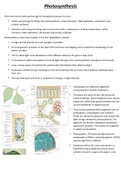
• Chloroplasts are a ened organelles
surrounded by a double membrane
• The grana are stacks of disc-like structures
called thylakoids. Some thylakoids have tubular
extensions called inter-granal lamellae that join
up with thylakoids in adjacent grana
• They contain photosynthe c pigments such as
chlorophyll a, chlorophyll b and carotene.
These are coloured substances that absorb the
light energy needed for photosynthesis. The
pigments are found in thylakoid membranes,
a ached to proteins. The protein and pigment
is called a photosystem
• Photosystem I (PSI) absorbs light best at a
wavelength of 700nm and photosystem II (PSII)
absorbs light best at 680nm
• Contained within the inner membrane is a
uid- lled matrix called the stroma which
contains enzymes, sugars and organic acids.
Plant and animal cells need energy for biological processes to occur:
• Plants need energy for things like photosynthesis, ac ve transport, DNA replica on, cell division and
protein synthesis
• Animals need energy for things like muscle contrac on, maintenance of body temperature, ac ve
transport, DNA replica on, cell division and protein synthesis
Photosynthesis takes place largely in the leaf. Adapta ons include:
• A large SA that absorbs as much sunlight as possible
• An arrangement of leaves on the plant that minimises overlapping and so avoids the shadowing of one
leaf by another
• Thin to allow light to be absorbed and the di usion distance for gases is kept short
• A transparent cu cle and epidermis that let light through to the photosynthe c mesophyll cells beneath
• Long, narrow upper mesophyll cells packed with chloroplasts that collect sunlight
• Numerous stomata for gas exchange so that all mesophyll cells are only a short di usion pathway away
from one
• Stomata that open and close in response to changes in light intensity
• Chloroplasts are a ened organelles
surrounded by a double membrane
• The grana are stacks of disc-like structures
called thylakoids. Some thylakoids have tubular
extensions called inter-granal lamellae that join
up with thylakoids in adjacent grana
• They contain photosynthe c pigments such as
chlorophyll a, chlorophyll b and carotene.
These are coloured substances that absorb the
light energy needed for photosynthesis. The
pigments are found in thylakoid membranes,
a ached to proteins. The protein and pigment
is called a photosystem
• Photosystem I (PSI) absorbs light best at a
wavelength of 700nm and photosystem II (PSII)
absorbs light best at 680nm
• Contained within the inner membrane is a
uid- lled matrix called the stroma which
contains enzymes, sugars and organic acids.