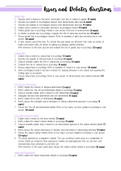
1. Evolutionary explanations for partner preferences
AO1:
- Sexual selection: evolutionary explanation of partner preference. Darwin.
Attributes/behaviours that increase reproductive success are passed on/exaggerated
in successive generations.
- Inter-sexual selection: between the sexes. Preferred strategy of the female, quality
over quantity. Trivers suggested that females make better investments around the
birth of offspring.
- Intra-sexual selection: means within the sexes, preferred male strategy to seek
quantity over quantity. Youthfulness is desired as men compete for more ‘fertile’
women. Pass on victorious genes for survival; larger body, aggression.
- Anisogamy: refers to the difference between male and female sex cells. Male sex
gametes are in large numbers, no shortage. Female gametes are more rare, giving
rise to mating strategies.
AO3:
STRENGTHS: P: research to support intra-sexual selection. E: Buss carried out a
survey of 10,000 adults across 33 countries. Asked questions in relation to
evolutionary theory predicting that these are important in partner preference.
Findings; females value resources, males value physical attractiveness and youth
(good reproductive capacity). E: reflect sex differences in partner preferences,
support preduction from sexual selection theory.
- P: research support for inter-sexual selection. E: Clark and Hatfield sent male and
female psychology students on uni campus. Asked question ‘I have been noticing
you around campus. I find you to be very attractive. Would you go to bed with me?’
0% of female students agreed, but 75% of males did immediately. E: supports the
view that women are more choosy with males with sexual partners, males adopted
different strategies to ensure reproductive success.
- CP: P: simplistic argument that one strategy is used by all males and one is used for
all females. E: Buss and Schmidt found that both sexes adopt similar mating
strategies when looking for long-term relationships; more choosy, seek more loving,
loyal and kind partners. E: more complex view of evolutionary pressures that
influence partner preferences, taking into account context of reproductive behaviours.
LIMITATION: P: underestimate social and cultural influences on partner preferences.
E: partner preferences have been impacted by changing social norms even in the
last century. Change faster than evolutionary timescales, influenced by cultural
changes such as availability of contraception. Women’s bigger role in the workplace
means that they are no longer reliant on males for resources. Has an impact on
women’s mating preferences, no longer resource oriented. E: today's partner
preferences are likely to be a combo of evolutionary/cultural influences. Theories that
do not account for both have limited explanations.
2. Factors affecting attraction - self disclosure
AO1:
- Self-disclosure: revealing personal info about yourself. Romantic partners reveal
more about themselves as the relationship develops. Can strengthen romantic bonds
when used appropriately.
- Social penetration theory: Altman and Taylor’s theory. Gradual process of revealing
thoughts and feelings to someone else. In romantic relationships, it involves
, reciprocal exchange as it shows signs of trust. Increasingly sharing causes deeper
‘penetration’ into each other's lives.
- Breadth and depth of self-disclosure: Altman and Taylor. Suggest two elements of
self-disclosure, as it increases there is more commitment to one another. Like layers
of an onion. SD becomes deeper as you go on in a relationship, eventually revealing
intimate ‘high risk’ info such as painful experiences and secrets. As disengagement
from a relationship occurs self-disclosure decreases - depenetration.
- Reciprocity: Reis and Shaver. For relationships to develop as well as depth and
breadth, must also have reciprocity. Balance in sharing intimate details, which
increases feelings of intimacy and deepens relationships.
AO3:
STRENGTHS: P: real world application. E: partners may deliberately use self-
disclosure to deepen relationships. Haas and Stafford found that 57% of homosexual
men and women sadid that honest self-disclouse is bet way to maintain/deepen
relationship. Less skilled partners (limited communication) learning to self-disclosure
could benefit relationships - shows satisfaction/commitment. E: psychological insight
can be valuable in helping relationship problems.
- P: predictions of self-disclosure from social penetration theory have research
support. E: Sprecher and Hendrick found strong correlation of hetrosexual couples
for satisfaction and self-disclosure. Those who used self-disclosure and felt it
reciprocated were more satisfied with relationships. Sprecher found in later study that
relationships are more satisfied when they take turns in self-disclosure. E: findings
support validity of theory.
- CP: P: self-disclosure research is correlational. E: assumed that self-disclosure leads
to more satisfaction but a correlational study cannot say if this is a valid conclusion.
Alt explanations can also exist; more satisfaction can lead to self-disclosure. Or
perhaps another variable, such as the amount of time spent together. E: self-
disclosure may not lead to direct satisfaction, reducing validity of the theory.
- LIMITATION: P: not accurate for all cultures to have increasing depth and breadth of
relationship to lead to more satisfying relationships. E: Tang et al reviewed research
into self-disclosure. Individualist cultures share more seual thought and feelings
compared to collectivist cultures. Lower levels of disclosure however does not mean
lower levels of satisfaction. E: self-disclosure theory is limited as it is based on
Western cultures and is not generalizable to other cultures.
3. Factors affecting attraction - physical attractiveness
AO1:
- Physical attractiveness: important factor in formation of romantic relationships. How
appealing we find someone’s face. General agreement across cultures of what is
considered physically attractive, and that relationships are formed with the most
attractive person available.
- Shackleford and Larsen: symmetry is more attractive as it is hard to fake, a sign of
genetic fitness. Also attracted to neotenous features as they trigger protective instinct
which is valuable for reproducing females.
- Halo effect: preconceived ideas of personality traits based on attractiveness. Dion et
al ‘What is beautiful is good’. Findings; physically attractive people that are seen with
good personality traits are seen as more attractive, leading more positive behaviours
towards them. Halo effect - one distinguishing feature (attractiveness) can lead to
disproportionate influence on judgement of attributes such as personality.
AO1:
- Sexual selection: evolutionary explanation of partner preference. Darwin.
Attributes/behaviours that increase reproductive success are passed on/exaggerated
in successive generations.
- Inter-sexual selection: between the sexes. Preferred strategy of the female, quality
over quantity. Trivers suggested that females make better investments around the
birth of offspring.
- Intra-sexual selection: means within the sexes, preferred male strategy to seek
quantity over quantity. Youthfulness is desired as men compete for more ‘fertile’
women. Pass on victorious genes for survival; larger body, aggression.
- Anisogamy: refers to the difference between male and female sex cells. Male sex
gametes are in large numbers, no shortage. Female gametes are more rare, giving
rise to mating strategies.
AO3:
STRENGTHS: P: research to support intra-sexual selection. E: Buss carried out a
survey of 10,000 adults across 33 countries. Asked questions in relation to
evolutionary theory predicting that these are important in partner preference.
Findings; females value resources, males value physical attractiveness and youth
(good reproductive capacity). E: reflect sex differences in partner preferences,
support preduction from sexual selection theory.
- P: research support for inter-sexual selection. E: Clark and Hatfield sent male and
female psychology students on uni campus. Asked question ‘I have been noticing
you around campus. I find you to be very attractive. Would you go to bed with me?’
0% of female students agreed, but 75% of males did immediately. E: supports the
view that women are more choosy with males with sexual partners, males adopted
different strategies to ensure reproductive success.
- CP: P: simplistic argument that one strategy is used by all males and one is used for
all females. E: Buss and Schmidt found that both sexes adopt similar mating
strategies when looking for long-term relationships; more choosy, seek more loving,
loyal and kind partners. E: more complex view of evolutionary pressures that
influence partner preferences, taking into account context of reproductive behaviours.
LIMITATION: P: underestimate social and cultural influences on partner preferences.
E: partner preferences have been impacted by changing social norms even in the
last century. Change faster than evolutionary timescales, influenced by cultural
changes such as availability of contraception. Women’s bigger role in the workplace
means that they are no longer reliant on males for resources. Has an impact on
women’s mating preferences, no longer resource oriented. E: today's partner
preferences are likely to be a combo of evolutionary/cultural influences. Theories that
do not account for both have limited explanations.
2. Factors affecting attraction - self disclosure
AO1:
- Self-disclosure: revealing personal info about yourself. Romantic partners reveal
more about themselves as the relationship develops. Can strengthen romantic bonds
when used appropriately.
- Social penetration theory: Altman and Taylor’s theory. Gradual process of revealing
thoughts and feelings to someone else. In romantic relationships, it involves
, reciprocal exchange as it shows signs of trust. Increasingly sharing causes deeper
‘penetration’ into each other's lives.
- Breadth and depth of self-disclosure: Altman and Taylor. Suggest two elements of
self-disclosure, as it increases there is more commitment to one another. Like layers
of an onion. SD becomes deeper as you go on in a relationship, eventually revealing
intimate ‘high risk’ info such as painful experiences and secrets. As disengagement
from a relationship occurs self-disclosure decreases - depenetration.
- Reciprocity: Reis and Shaver. For relationships to develop as well as depth and
breadth, must also have reciprocity. Balance in sharing intimate details, which
increases feelings of intimacy and deepens relationships.
AO3:
STRENGTHS: P: real world application. E: partners may deliberately use self-
disclosure to deepen relationships. Haas and Stafford found that 57% of homosexual
men and women sadid that honest self-disclouse is bet way to maintain/deepen
relationship. Less skilled partners (limited communication) learning to self-disclosure
could benefit relationships - shows satisfaction/commitment. E: psychological insight
can be valuable in helping relationship problems.
- P: predictions of self-disclosure from social penetration theory have research
support. E: Sprecher and Hendrick found strong correlation of hetrosexual couples
for satisfaction and self-disclosure. Those who used self-disclosure and felt it
reciprocated were more satisfied with relationships. Sprecher found in later study that
relationships are more satisfied when they take turns in self-disclosure. E: findings
support validity of theory.
- CP: P: self-disclosure research is correlational. E: assumed that self-disclosure leads
to more satisfaction but a correlational study cannot say if this is a valid conclusion.
Alt explanations can also exist; more satisfaction can lead to self-disclosure. Or
perhaps another variable, such as the amount of time spent together. E: self-
disclosure may not lead to direct satisfaction, reducing validity of the theory.
- LIMITATION: P: not accurate for all cultures to have increasing depth and breadth of
relationship to lead to more satisfying relationships. E: Tang et al reviewed research
into self-disclosure. Individualist cultures share more seual thought and feelings
compared to collectivist cultures. Lower levels of disclosure however does not mean
lower levels of satisfaction. E: self-disclosure theory is limited as it is based on
Western cultures and is not generalizable to other cultures.
3. Factors affecting attraction - physical attractiveness
AO1:
- Physical attractiveness: important factor in formation of romantic relationships. How
appealing we find someone’s face. General agreement across cultures of what is
considered physically attractive, and that relationships are formed with the most
attractive person available.
- Shackleford and Larsen: symmetry is more attractive as it is hard to fake, a sign of
genetic fitness. Also attracted to neotenous features as they trigger protective instinct
which is valuable for reproducing females.
- Halo effect: preconceived ideas of personality traits based on attractiveness. Dion et
al ‘What is beautiful is good’. Findings; physically attractive people that are seen with
good personality traits are seen as more attractive, leading more positive behaviours
towards them. Halo effect - one distinguishing feature (attractiveness) can lead to
disproportionate influence on judgement of attributes such as personality.