CHAPTER 20
The Definite Integral and the
Fundamental Theorem of Calculus
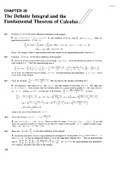
20.1 Evaluate 4 dx by the direct (Riemann) definition of the integral.
Let 2 = x0 <xl < • • • < xn_i < xn =5 be any partition of [2,5], and let A,JC = x. —*,•_,. Then an
approximating sum for 4 dx is
= 4(jt,, - x0) = 4(5 - 2) = 4 • 3 = 12.
Hence, the integral, which is approximated arbitrarily closely by the approximating sums, must be 12.
20.2 Calculate 5x2dx by the direct definition of the integral.
Divide [0,1] into n equal subintervals, each of length A,* = l//i. In the /th subinterval, choose x* to be the
right endpoint i/n. Then the approximating sum is
As we make the subdivision finer by letting n —» +», the approximating sum approaches | • 1 • 2 =which
f,
is the value of the integral.
20.3 Prove the formula that was used in the solution of Problem 20.2.
Use induction with respect to n. For n = l. the sum consists of one term (I) 2 = 1. The right side
is ( l - 2 - 3 ) / 6 = l . Now assume that the formula holds for a given positive integer n. We must prove it
for n + I. Adding (n + I) 2 to both sides of the formula we have
which is the case of the formula for n + 1.
20.4 Prove the formula 1+ 2+ • • •+ n =
Let S = 1 + 2 + • • • + (n - 1) + n. Then we also can write 5 = n + (n - 1) + • • • + 2 + 1. If we add
these two equations column by column, we see that 25 is equal to the number n + I added to itself n times.
Thus, 25 = «(« + !), S = n ( n + l)/2.
20.5 Show that by the direct definition of the integral.
Divide the interval [0, b\ into n equal subintervals of length bin, by the points 0 = x0 < bin <2bln<- • • <
nbln = x = b. In the ith subinterval choose x* to be the right-hand endpoint Ibln. Then an approximating
sum is As «—»+«>, the approximating sum approaches
b 12, which is, therefore, the value of the integral.
152
, THE DEFINITE INTEGRAL AND THE FUNDAMENTAL THEOREM OF CALCULUS 153
20.6 Evaluate
20.7 Evaluate
20.8 For the function / graphed in Fig. 20-1, express f(x) dx in terms of the areas Al, A2, and A3.
Fig. 20-1
I The integral is equal to the sum of the areas above the *-axis and under the graph, minus the sum of the areas
under the x-axis and above the graph. Hence, J05 f(x) dx = A2 - Al - A3.
In Problems 20.9-20.14, use the fundamental theorem of calculus to compute the given definite integral.
20.9 (3x2 - 2x + 1) dx.
(3x2 -2x + l)dx = x3-x2 + x. (We omit the arbitrary constant in all such cases.) So (3x2 -2x +
l ) ^ = ( ^ 3 - x 2 + ^)] 3 _ 1 = (3 3 -3 2 + 3)-[(-l) 3 -(-l) 2 + (-l)] = 21-(-3) = 24.
20.10 cos x dx.
cos x dx = sin x. Hence,
20.11 J7/3 sec2 x dx.
sec2 x dx = tan x. Hence,
20.12 x312 dx
x312 dx = f x5'2. Hence,
20.1
dx = $ (2x'l/2 -x)dx = 4xl/2 - \x2. Hence,
The Definite Integral and the
Fundamental Theorem of Calculus
20.1 Evaluate 4 dx by the direct (Riemann) definition of the integral.
Let 2 = x0 <xl < • • • < xn_i < xn =5 be any partition of [2,5], and let A,JC = x. —*,•_,. Then an
approximating sum for 4 dx is
= 4(jt,, - x0) = 4(5 - 2) = 4 • 3 = 12.
Hence, the integral, which is approximated arbitrarily closely by the approximating sums, must be 12.
20.2 Calculate 5x2dx by the direct definition of the integral.
Divide [0,1] into n equal subintervals, each of length A,* = l//i. In the /th subinterval, choose x* to be the
right endpoint i/n. Then the approximating sum is
As we make the subdivision finer by letting n —» +», the approximating sum approaches | • 1 • 2 =which
f,
is the value of the integral.
20.3 Prove the formula that was used in the solution of Problem 20.2.
Use induction with respect to n. For n = l. the sum consists of one term (I) 2 = 1. The right side
is ( l - 2 - 3 ) / 6 = l . Now assume that the formula holds for a given positive integer n. We must prove it
for n + I. Adding (n + I) 2 to both sides of the formula we have
which is the case of the formula for n + 1.
20.4 Prove the formula 1+ 2+ • • •+ n =
Let S = 1 + 2 + • • • + (n - 1) + n. Then we also can write 5 = n + (n - 1) + • • • + 2 + 1. If we add
these two equations column by column, we see that 25 is equal to the number n + I added to itself n times.
Thus, 25 = «(« + !), S = n ( n + l)/2.
20.5 Show that by the direct definition of the integral.
Divide the interval [0, b\ into n equal subintervals of length bin, by the points 0 = x0 < bin <2bln<- • • <
nbln = x = b. In the ith subinterval choose x* to be the right-hand endpoint Ibln. Then an approximating
sum is As «—»+«>, the approximating sum approaches
b 12, which is, therefore, the value of the integral.
152
, THE DEFINITE INTEGRAL AND THE FUNDAMENTAL THEOREM OF CALCULUS 153
20.6 Evaluate
20.7 Evaluate
20.8 For the function / graphed in Fig. 20-1, express f(x) dx in terms of the areas Al, A2, and A3.
Fig. 20-1
I The integral is equal to the sum of the areas above the *-axis and under the graph, minus the sum of the areas
under the x-axis and above the graph. Hence, J05 f(x) dx = A2 - Al - A3.
In Problems 20.9-20.14, use the fundamental theorem of calculus to compute the given definite integral.
20.9 (3x2 - 2x + 1) dx.
(3x2 -2x + l)dx = x3-x2 + x. (We omit the arbitrary constant in all such cases.) So (3x2 -2x +
l ) ^ = ( ^ 3 - x 2 + ^)] 3 _ 1 = (3 3 -3 2 + 3)-[(-l) 3 -(-l) 2 + (-l)] = 21-(-3) = 24.
20.10 cos x dx.
cos x dx = sin x. Hence,
20.11 J7/3 sec2 x dx.
sec2 x dx = tan x. Hence,
20.12 x312 dx
x312 dx = f x5'2. Hence,
20.1
dx = $ (2x'l/2 -x)dx = 4xl/2 - \x2. Hence,