Week 1
Lecture (1): intro to scientific method
How does fake news affect the population
Does a campaign work? What are the effects? For whom does it work? Different effect for
different people? Why does it work (or not)?
Knowledge is based on
- intuition/belief (gut feeling)
- Consensus
- Tenacity
- Authority
- Observation (empiricism)
- Logical reasoning
Scientific research is a systematic process of gathering theoretical knowledge through
observation (empiricism).
Empirical Based on social reality
Systematic and cumulative
- Builds on previous research
- In search for patterns and associations
Research is a systematic process
- Posing questions
- Answering questions
- Demonstration that your results are valid
- Sharing your research results
Communication research is a systematic process of asking and answering questions about
human communication
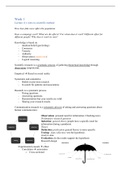
Observation: personal need for information. Checking news
Preliminary research question
Induction: general theory people have a specific need for
information during a pandemic
Theory
Deduction: predication general theory to more specific
Testing: data collection; test the hypothesis
Analyze data
Evaluation: do the results support the hypothesis
Research design
-
Experimental (casual) effect
- Correlation association
o Cross-sectional
, o Longitudinal
Data collection
- Observation during experiment in real life
- Pose questions survey in-depth focus group interviews
- analyze content - content of existing
SUMMARY
You now know what communication research is about:
- Systematic process
- Posing questions
- Answering questions with valid results
- Sharing your results
- Based on your research objective and question you choose a strategy
- Two main research strategies –quantitative & qualitative
- Based on the strategy you chose, you determine design and data collection method
Micro lectures
Non- scientific methods
- Intuition/belief
- Consensus Opinion
- Authority
- Causal observation
- Informal logic Biased/flawed
Scientific method
We can’t use this we need systematic observation that is formal logic, consistently applies
also known as the scientific method
- Better chance of valid explanations
- Evaluate plausibility of hypotheses
Scientific method 6 principles
1. Empirically testable physical data, observations
2. Replicable repeat the setting, repeatedly
3. Objective doesn’t matter who does it, should get the same results, clear
assumptions, concepts, procedures, independently
4. Transparent replicated by anyone, publicly shared information
5. Falsifiable imagine finding contradictions to the hypothesis
6. Logically consistent Hypothesis internally coherent, conclusion logically
consistent, logically sound
Scientific claims
Scientific attitude; critical, open transparent, able to get critique
Basic claim – observation (accurate or inaccurate); doesn’t describe/explain, general relation
,Hypothesis / Law – describes/explain pattern, general relation; not/strongly supported. A law
is strongly supported, a formula.
Theory – overarching explanation of many related phenomena
Empirical cycle
Process of hypotheses and testing, systematic. Hypothetical deductive approach
Observation sparks idea for hypothesis, interesting relation we want to explain come from
previous research. Observing relation one or more instances
Induction general rule, with inductive reasoning relation in specific instance is
transformed to a general rule
§
Deduction relation should hold in new instances, expectation/prediction is deduced about
new observations; hypothesis is transformed with deductive reasoning and specification of
research set up into prediction about new observations
Testing statistical processing compare data to predictions data collection; descriptive-
summarize; inferential-decide. New data collected and – with aid of statistics – compared to
predictions
Evaluation interoperate results in terms of hypothesis, prediction confirmed > hypothesis
provisionally supported, prediction disconfirmed > not automatically rejected, repeat research
or adjust hypothesis
Epistemology
How can we know it?
- What is knowledge
- Epistemology study of knowledge
Rationalism knowledge through reasoning, plato and decart
Empiricism knowledge through sensory experience, Aristotle
Ontology
Study of being
Nature of reality
- Existence or external reality
o Outside
Materialism
Everything is interaction of physical matter
o Only in mind
, Idealism
- Existence of
o Particulars
Specific instances
o Universal
Abstract, (love)
Lecture (2): intro to scientific method
A systematic process of gathering theoretical knowledge
through observation
World View I
- Human communication is objectively measurable and
can be summarized in rules.
- “Nomothetic” approach (involves rules and patterns)
World View II
- Human communication is subjective, individualistic and must be described as such.
- “Idiographic” approach (uniqueness of subjects, objects or phenomena)
Two scientific approaches
- Empirical-Analytical
o Observe, measure from researcher’s perspective
o Observation= empiricism
o Explaining
o Rule out alternative explanations
o Nomothetic approach (worldview I): reality is objectively measurable, uses
reason
o Quantitative
o Experiment, survey, content analysis
- Empirical-Interpretative
o Observe, interpret from participants’ perspectives
o Understanding
o Idiographic approach (worldview II): communication is subjective and unique
and must be described as such
o Qualitative
o Individual interviews, focus group interviews, ethnography
Falsification
- Verification confirm interpretative approach
- Falsification refute analytical approach
- If not refuted...then provisional truth: you found supportfor your hypothesis
INCORRECT: you acceptedyour hypothesis
Hypothesis
- Scientific claim
- Testable statement about reality (the world around us)
- We test by observing (social) reality = empiricism (scientific method)
Lecture (1): intro to scientific method
How does fake news affect the population
Does a campaign work? What are the effects? For whom does it work? Different effect for
different people? Why does it work (or not)?
Knowledge is based on
- intuition/belief (gut feeling)
- Consensus
- Tenacity
- Authority
- Observation (empiricism)
- Logical reasoning
Scientific research is a systematic process of gathering theoretical knowledge through
observation (empiricism).
Empirical Based on social reality
Systematic and cumulative
- Builds on previous research
- In search for patterns and associations
Research is a systematic process
- Posing questions
- Answering questions
- Demonstration that your results are valid
- Sharing your research results
Communication research is a systematic process of asking and answering questions about
human communication
Observation: personal need for information. Checking news
Preliminary research question
Induction: general theory people have a specific need for
information during a pandemic
Theory
Deduction: predication general theory to more specific
Testing: data collection; test the hypothesis
Analyze data
Evaluation: do the results support the hypothesis
Research design
-
Experimental (casual) effect
- Correlation association
o Cross-sectional
, o Longitudinal
Data collection
- Observation during experiment in real life
- Pose questions survey in-depth focus group interviews
- analyze content - content of existing
SUMMARY
You now know what communication research is about:
- Systematic process
- Posing questions
- Answering questions with valid results
- Sharing your results
- Based on your research objective and question you choose a strategy
- Two main research strategies –quantitative & qualitative
- Based on the strategy you chose, you determine design and data collection method
Micro lectures
Non- scientific methods
- Intuition/belief
- Consensus Opinion
- Authority
- Causal observation
- Informal logic Biased/flawed
Scientific method
We can’t use this we need systematic observation that is formal logic, consistently applies
also known as the scientific method
- Better chance of valid explanations
- Evaluate plausibility of hypotheses
Scientific method 6 principles
1. Empirically testable physical data, observations
2. Replicable repeat the setting, repeatedly
3. Objective doesn’t matter who does it, should get the same results, clear
assumptions, concepts, procedures, independently
4. Transparent replicated by anyone, publicly shared information
5. Falsifiable imagine finding contradictions to the hypothesis
6. Logically consistent Hypothesis internally coherent, conclusion logically
consistent, logically sound
Scientific claims
Scientific attitude; critical, open transparent, able to get critique
Basic claim – observation (accurate or inaccurate); doesn’t describe/explain, general relation
,Hypothesis / Law – describes/explain pattern, general relation; not/strongly supported. A law
is strongly supported, a formula.
Theory – overarching explanation of many related phenomena
Empirical cycle
Process of hypotheses and testing, systematic. Hypothetical deductive approach
Observation sparks idea for hypothesis, interesting relation we want to explain come from
previous research. Observing relation one or more instances
Induction general rule, with inductive reasoning relation in specific instance is
transformed to a general rule
§
Deduction relation should hold in new instances, expectation/prediction is deduced about
new observations; hypothesis is transformed with deductive reasoning and specification of
research set up into prediction about new observations
Testing statistical processing compare data to predictions data collection; descriptive-
summarize; inferential-decide. New data collected and – with aid of statistics – compared to
predictions
Evaluation interoperate results in terms of hypothesis, prediction confirmed > hypothesis
provisionally supported, prediction disconfirmed > not automatically rejected, repeat research
or adjust hypothesis
Epistemology
How can we know it?
- What is knowledge
- Epistemology study of knowledge
Rationalism knowledge through reasoning, plato and decart
Empiricism knowledge through sensory experience, Aristotle
Ontology
Study of being
Nature of reality
- Existence or external reality
o Outside
Materialism
Everything is interaction of physical matter
o Only in mind
, Idealism
- Existence of
o Particulars
Specific instances
o Universal
Abstract, (love)
Lecture (2): intro to scientific method
A systematic process of gathering theoretical knowledge
through observation
World View I
- Human communication is objectively measurable and
can be summarized in rules.
- “Nomothetic” approach (involves rules and patterns)
World View II
- Human communication is subjective, individualistic and must be described as such.
- “Idiographic” approach (uniqueness of subjects, objects or phenomena)
Two scientific approaches
- Empirical-Analytical
o Observe, measure from researcher’s perspective
o Observation= empiricism
o Explaining
o Rule out alternative explanations
o Nomothetic approach (worldview I): reality is objectively measurable, uses
reason
o Quantitative
o Experiment, survey, content analysis
- Empirical-Interpretative
o Observe, interpret from participants’ perspectives
o Understanding
o Idiographic approach (worldview II): communication is subjective and unique
and must be described as such
o Qualitative
o Individual interviews, focus group interviews, ethnography
Falsification
- Verification confirm interpretative approach
- Falsification refute analytical approach
- If not refuted...then provisional truth: you found supportfor your hypothesis
INCORRECT: you acceptedyour hypothesis
Hypothesis
- Scientific claim
- Testable statement about reality (the world around us)
- We test by observing (social) reality = empiricism (scientific method)