NR 566 WEEK ONE QUIZ
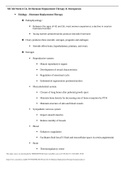
R 566 Week 1 Notes Ch. 21, 33, & 41 Chapter 21: Drugs Affecting the Endocrine System Bisphosphonates Pharmacokinetics Absorption and Distribution o All oral bisphosphonates potentially cause esophagitis and gastric irritation o Absorption and bioavailability of oral doses are significantly reduced by the presence of food in the gut or other preparations containing divalent cations. o To enhance absorption, the patient takes the drug with 8 oz of water, No other food or drink should be ingested, and the patient must remain upright for at least half an hour (1 hour with ibandronate). o all mainly distributed to bone. o Their terminal half-life in bone is exceedingly long, varying from more than 10 years for alendronate to more than 90 days for etidronate. o The half-life of risedronate is much shorter, at 480 hours; ibandronate is 220 hours; zoledronic acid is 167 hours; and tiludronate is 150 hours these times are thought to represent the dissociation of the drug from the bone surface, rather than its time within the bone. o Most bisphosphonates are Pregnancy Category C. Pamidronate and zoledronic acid are Category D o All bisphosphonates are used with extreme caution during breastfeeding; zoledronic acid binds to bone for long periods so is never used in lactating mothers. o Safety and efficacy in children have not been fully established, but children have been treated with etidronate (Pregnancy Category B) at doses recommended for adults to prevent heterotopic ossifications or soft tissue calcifications Metabolism and Excretion o no evidence that any are systemically metabolized. o Drug that is not distributed to bone is largely excreted in the urine. o these drugs are not recommended for patients with moderate to severe renal impairment (serum creatinine greater than 4.9; creatinine clearance (CCr) less than 30 to 35 mL/min). Dosage adjustments may be necessary if the drug must be given Pharmacodynamics (MOA) adhere tightly to bone and, by inhibiting osteoclastic activity, are potent inhibitors of both normal and abnormal bone resorption. Etidronate (Didronel) reduces both bone resorption and bone formation because formation is coupled with resorption. Pamidronate (Aredia) and risedronate (Actonel) inhibit bone resorption without inhibiting bone formation and mineralization Alendronate (Fosamax) is a highly selective inhibitor of bone resorption and is 100 to 500 times more potent than the other drugs. o does not interfere with osteoclast recruitment or attachment, o does inhibit osteoclastic activity Tiludronate (Skelid) inhibits osteoclastic activity through two different mechanisms. o It inhibits protein-tyrosine-phosphatase, resulting in detachment of osteoclasts from the bone surface, o It inhibits the osteoclastic proton pump. Zoledronic acid (Zometa) inhibits osteoclastic activity and induces osteoclast apoptosis. o also inhibits the increased osteoclastic activity and skeletal calcium release induced by various stimulatory factors released by tumors. Ibandronate (Boniva) inhibits osteoclast activity and reduces bone resorption and turnover based on its affinity for hydroxyapatite, which is part of the mineral matrix of the bone

Geschreven voor
- Instelling
- Chamberlain College Of Nursing
- Vak
- NR 566 / NR566
Documentinformatie
- Geüpload op
- 9 juli 2022
- Aantal pagina's
- 5
- Geschreven in
- 2021/2022
- Type
- Overig
- Persoon
- Onbekend
Onderwerpen
-
nr 566 week one quiz

Ook beschikbaar in voordeelbundel