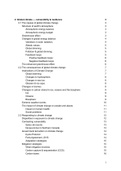
2. Global climate — vulnerability & resilience 3
2.1 The causes of global climate change 3
Structure of earth's atmosphere 3
Atmospheric energy balance 3
Atmospheric energy budget 3
Greenhouse effect 3
Changes in global energy balance 4
Variations in solar radiation: 4
Albedo values: 5
Global dimming: 5
Pollution & global dimming: 5
Feedback loops: 5
Positive feedback loops: 6
Negative feedback loops: 6
The enhanced greenhouse effect 6
2.2 The consequences of global climate change 7
Implications of Climate Change: 7
Global warming: 7
Changes to hydrosphere: 8
Changes in sea ice: 8
Glaciers & ice caps: 8
Changes in biomes: 8
Changes in carbon stored in ice, oceans and the biosphere 9
Ice: 9
Oceans: 9
Biosphere: 9
Extreme weather events 10
The impact of climate change on people and places 11
Impact on human health: 11
Social problems: 11
2.3 Responding to climate change 12
Disparities in exposure to climate change 12
Contrasting vulnerability 13
Swiss ski resorts: 13
Nunavummiut in Northern Canada: 13
Government led action on climate change 14
Kyoto Protocol: 14
Paris Agreement, 2015: 14
Adaptation strategies: 15
Mitigation strategies 15
What mitigation involves: 15
Carbon capture & sequestration (CCS): 15
Carbon taxes: 16
1
, Carbon trading: 16
Carbon offset schemes: 16
Geo-engineering: 16
Ocean fertilisation: 16
Civil society and corporate strategies to address global climate change 16
Civil societies: 16
Case Study: Women in Bangladesh 17
Case study: WWF Australia 17
2
, 2. Global climate — vulnerability & resilience
2.1 The causes of global climate change
Structure of earth's atmosphere
Atmosphere:
● a mixture of solids, liquids a gases
● up to 80km height
● gases: oxygen, nitrogen, argon, carbon dioxide and other gases
→ several layers of gases that makes our earth function and protects us from the sun
and other space debris
Atmospheric energy balance
Insolation: incoming solar radiation
● open energy system that receives energy from the Sun (insolation) and the earth
● solar energy regulates all weather systems and climates
● Earth's energy:
○ comes from tropical regions
○ is lost in temperate or polar regions
→ energy is redistributed by wind circulation and ocean currents
Atmospheric energy budget
Radiation: emission of short & long wavelengths → most of the Sun’s radiation is short
waves (visible light & ultraviolet rays)
Convection: transfer of heat by the movement of a gas or liquid
Conduction: transfer of heat by contact
● was balance between inputs (insolation) and outputs (re-radiation)
→ BUT recent imbalance → global warming → because of human activity
● normal balance is achieved through radiation , convection & conduction
● solar energy:
○ 46% is absorbed by the
earth
○ 31% is reflected to space
○ 22% drives the
hydrological cycle
○ 1% powers the winds and
ocean currents
Greenhouse effect
Greenhouse effect: process by which
greenhouse gases allow solar radiation to
pass through the atmosphere but trap a
part of outgoing long-wave radiation from the Earth
3
2.1 The causes of global climate change 3
Structure of earth's atmosphere 3
Atmospheric energy balance 3
Atmospheric energy budget 3
Greenhouse effect 3
Changes in global energy balance 4
Variations in solar radiation: 4
Albedo values: 5
Global dimming: 5
Pollution & global dimming: 5
Feedback loops: 5
Positive feedback loops: 6
Negative feedback loops: 6
The enhanced greenhouse effect 6
2.2 The consequences of global climate change 7
Implications of Climate Change: 7
Global warming: 7
Changes to hydrosphere: 8
Changes in sea ice: 8
Glaciers & ice caps: 8
Changes in biomes: 8
Changes in carbon stored in ice, oceans and the biosphere 9
Ice: 9
Oceans: 9
Biosphere: 9
Extreme weather events 10
The impact of climate change on people and places 11
Impact on human health: 11
Social problems: 11
2.3 Responding to climate change 12
Disparities in exposure to climate change 12
Contrasting vulnerability 13
Swiss ski resorts: 13
Nunavummiut in Northern Canada: 13
Government led action on climate change 14
Kyoto Protocol: 14
Paris Agreement, 2015: 14
Adaptation strategies: 15
Mitigation strategies 15
What mitigation involves: 15
Carbon capture & sequestration (CCS): 15
Carbon taxes: 16
1
, Carbon trading: 16
Carbon offset schemes: 16
Geo-engineering: 16
Ocean fertilisation: 16
Civil society and corporate strategies to address global climate change 16
Civil societies: 16
Case Study: Women in Bangladesh 17
Case study: WWF Australia 17
2
, 2. Global climate — vulnerability & resilience
2.1 The causes of global climate change
Structure of earth's atmosphere
Atmosphere:
● a mixture of solids, liquids a gases
● up to 80km height
● gases: oxygen, nitrogen, argon, carbon dioxide and other gases
→ several layers of gases that makes our earth function and protects us from the sun
and other space debris
Atmospheric energy balance
Insolation: incoming solar radiation
● open energy system that receives energy from the Sun (insolation) and the earth
● solar energy regulates all weather systems and climates
● Earth's energy:
○ comes from tropical regions
○ is lost in temperate or polar regions
→ energy is redistributed by wind circulation and ocean currents
Atmospheric energy budget
Radiation: emission of short & long wavelengths → most of the Sun’s radiation is short
waves (visible light & ultraviolet rays)
Convection: transfer of heat by the movement of a gas or liquid
Conduction: transfer of heat by contact
● was balance between inputs (insolation) and outputs (re-radiation)
→ BUT recent imbalance → global warming → because of human activity
● normal balance is achieved through radiation , convection & conduction
● solar energy:
○ 46% is absorbed by the
earth
○ 31% is reflected to space
○ 22% drives the
hydrological cycle
○ 1% powers the winds and
ocean currents
Greenhouse effect
Greenhouse effect: process by which
greenhouse gases allow solar radiation to
pass through the atmosphere but trap a
part of outgoing long-wave radiation from the Earth
3