Memory
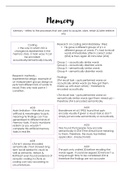
Memory – refers to the processes that are used to acquire, store, retain & later retrieve
info
Coding Research on coding (Alan Baddeley 1966)
= the way in which info is > He gave 4 different groups of p’s 4
changed & represented in the different groups of words. P’s had to recall
memory store. 3 main ways it can words immediately after in correct order
be encoded; (STM) & then again 20 mins later (LTM)
acoustically/semantically/visually
Group 1 – acoustically similar words
Group 2 – acoustically dissimilar words
Group 3 – semantically similar words
Group 4 – semantically dissimilar words
Research methods –
Findings
experimental design; example of
STM recall task – ppts performed worse on
an independent groups design as
acoustically similar words (as they got them
ppts had different lists of words to
mixed up with each other) – therefore its
recall. They only took part in 1
encoded acoustically.
condition.
LTM recall task – ppts performed worse on
semantically similar words (got them mixed up) –
therefore LTM is encoded semantically.
AO3 AO3
Main limitation – the stimuli was Brandimore et al (1992) found that ppts
artificial & meaningless to ppts, encode visually if given a visual task so don’t
meaning his findings can’t be simply just encode semantically or acoustically
generalised to different kinds of
memory tasks. It lacks mundane
realism as you wouldn’t AO3
complete this artificial memory Was found that people may encode
tasks in real life. semantically in STM if the stimuli have meaning
to them. Therefore, the study has limited
application. (=reductionist)
AO3
LTM isn’t always encoded
semantically. Frost showed long AO3
term recall related to visual as The ppts only waited 20 before recalling the
well as semantic. Nelson & words again. It could be argued 20 mins isn’t a
Rothbart even found evidence of long enough time to be considered LTM &
acoustic coding in LTM & so therefore the findings are not accurate
coding can vary according to
circumstances.
, Capacity
= the amount of info that can be held in memory at any 1 time
Research 1 on capacity (Joseph Jacobs 1887) AO3
> He investigated digit span. He’d give ppts 4 It was conducted a long time ago –
digits to remember & then 5 & so on until therefore may not have been
the ppt can’t recall the order correctly adequately controlled. Results could
be affected by cofounding variables.
He found the mean span for digits to be 9.3 items
& 7.3 for letters. He also found capacity changes
with age; AO3
Mean for 8 yrs old = 6.6 Results have been replicated by other
Mean for 19 yrs old = 8.6 researchers, therefore supporting its
validity.
AO3 Research 2 on capacity
Miller may have overestimated capacity of STM. Cowan (George miller 1956)
reviewed other research & concluded capacity was > He made
only about 4 chunks. observations & came
to the conclusion
that capacity for STM
AO3
IS 7 +/- 2 (5-9 items) &
Vogel et al found that 4 items was about the limit for
also notes you recall
visual items.
5 words as well as 5
letters by chunking.
AO3
Size of the chunk matters – Simon (2001) found people
have a shorter span for larger chunks
Duration
= length of time info/memories can be held
Research 1 on duration (Peterson & Peterson 1959)
> Conducted study that presented ppts with a
trigram (e.g. GHF, TYP = meaningless 3- Research methods –
constant syllables) & were asked to count experimental design; in this
backwards from a random no. & then were experiment, each ppt did all
asked to recall them after different intervals of conditions – known as repeated
3 6 9 12 15 18 seconds, aim was to prevent measures.
rehearsal
> Ppts were 24 uni students (therefore lacks
population validity)
, Findings;
After 3 seconds – 80% or trigrams recalled correctly
After 6 seconds – 50%
After 18s seconds – 10%
STM has a limited of duration of about 18 seconds
when rehearsal is prevented
AO3 AO3
Stimuli are meaningless & task is artificial – therefore Task is artificial & therefore
results can’t be generalised to other memory tasks. lacks mundane realism. The
HOWEVER, we do sometimes try to remember experiment was conducted
meaningless info such as telephone numbers. So may not in a lab & so also lacks
be totally irrelevant. ecological validity.
AO3 AO3
The memory may have been displaced by counting More recent studies e.g.
backwards instead of not rehearsing it. Therefore, the Narine et al (1999) found
study may lack internal validity (=not measuring what its items could be recalled after
set out to) 96 seconds
Research 2 on duration (Bahrick et al 1975)
> He studied duration of LTM using 392 ppts aged between 17-74. High
school yearbooks were obtained.
> Recall was tested in various ways
1) photo recognition – within 15 yrs of graduation ppts tested 90% accurate
but after 48 yrs, recall declined to 70%.
2) free call – 60 % accurate after 15yrs & 30% after 48 yrs
AO3
Study has high mundane realism – its something you’d do AO3
in everyday life because it involves remembering your It is a natural experiment
high school life. as the IV hasn’t been
directly manipulated. This
means there is high
ecological validity.
AO3 However, the drawback is
Confounding variables – Bahrick had no control over we are unable to establish
how often participants looked at year books or had a casual relationship.
contact with high school friends.
Memory – refers to the processes that are used to acquire, store, retain & later retrieve
info
Coding Research on coding (Alan Baddeley 1966)
= the way in which info is > He gave 4 different groups of p’s 4
changed & represented in the different groups of words. P’s had to recall
memory store. 3 main ways it can words immediately after in correct order
be encoded; (STM) & then again 20 mins later (LTM)
acoustically/semantically/visually
Group 1 – acoustically similar words
Group 2 – acoustically dissimilar words
Group 3 – semantically similar words
Group 4 – semantically dissimilar words
Research methods –
Findings
experimental design; example of
STM recall task – ppts performed worse on
an independent groups design as
acoustically similar words (as they got them
ppts had different lists of words to
mixed up with each other) – therefore its
recall. They only took part in 1
encoded acoustically.
condition.
LTM recall task – ppts performed worse on
semantically similar words (got them mixed up) –
therefore LTM is encoded semantically.
AO3 AO3
Main limitation – the stimuli was Brandimore et al (1992) found that ppts
artificial & meaningless to ppts, encode visually if given a visual task so don’t
meaning his findings can’t be simply just encode semantically or acoustically
generalised to different kinds of
memory tasks. It lacks mundane
realism as you wouldn’t AO3
complete this artificial memory Was found that people may encode
tasks in real life. semantically in STM if the stimuli have meaning
to them. Therefore, the study has limited
application. (=reductionist)
AO3
LTM isn’t always encoded
semantically. Frost showed long AO3
term recall related to visual as The ppts only waited 20 before recalling the
well as semantic. Nelson & words again. It could be argued 20 mins isn’t a
Rothbart even found evidence of long enough time to be considered LTM &
acoustic coding in LTM & so therefore the findings are not accurate
coding can vary according to
circumstances.
, Capacity
= the amount of info that can be held in memory at any 1 time
Research 1 on capacity (Joseph Jacobs 1887) AO3
> He investigated digit span. He’d give ppts 4 It was conducted a long time ago –
digits to remember & then 5 & so on until therefore may not have been
the ppt can’t recall the order correctly adequately controlled. Results could
be affected by cofounding variables.
He found the mean span for digits to be 9.3 items
& 7.3 for letters. He also found capacity changes
with age; AO3
Mean for 8 yrs old = 6.6 Results have been replicated by other
Mean for 19 yrs old = 8.6 researchers, therefore supporting its
validity.
AO3 Research 2 on capacity
Miller may have overestimated capacity of STM. Cowan (George miller 1956)
reviewed other research & concluded capacity was > He made
only about 4 chunks. observations & came
to the conclusion
that capacity for STM
AO3
IS 7 +/- 2 (5-9 items) &
Vogel et al found that 4 items was about the limit for
also notes you recall
visual items.
5 words as well as 5
letters by chunking.
AO3
Size of the chunk matters – Simon (2001) found people
have a shorter span for larger chunks
Duration
= length of time info/memories can be held
Research 1 on duration (Peterson & Peterson 1959)
> Conducted study that presented ppts with a
trigram (e.g. GHF, TYP = meaningless 3- Research methods –
constant syllables) & were asked to count experimental design; in this
backwards from a random no. & then were experiment, each ppt did all
asked to recall them after different intervals of conditions – known as repeated
3 6 9 12 15 18 seconds, aim was to prevent measures.
rehearsal
> Ppts were 24 uni students (therefore lacks
population validity)
, Findings;
After 3 seconds – 80% or trigrams recalled correctly
After 6 seconds – 50%
After 18s seconds – 10%
STM has a limited of duration of about 18 seconds
when rehearsal is prevented
AO3 AO3
Stimuli are meaningless & task is artificial – therefore Task is artificial & therefore
results can’t be generalised to other memory tasks. lacks mundane realism. The
HOWEVER, we do sometimes try to remember experiment was conducted
meaningless info such as telephone numbers. So may not in a lab & so also lacks
be totally irrelevant. ecological validity.
AO3 AO3
The memory may have been displaced by counting More recent studies e.g.
backwards instead of not rehearsing it. Therefore, the Narine et al (1999) found
study may lack internal validity (=not measuring what its items could be recalled after
set out to) 96 seconds
Research 2 on duration (Bahrick et al 1975)
> He studied duration of LTM using 392 ppts aged between 17-74. High
school yearbooks were obtained.
> Recall was tested in various ways
1) photo recognition – within 15 yrs of graduation ppts tested 90% accurate
but after 48 yrs, recall declined to 70%.
2) free call – 60 % accurate after 15yrs & 30% after 48 yrs
AO3
Study has high mundane realism – its something you’d do AO3
in everyday life because it involves remembering your It is a natural experiment
high school life. as the IV hasn’t been
directly manipulated. This
means there is high
ecological validity.
AO3 However, the drawback is
Confounding variables – Bahrick had no control over we are unable to establish
how often participants looked at year books or had a casual relationship.
contact with high school friends.