Lecture 1
Internationalization & Culture
Learning objectives:
At the end of this lecture you should be able to
• Describe the growth and spread of internationalization
• Discriminate between different perspectives on globalization
• Critically evaluate the implications of the cultural and institutional environment on
how HRM is conducted
• Explain the difference between international and intercultural human resource
management
• Define the concept of culture and give examples of cultural typologies
• Explain and assess Hostede’s five cultural dimensions
Going global
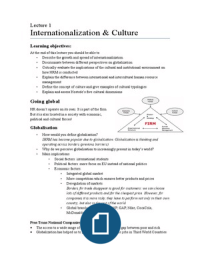
HR doesn’t operate on its own: It is part of the firm.
But it is also located in a society with economic,
political and cultural forces!
Globalisation
• How would you define globalisation?
IHRM has become popular due to globalization. Globalization is thinking and
operating across borders (previous barriers).
• Why do we perceive globalisation to increasingly present in today‘s world?
• Main implications
• Social factors: international students
• Political factors: more focus on EU instead of national politics
• Economic factors
• Integrated global market
• More competition which ensures better products and prices
• Deregulation of markets
Borders for trade disappear is good for customers: we can choose
lots of different products and for the cheapest price. However, for
companies it is more risky, they have to perform not only in their own
country, but also in the rest of the world
• Global brands: Apple, Google, HP, GAP, Nike, CocaCola,
McDonalds ….
Pros Trans National Companies Cons TNC
The access to a wide range of products Widen the gap between poor and rich
Globalization has helped us to produce Exploit the jobs in Third World Countries
, better technology no good circumstances, low wages
Encourage competition Loss of cultural identity
Insights in other cultures First world countries lose jobs by
outsourcing
Impact of globalization on organizations
Need for flexibility and adaptivity
Main drivers are:
o Technology and communication
o Global competition
o Organizational structures
Organizational requirements
o Global leadership
o Adaptable and flexible organizational structures
Incorporate people from different nationalities
o Managing supply chains
For example: organizations can purchase cheap raw materials in India and
manufacture them in Bangladesh
o Managing a diverse work force
o Knowledge management systems
Solutions for problems can be found all over the world
o Retention of intellectual capital
People who are the key performers, are usually international people and can
work everywhere. How can organizations retain the good people and prevent
them to move to other global organizations more competition on people.
o Innovation
o Et cetera
What does this mean for HR?
Think globally, but act locally
Integration versus local adaptiveness.
Free-market capitalism associated with profit maximization and individual rewards
Opportunity for HR to develop practices and policies that add value
Understanding the implications of HR in non-UK countries such as Middle-East,
China, India.
What we have learned so far in this master are Western HR practice, but the question
is whether or not we can transfer these practices to Asia?
How can HR meet these requirements? (How to achieve this will be covered in this course)
• Global leadership
• Adaptable and flexible organisational structures
• Managing supply chains
• Managing a diverse workforce
• Knowledge management systems
• Retention of intellectual capital
• Innovation
Internationalization & Culture
Learning objectives:
At the end of this lecture you should be able to
• Describe the growth and spread of internationalization
• Discriminate between different perspectives on globalization
• Critically evaluate the implications of the cultural and institutional environment on
how HRM is conducted
• Explain the difference between international and intercultural human resource
management
• Define the concept of culture and give examples of cultural typologies
• Explain and assess Hostede’s five cultural dimensions
Going global
HR doesn’t operate on its own: It is part of the firm.
But it is also located in a society with economic,
political and cultural forces!
Globalisation
• How would you define globalisation?
IHRM has become popular due to globalization. Globalization is thinking and
operating across borders (previous barriers).
• Why do we perceive globalisation to increasingly present in today‘s world?
• Main implications
• Social factors: international students
• Political factors: more focus on EU instead of national politics
• Economic factors
• Integrated global market
• More competition which ensures better products and prices
• Deregulation of markets
Borders for trade disappear is good for customers: we can choose
lots of different products and for the cheapest price. However, for
companies it is more risky, they have to perform not only in their own
country, but also in the rest of the world
• Global brands: Apple, Google, HP, GAP, Nike, CocaCola,
McDonalds ….
Pros Trans National Companies Cons TNC
The access to a wide range of products Widen the gap between poor and rich
Globalization has helped us to produce Exploit the jobs in Third World Countries
, better technology no good circumstances, low wages
Encourage competition Loss of cultural identity
Insights in other cultures First world countries lose jobs by
outsourcing
Impact of globalization on organizations
Need for flexibility and adaptivity
Main drivers are:
o Technology and communication
o Global competition
o Organizational structures
Organizational requirements
o Global leadership
o Adaptable and flexible organizational structures
Incorporate people from different nationalities
o Managing supply chains
For example: organizations can purchase cheap raw materials in India and
manufacture them in Bangladesh
o Managing a diverse work force
o Knowledge management systems
Solutions for problems can be found all over the world
o Retention of intellectual capital
People who are the key performers, are usually international people and can
work everywhere. How can organizations retain the good people and prevent
them to move to other global organizations more competition on people.
o Innovation
o Et cetera
What does this mean for HR?
Think globally, but act locally
Integration versus local adaptiveness.
Free-market capitalism associated with profit maximization and individual rewards
Opportunity for HR to develop practices and policies that add value
Understanding the implications of HR in non-UK countries such as Middle-East,
China, India.
What we have learned so far in this master are Western HR practice, but the question
is whether or not we can transfer these practices to Asia?
How can HR meet these requirements? (How to achieve this will be covered in this course)
• Global leadership
• Adaptable and flexible organisational structures
• Managing supply chains
• Managing a diverse workforce
• Knowledge management systems
• Retention of intellectual capital
• Innovation