On Being a Scientist 2022
Week 1: What is science
College 1.1
Is scientific knowledge different from everyday knowledge? If so, how can we distinguish these two
from each other?
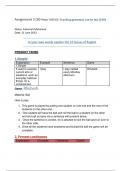
Everyday knowledge Scientific knowledge
practical counterintuitive
commonsensical Involves theoretical framework
Based on everyday experience Based upon imaginative ideas
! Two poles of science = imaginative ideas + solid facts
- Science -> need for stretch of imagination for innovative ideas, not everything is always what
it seems to be -> these “theories” have to be grounded on solid facts.
But, how to demarcate science from pseudoscience?
- Karl Popper: compared the theories of Freud, Marx and Einstein. They all seemed scientific,
and all were sophisticated, counterintuitive and can account for many facts. The main
difference between Freud/ Marx and Einstein’s theory was highly risky -> it predicted a
specific phenomena that had never been predicted before.
- Popper’s view -> took falsifiability as criterion from demarcating science from non-science ->
Science does not revolve around the question how you can establish something as true, but
how to establish something as false. The scientific quality of a theory is determined by its
prohibitive nature, rather than by the amount of supportive evidence. The essence of
science is critical testing of one’s ideas rather then amassing support for them.
- Prohibitive nature: a theory with a prohibitive nature forbids particular events/ experimental
results.
College 1.2
Is history science?
- Popper: No -> History is a singular process that occurs only once, so it is impossible to
formulate and test general laws about history.
- Nicholas Ponter: No -> history is not reproducible, you cannot control the variables, it is a
description.
- But: “history is just a description” is a misjudge:
- Historians may not look for exact laws, it may not be completely reproducible, but
they do look for historical patterns and compelling narratives.
- Historians may not make predictions about the future, but their narratives can be
tested.
, - Falsification criterion -> History is/ can be falsifiable: new historical evidence can
falsify a already accepted event/ narrative.
- Whether it may or may not be a “science” is also a literal discussion. In English literature we
make a difference in different kind of sciences/ disciplines. With science “natural sciences” is
meant. In German, the literal translation for science is “Wissenschaft”, which includes all the
different disciplines. In German language History is, in fact, a science.
Why is it almost impossible to provide straightforward criteria to differentiate between scientific
and other kind of knowledge?
- Critical tests of scientific hypotheses are extremely rare/ almost impossible.
- All observations are theory-laden -> perception involves interpretation/ is based on a
conceptual framework.
- It is impossible to test a scientific hypothesis in isolation -> an empirical test usually requires
background assumptions.
Week 2: scientific questions
College 2
“What kind of questions do scientists ask?”
- (large) How/ why questions vs (smaller, more precise) scientific questions
- Large how/ why questions are too big to handle at once -> scientist transform these
into smaller, more concrete, questions (how many/ correlation).
- Scientists transform a larger curiosity into a manageable research question that
typically can be answer by a yes/ no/ number.
“Are all research questions allowed?”
- The research might have negative consequences for those involved
- Declaration of Helsinki: humans who take part in a scientific experiment should be
informed about the nature of the experiment and should not be harmed in the
experiment.
- Animals -> animals should not suffer unnecessarily in scientific experiments.
- The outcome of scientific research/ answers may have negative outcomes
- No existing regulations yet. But a scientist is responsible to be aware of the negative
outcomes its own research might have (might be a racism-related or an ethical
discussion involved).
Feedback video
Test: “is the size of my research question good”
- Small enough? If you can imagine an answer to your research question, it is likely that your
question is small enough (how many, is there a correlation, when happened, who).
Week 1: What is science
College 1.1
Is scientific knowledge different from everyday knowledge? If so, how can we distinguish these two
from each other?
Everyday knowledge Scientific knowledge
practical counterintuitive
commonsensical Involves theoretical framework
Based on everyday experience Based upon imaginative ideas
! Two poles of science = imaginative ideas + solid facts
- Science -> need for stretch of imagination for innovative ideas, not everything is always what
it seems to be -> these “theories” have to be grounded on solid facts.
But, how to demarcate science from pseudoscience?
- Karl Popper: compared the theories of Freud, Marx and Einstein. They all seemed scientific,
and all were sophisticated, counterintuitive and can account for many facts. The main
difference between Freud/ Marx and Einstein’s theory was highly risky -> it predicted a
specific phenomena that had never been predicted before.
- Popper’s view -> took falsifiability as criterion from demarcating science from non-science ->
Science does not revolve around the question how you can establish something as true, but
how to establish something as false. The scientific quality of a theory is determined by its
prohibitive nature, rather than by the amount of supportive evidence. The essence of
science is critical testing of one’s ideas rather then amassing support for them.
- Prohibitive nature: a theory with a prohibitive nature forbids particular events/ experimental
results.
College 1.2
Is history science?
- Popper: No -> History is a singular process that occurs only once, so it is impossible to
formulate and test general laws about history.
- Nicholas Ponter: No -> history is not reproducible, you cannot control the variables, it is a
description.
- But: “history is just a description” is a misjudge:
- Historians may not look for exact laws, it may not be completely reproducible, but
they do look for historical patterns and compelling narratives.
- Historians may not make predictions about the future, but their narratives can be
tested.
, - Falsification criterion -> History is/ can be falsifiable: new historical evidence can
falsify a already accepted event/ narrative.
- Whether it may or may not be a “science” is also a literal discussion. In English literature we
make a difference in different kind of sciences/ disciplines. With science “natural sciences” is
meant. In German, the literal translation for science is “Wissenschaft”, which includes all the
different disciplines. In German language History is, in fact, a science.
Why is it almost impossible to provide straightforward criteria to differentiate between scientific
and other kind of knowledge?
- Critical tests of scientific hypotheses are extremely rare/ almost impossible.
- All observations are theory-laden -> perception involves interpretation/ is based on a
conceptual framework.
- It is impossible to test a scientific hypothesis in isolation -> an empirical test usually requires
background assumptions.
Week 2: scientific questions
College 2
“What kind of questions do scientists ask?”
- (large) How/ why questions vs (smaller, more precise) scientific questions
- Large how/ why questions are too big to handle at once -> scientist transform these
into smaller, more concrete, questions (how many/ correlation).
- Scientists transform a larger curiosity into a manageable research question that
typically can be answer by a yes/ no/ number.
“Are all research questions allowed?”
- The research might have negative consequences for those involved
- Declaration of Helsinki: humans who take part in a scientific experiment should be
informed about the nature of the experiment and should not be harmed in the
experiment.
- Animals -> animals should not suffer unnecessarily in scientific experiments.
- The outcome of scientific research/ answers may have negative outcomes
- No existing regulations yet. But a scientist is responsible to be aware of the negative
outcomes its own research might have (might be a racism-related or an ethical
discussion involved).
Feedback video
Test: “is the size of my research question good”
- Small enough? If you can imagine an answer to your research question, it is likely that your
question is small enough (how many, is there a correlation, when happened, who).