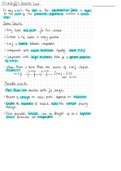
Kirchhoff 's Second Law
In
any circuit , the sum
of the electromotive forces is equal
to the sum
of the
potential differences around a closed
loop .
Series Circuits
•
Only have one path for the current .
Current is the same in
every position
• .
•
e.
m.f.io shared between components .
components with equal resistances equally share e. m.fi
•
•
components with
larger resistances take
up a
greater proportion
of e. m -
f .
When there than
is more one source of e. m
f. check
•
-
,
POLARITY E. = 9. or Ei " "
e. { e. m f. 3 OV
o
g.
=
-
.
- -
- -
- -
NOT 15 OV
-
.
Parallel circuits .
•
More than one possible path for charges .
•
Amount of charge on each path depends on resistance .
Greater the resistance of lower the current
branch
passing
•
,
through .
Each parallel branch can be
thought of as a separate
•
circuit .
Branches are independent .
, The sum of the p d s
of the components on
any branch
• -
-
to the total e.m.fi
is
equal
Combining resistors
In series :
total resistance is proportional to the number
of resistors therefore total resistance ,
is the sum of the individual resistances
RER ,
+
Rzt .
.
.
In
parallel : as more resistors are added in parallel , resistance
drops .
Additional resistor provides another
path
current cross-sectional
for ,
increasing area
,
and so
lowering resistance .
¥ ¥ ¥
=
+ . . _
Internal Resistance
This
Work is done in the
that some
cell whenever a current
lost
passes
not all
'
' through it .
as heat and
means
energy is ,
energy
transferred
to the
charge is available
for the circuit .
As result the terminals the power
a ,
p.cl .
measured
of at
source (terminal p
-
d.) is lower than the actual em f- This .
difference is called lost volts .
lowers the terminal p d.
Increasing the current .
,
as it means
by the charges
more work is done in the cell
In
any circuit , the sum
of the electromotive forces is equal
to the sum
of the
potential differences around a closed
loop .
Series Circuits
•
Only have one path for the current .
Current is the same in
every position
• .
•
e.
m.f.io shared between components .
components with equal resistances equally share e. m.fi
•
•
components with
larger resistances take
up a
greater proportion
of e. m -
f .
When there than
is more one source of e. m
f. check
•
-
,
POLARITY E. = 9. or Ei " "
e. { e. m f. 3 OV
o
g.
=
-
.
- -
- -
- -
NOT 15 OV
-
.
Parallel circuits .
•
More than one possible path for charges .
•
Amount of charge on each path depends on resistance .
Greater the resistance of lower the current
branch
passing
•
,
through .
Each parallel branch can be
thought of as a separate
•
circuit .
Branches are independent .
, The sum of the p d s
of the components on
any branch
• -
-
to the total e.m.fi
is
equal
Combining resistors
In series :
total resistance is proportional to the number
of resistors therefore total resistance ,
is the sum of the individual resistances
RER ,
+
Rzt .
.
.
In
parallel : as more resistors are added in parallel , resistance
drops .
Additional resistor provides another
path
current cross-sectional
for ,
increasing area
,
and so
lowering resistance .
¥ ¥ ¥
=
+ . . _
Internal Resistance
This
Work is done in the
that some
cell whenever a current
lost
passes
not all
'
' through it .
as heat and
means
energy is ,
energy
transferred
to the
charge is available
for the circuit .
As result the terminals the power
a ,
p.cl .
measured
of at
source (terminal p
-
d.) is lower than the actual em f- This .
difference is called lost volts .
lowers the terminal p d.
Increasing the current .
,
as it means
by the charges
more work is done in the cell